
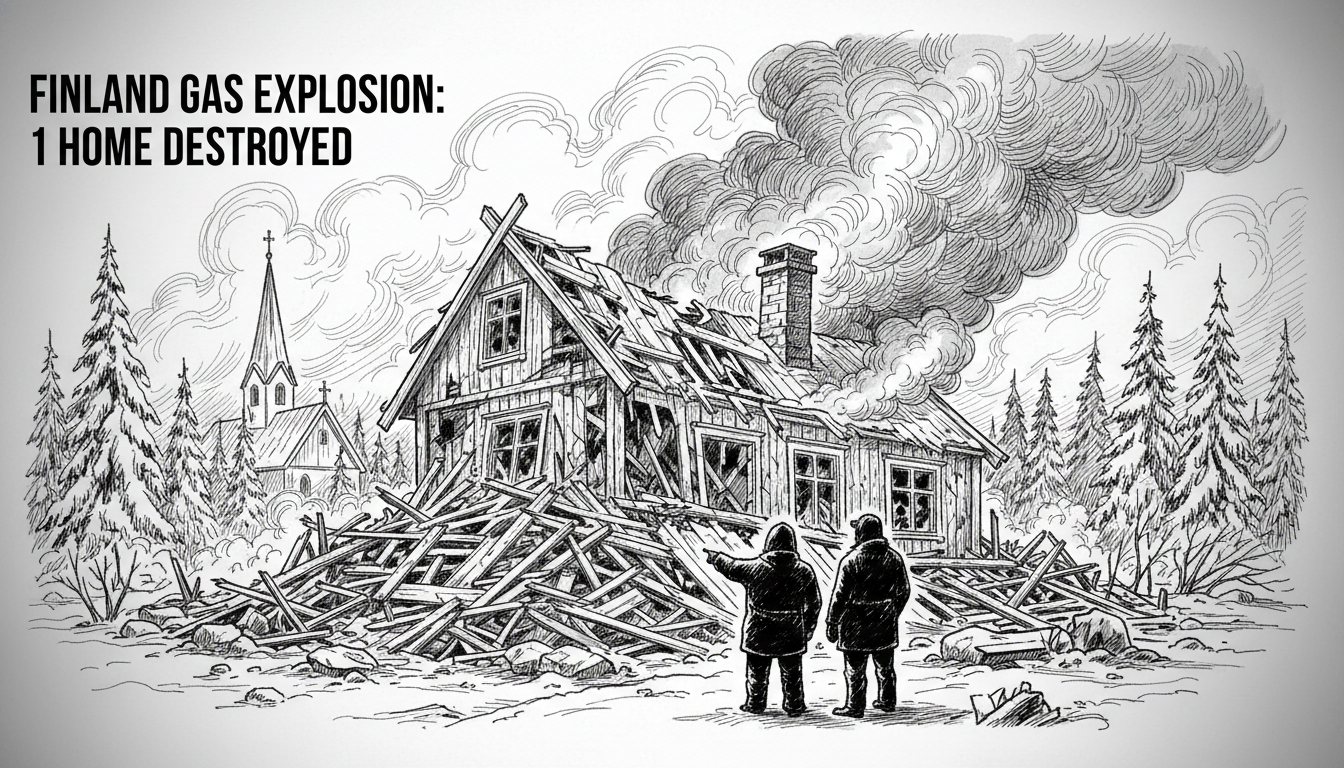
Finland's Lapinlahti gas explosion has leveled a garage and damaged a house beyond repair, with police focusing on a leaking gas cylinder. The powerful blast on Saturday afternoon sent garage doors flying across the street to a neighbor's property, causing what authorities estimate is total structural loss. Initial reports confirm no injuries, but the incident has ignited a fresh examination of household safety protocols across the Nordic nation.
The Lapinlahti Blast Scene
Residents in the quiet Lapinlahti community were startled by a deafening explosion that ripped through a detached house garage. The force was so intense that the garage collapsed completely, and its double doors were thrown meters away. The adjacent house sustained catastrophic damage, rendered uninhabitable by the shockwave. Police cordoned off the area immediately, launching an investigation into the cause of the devastating event. This type of incident, while rare, triggers mandatory reviews by both local police and national safety authorities.
Central Finland Police Department confirmed the scene was secure and no explosive materials were present. Investigators quickly ruled out malfunctions in the building's technical systems as a possible source. Their attention turned to a common household item: a liquefied petroleum gas (LPG) cylinder stored in the garage. A leak from such a cylinder, accumulating gas in an enclosed space, can create a highly volatile mixture with air. A single spark from an electrical appliance or light switch can then trigger a massive explosion.
Investigation Points to Cylinder Leak
After a preliminary examination, police have stated the leading probable cause is a leaking gas cylinder. 'The investigation is ongoing, but all current evidence points to an accident involving a propane cylinder,' a police spokesperson said in a statement. The case highlights the latent risks associated with everyday energy sources. Finnish law requires thorough investigations into all significant gas-related incidents to determine liability and prevent recurrence.
The Eduskunta, Finland's parliament, has established strict guidelines for such probes. Findings are typically shared with the Finnish Safety and Chemicals Agency (Tukes), which oversees product and chemical safety. Tukes maintains a national registry of accidents involving pressure equipment, including gas cylinders. This data directly informs regulatory updates and public safety campaigns. The Lapinlahti explosion will likely become a data point in this continuous safety feedback loop.
Finland's Rigorous Gas Safety Framework
Finland enforces some of Europe's most comprehensive regulations for gas cylinder storage and handling. These rules are shaped by both national legislation and EU directives on equipment and product safety. Cylinders must be regularly inspected, stored upright in well-ventilated areas, and kept away from heat sources. Many of these protocols stem from EU-wide standards harmonized across member states to ensure a high level of consumer protection.
‘The Finnish regulatory framework for gas safety is detailed and enforced,’ explains Martti Korhonen, a safety engineer formerly with Tukes. ‘However, compliance at the household level always hinges on user awareness. A cylinder can develop a slow leak from a valve or fitting over time, often going unnoticed until it's too late.’ Korhonen emphasizes that garages and sheds, often used for storage, are frequently poorly ventilated, creating perfect conditions for gas accumulation.
In Helsinki, the Ministry of Economic Affairs and Employment, which supervises Tukes, periodically reviews these regulations. Any significant accident can prompt legislative scrutiny. While this incident appears accidental, it will undoubtedly be cited in future discussions about strengthening public information campaigns or inspection regimes. The government coalition, led by Prime Minister Petteri Orpo, has prioritized operational efficiency in regulation, balancing safety with practical burdens on citizens.
Expert Analysis on Prevention and Risk
Safety experts stress that prevention is straightforward but requires diligence. ‘Proper storage is non-negotiable,’ says Dr. Elina Saarelainen, a materials risk analyst at Aalto University. ‘Cylinders should never be stored in basements or attached garages with living spaces. They must be checked for damage and have their valves closed securely when not in use.’ She notes that many older cylinders in circulation may lack modern safety features now mandated by EU codes.
Dr. Saarelainen points to building codes as another mitigating factor. Finnish construction standards are designed for harsh climates and include considerations for safety. However, the force from a gas explosion can exceed standard structural load assumptions. ‘The damage in Lapinlahti shows the immense energy released,’ she adds. ‘This is a reminder that while regulations provide a strong foundation, personal responsibility is the final layer of defense.’
EU Standards and National Enforcement
Finland's approach integrates the EU's General Product Safety Directive and specific pressure equipment regulations. These set essential requirements for cylinder manufacturing, testing, and certification. National authorities like Tukes conduct market surveillance to ensure non-compliant products do not enter circulation. The incident raises questions about the lifecycle of these cylinders and whether periodic testing requirements for household units are sufficient.
From a political perspective, Finnish MEPs have historically advocated for high safety standards in EU negotiations. This incident, while local, resonates with broader European conversations about consumer product safety and the ‘right to repair.’ Ensuring that safety information is accessible in multiple languages, including for Finland's Swedish-speaking minority, is also part of the regulatory challenge. The government must communicate risks effectively to all segments of the population.
Moving Forward: Policy and Awareness
The Lapinlahti explosion will result in a detailed final report from the police and possibly Tukes. This document will recommend any necessary changes to guidelines or highlight areas for improved public education. Past similar incidents have led to targeted information drives by local fire and rescue services, reminding homeowners of storage basics.
For now, the focus remains on supporting the affected family and completing the investigation. The tangible loss of a home underscores a silent risk in many communities. As Finland continues to balance its energy needs with safety, this event is a stark reminder that vigilance with commonplace items is crucial. Will this accident lead to stricter enforcement or new public safety initiatives from the government in Helsinki?