
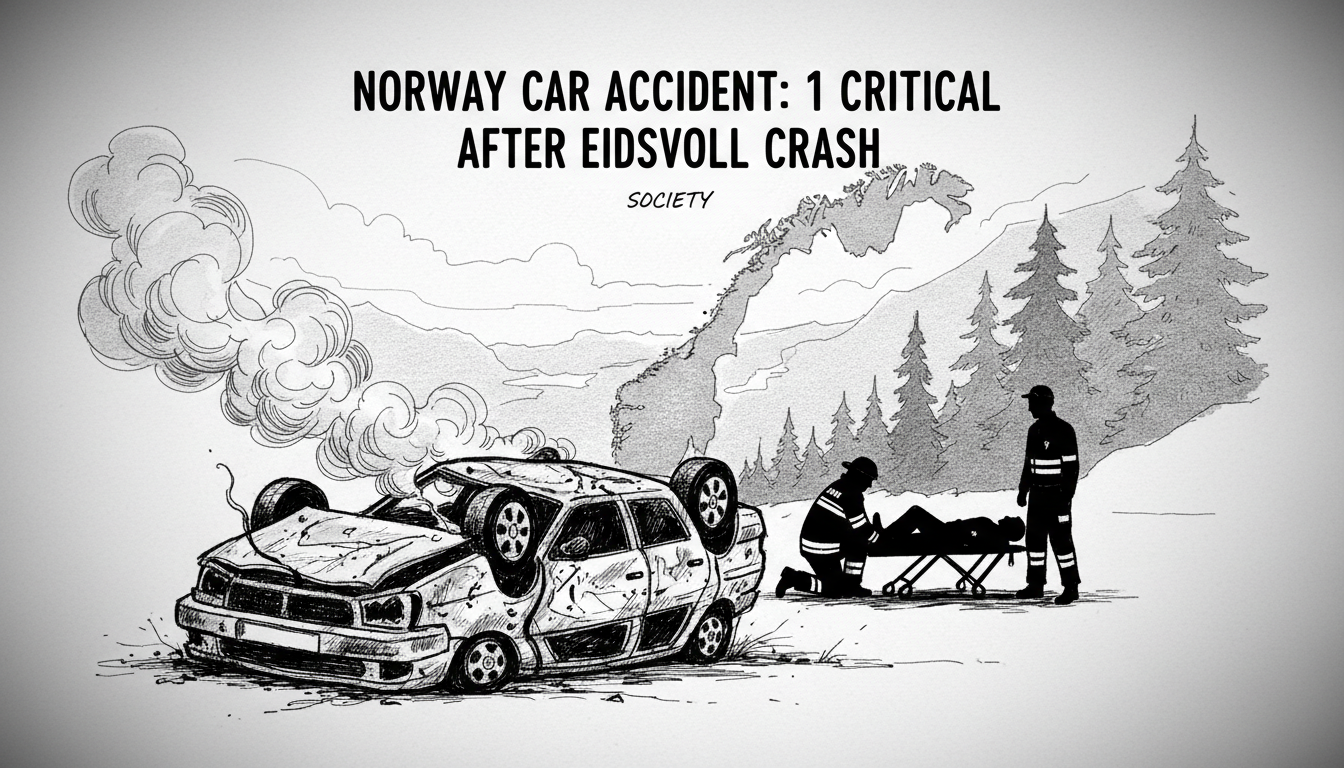
Norway car accident investigators are working to determine the cause of a serious head-on collision in Eidsvoll that left one person critically injured. The crash occurred on a road in the historically significant municipality north of Oslo, involving two vehicles and two individuals. Police confirmed the critically injured man was transported to a hospital, while the driver of the second vehicle was reported to be in stable condition and conscious at the scene.
A Quiet Road Turned Emergency Scene
Emergency services responded to the report of a front collision, known in traffic safety circles as one of the most dangerous crash configurations. The combined force of two vehicles impacting head-on often results in severe trauma. Operations manager Ørjan Hustad with the East Police District provided the initial details, noting both drivers were conscious following the crash. The focus for first responders was immediate medical stabilization and extraction. The specific road within Eidsvoll has not been disclosed pending the initial investigation phase.
Eidsvoll, with a population of roughly 25,000, is more famously known as the birthplace of modern Norway. It was at Eidsvoll Manor in 1814 that delegates signed the country's constitution. The municipality's roads, a mix of main thoroughfares and quieter rural routes, connect it to Oslo and other towns in Akershus county. This accident shifts focus from its historic role to its modern infrastructure and the safety of those who travel through it daily.
The Grim Mechanics of Head-On Collisions
Traffic safety experts consistently rank frontal impacts among the deadliest types of road accidents. The physics are brutally simple: the speed of one vehicle is added to the speed of the oncoming vehicle to calculate the force of impact. A collision between two cars each traveling at 80 km/h mimics the force of a single car hitting a solid wall at 160 km/h. Survival and injury severity hinge on a narrow set of factors including vehicle safety ratings, seatbelt use, and the precise angle of impact.
"Investigations into these incidents typically follow a clear path," explains a veteran traffic analyst who has consulted on Norwegian road safety campaigns. "Police will map skid marks, assess vehicle deformation, and evaluate road conditions. They will look for any indication of driver error, impairment, or mechanical failure. The goal is not just to assign blame, but to understand the sequence of events to prevent recurrence." Norwegian roads, while generally safe by global standards, are not immune to these high-energy crashes, particularly on two-lane roads without median barriers.
Norway's Road Safety Context
This Eidsvoll traffic accident occurs within a national framework of ambitious road safety targets. Norway's Vision Zero policy, adopted from a Swedish model, aims to eliminate all traffic fatalities and serious injuries. The approach considers that human error is inevitable, and thus the road system must be designed to forgive those errors. This has led to widespread installation of median barriers on highways, rumble strips, and lower speed limits in populated areas.
Despite these measures, head-on collisions remain a persistent challenge, especially on older road networks in regions like Akershus. They account for a disproportionate number of fatal outcomes compared to other crash types. Each serious accident triggers a review by local road authorities to assess if engineering changes—such as centerline rumble strips or improved signage—are warranted at the location.
The psychological impact on emergency personnel and investigators is also a recognized part of Norway's systematic response. Debriefings and support are standard following critical incidents, acknowledging the toll of dealing with severe trauma.
The Human Cost Beyond the Statistics
Behind the police bulletins and expert analysis are individuals and families whose lives are abruptly changed. A critically injured person faces a long and uncertain path of surgery, rehabilitation, and potential lifelong consequences. The other driver, while physically less harmed, may grapple with severe psychological trauma from the event.
For the local community in Eidsvoll, news of a serious crash close to home creates a ripple of anxiety. It prompts residents to reconsider their own daily routes and the behavior of other drivers they share the road with. These incidents temporarily shatter the sense of routine safety that most commuters take for granted.
Norwegian law provides a comprehensive support system for traffic accident victims through the Norwegian System of Compensation for Personal Injury (Norsk pasientskadeerstatning for traffic injuries, part of a broader scheme). However, navigating medical care and compensation processes adds another layer of stress to recovery.
A Community Waits for Answers
As the investigation into this Norway car accident continues, the immediate questions are medical. The condition of the critically injured man will be the primary concern for authorities and the community. The police investigation will proceed methodically, examining the vehicles, gathering witness statements if any are available, and reconstructing the moments before impact.
The findings could influence local traffic calming measures. Previous serious accidents in Norway have led to swift municipal action, such as reduced speed limits or the installation of temporary barriers while permanent solutions are engineered. The Eidsvoll municipality's technical department will likely await the police report before deciding on any infrastructural response.
This single event on a road in Eidsvoll is a stark reminder of the fragility of road safety. It underscores the constant balance between efficient transportation and the imperative to protect human life. For Norway, a nation proud of its progressive safety policies, each serious crash is both a tragedy and a test of its commitment to Vision Zero. The hope now rests with medical teams working to save a life, and with investigators whose work might prevent the next family from receiving that devastating phone call.