
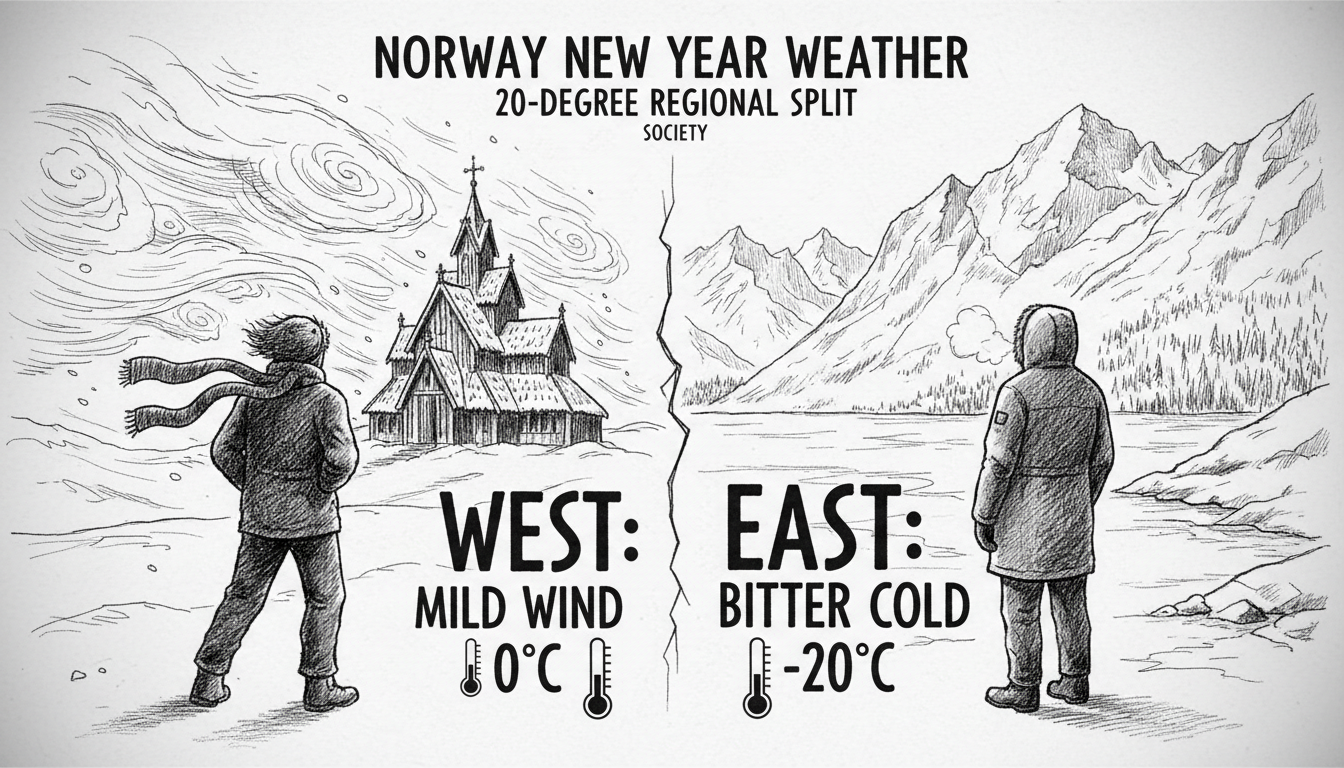
Norway New Year weather predictions show a stark 20-degree Celsius gap between the freezing interior and milder coastal cities, setting the stage for a divided celebration. As Norwegians prepare to ring in 2025, one question dominates: will their New Year's Eve be a winter wonderland or a damp affair? Meteorologist Magnus Ovhed from the Norwegian Meteorological Institute provides the answer, emphasizing regional disparities that reflect the country's complex climate. With a high-pressure system anchoring over Southern Norway, temperatures in Lillehammer could plunge to -5°C while Ålesund sees +4°C, highlighting the nation's geographical extremes.
A Nation Divided: Coastal Mild vs. Interior Cold
The Norwegian Meteorological Institute's forecast reveals a clear split. Southern Norway's interior, under a stable high-pressure system, will experience cold, clear conditions. Coastal areas from Bergen to Stavanger may see temperatures above freezing, with occasional rain. This pattern stems from Norway's unique topography, where the Scandinavian Mountains block maritime influences, creating microclimates. For every degree of latitude north, the weather shifts dramatically, affecting everything from energy consumption to holiday plans.
Magnus Ovhed explains the mechanics. "A high-pressure system over Southern Norway makes it cold inland, but coastal areas can have plus degrees in the romjula period," he said. Romjula, the days between Christmas and New Year, often sees volatile weather. This year, the high pressure brings calm winds to the south, but uncertainty lingers. The institute's models show that such systems can persist, influencing heating oil demand and hydroelectric reservoir levels in mountainous regions.
Northern Exposure: Snow Showers on the Horizon
Northern Norway, including Trøndelag, Nordland, Troms, and Finnmark, faces a different scenario. Ovhed notes, "There is a fairly cold air stream over Northern Norway. We can get periods of snow showers during the romjula." This means cities like Tromsø and Bodø should expect snow, with temperatures ranging from -4°C to 1°C. The Arctic conditions here are crucial for local industries, from fisheries to tourism, and can impact offshore oil operations in the Barents Sea.
The snow showers start as rain but transition to snow due to the cold air mass. How far south these showers extend remains uncertain, a testament to forecasting challenges in Norway's rugged terrain. In Finnmark, Kautokeino might see -16°C, emphasizing the deep freeze common in the Arctic interior. These conditions align with historical norms for Northern Norway, where snow cover is typical but variable due to climate change influences.
Southern Serenity or Surprise?
In Southern Norway, the forecast suggests relative calm. Oslo and Lillehammer will have overcast skies with sun, temperatures from -1°C to 1°C. This mild cold snap reduces heating demands slightly, but energy analysts watch closely for impacts on gas and power prices. Coastal cities like Bergen and Stavanger may see rain, with temperatures of 2-4°C. The uncertainty lies in Møre and Romsdal, where Ovhed calls it a "gambling" situation between cool, clear weather or sleet and snow showers.
The variability underscores Norway's dependence on accurate weather data for its energy sector. Hydropower reservoirs in the south rely on precipitation, while offshore oil platforms in the North Sea monitor winds and waves. This New Year's weather, while seemingly mundane, has ripple effects on national infrastructure and economic planning.
City-by-City Breakdown: What to Expect
Here’s a snapshot of key locations, based on the latest forecasts. Each city reflects the regional divide, with data sourced from official meteorological services.
- Oslo: -1 to 1°C, overcast and sun. The capital's celebrations may be chilly but dry, affecting outdoor events.
- Bergen: 2 to 4°C, overcast, sun, and rain. Coastal humidity could lead to damp conditions.
- Stavanger: 2 to 4°C, overcast and sun. Similar to Bergen, with mild temperatures.
- Trondheim: 0 to 2°C, overcast and snow/rain. A mix typical for central Norway.
- Tromsø: -4 to -2°C, snow and overcast. Arctic snow likely, influencing local tourism.
- Lillehammer: -5 to -3°C, overcast and sun. Cold and clear, ideal for winter sports.
- Kautokeino: -16 to -13°C, overcast. Extreme cold highlights the Arctic interior's severity.
- Ålesund: 3 to 4°C, overcast and rain. Coastal mildness prevails.
- Bodø: -1 to 1°C, overcast and snow. Northern coastal conditions with snow potential.
- Kristiansand: 1 to 3°C, sun and overcast. Southern coast sees milder weather.
This table illustrates the breadth of conditions, from the deep freeze of Finnmark to the near-thaw of the western fjords. For residents, it means tailoring celebrations to local forecasts, with implications for transportation and safety.
Expert Uncertainty: The Meteorologist's Challenge
Magnus Ovhed stresses the inherent limits of forecasting. "It is still too early to say for sure how the weather will be on New Year's Eve," he said, noting that models can change rapidly. This uncertainty is amplified in Norway, where the confluence of Atlantic currents, mountain ranges, and Arctic air creates unpredictable patterns. The Meteorological Institute uses advanced satellite data and climate models, but regional nuances often require last-minute updates.
For context, Norway's weather variability has increased in recent decades, linked to broader climate shifts. The institute monitors these trends for policy implications, especially in Arctic regions where warming affects ice melt and shipping routes. This New Year's forecast, while short-term, fits into a larger narrative of climatic adaptation that Norway must navigate, from oil extraction in the Barents Sea to renewable energy investments.
Beyond the Forecast: Implications for Norway
The weather divide has practical consequences. In the north, snow showers may disrupt road and air travel, critical for remote communities. In the south, calm winds reduce wind power generation, potentially affecting electricity grids. Energy analysts note that cold snaps in the interior can spike demand for heating oil, influencing Norway's domestic energy balance despite its oil exporter status.
For the government, accurate weather data is vital for Arctic policy, ensuring safe operations in northern waters. The Storting has allocated funds for improved meteorological services, recognizing their role in economic stability. As Norwegians celebrate, these underpinnings remind us that weather is more than a conversation starter—it's a key factor in national planning.
Looking ahead, climate models suggest that such regional splits may intensify, with warmer coastal winters and volatile Arctic precipitation. This New Year's Eve offers a snapshot of Norway's climatic diversity, a testament to its geography and a challenge for its future. Will your celebration be under a clear, cold sky or a blanket of snow? The answer depends entirely on your zip code, reflecting the enduring complexity of Norway's weather.