
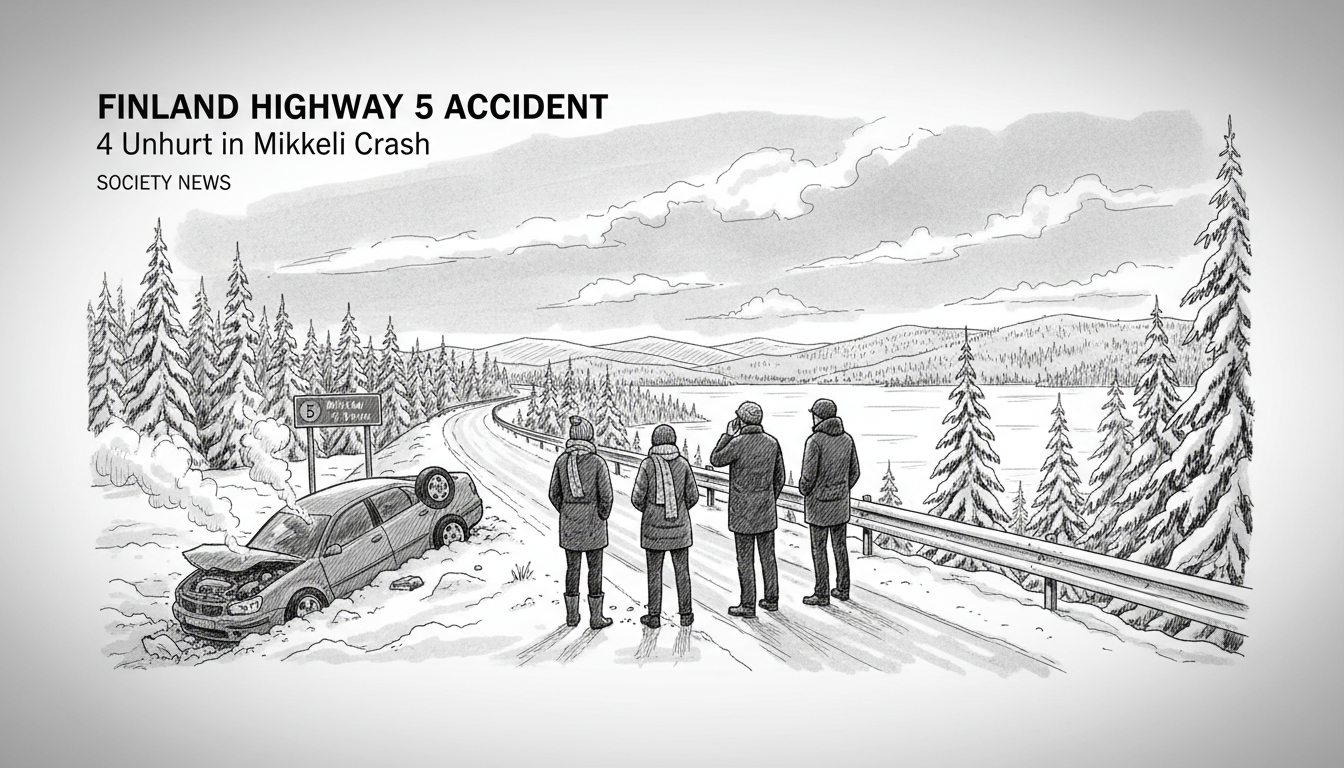
Finland Highway 5 witnessed a vehicle leaving the roadway near Mikkeli on Tuesday afternoon, an incident that ended with a fortunate outcome. Two adults and two children emerged physically unharmed after their car veered off the major route, known locally as Viitostie, around one kilometer from the Rahula ramp. Emergency services from the South Savo Rescue Department received the alert at 14:13 and transported all four occupants for a precautionary medical examination, a standard and critical procedure in Finnish road safety protocol.
This accident on a key national artery highlights the ever-present risks of Finnish road travel, even when outcomes defy tragedy. The event occurred on European route E63, a vital transport corridor stretching from the southern regions to Lapland. While the immediate cause of the single-vehicle departure remains under investigation by local authorities, the incident serves as a stark reminder of the variables drivers face. Autumn in Finland brings rapidly changing conditions—wet leaves, diminishing daylight, and the first frosts—that demand heightened vigilance from all motorists.
A Routine Call with an Uncommon Outcome
The response unfolded with the precision typical of Finland's emergency services. Units from the Etelä-Savon pelastuslaitos (South Savo Rescue Department) were dispatched to the specified kilometer marker on Highway 5. Their initial assessment confirmed the vehicle was off the roadway on the right-hand side, relative to its direction of travel toward Mikkeli. The most significant finding, relayed in their official release, was the absence of immediate visible injuries among the two adults and two children inside the car.
Despite the positive initial report, Finnish rescue and medical guidelines are unequivocal. "All involved parties were transported to be checked," the rescue department's statement noted, adhering to a core tenet of post-accident care. This policy is especially stringent when children are involved, as their symptoms can be subtler or delayed. The decision to transport all four individuals reflects a preventative approach designed to catch potential internal or soft-tissue injuries that adrenaline and shock can mask in the immediate aftermath of a collision or sudden impact.
The Critical Importance of Post-Accident Checks
Medical and traffic safety experts consistently advocate for the protocol followed in Mikkeli. Dr. Liisa Tervo, a specialist in emergency medicine at Helsinki University Hospital, explains the rationale. "In any traffic incident involving significant force, a medical evaluation is non-negotiable. For adults, whiplash or a concussion might not manifest for hours. For children, the need is even greater due to their developing physiology and often limited ability to articulate specific pain or discomfort," Tervo said in a recent seminar on road safety medicine.
This expert perspective underscores that the Mikkeli response was not an overreaction but a textbook example of correct procedure. The potential for occult injury—medical terminology for a hidden or not immediately obvious condition—is a well-documented risk in vehicular accidents, even those appearing minor. Finnish health authorities recommend that anyone involved in a road traffic accident, regardless of perceived severity, seek a professional assessment. This case, with its vulnerable young passengers, perfectly illustrates why such guidelines exist and are rigorously applied by first responders across the country.
Highway 5: A Vital Artery with Inherent Challenges
Highway 5 (Valtatie 5) is far from a minor local road. It functions as a primary north-south connector, linking the region of Päijät-Häme in the south to the vast expanses of Lapland in the north, forming part of the international E63 route. The section near Mikkeli, a city of approximately 52,000 people and the capital of the South Savo region, sees a mix of local commuter traffic, heavy goods vehicles, and long-distance travelers. Its importance to regional and national logistics and mobility cannot be overstated.
The road's design and maintenance standards are generally high, consistent with Finland's reputation for quality infrastructure. However, no roadway is immune to accidents. Factors contributing to single-vehicle departures can be multifaceted, often involving a combination of driver attention, vehicle condition, weather, and road surface conditions. At this time of year, the period known as "ruska" when leaves turn and fall, roads can become unexpectedly slick with decomposing foliage, especially during morning dew or light rain. Early afternoon, the time of this incident, can also present challenges with low sun angles creating glare.
Finland's Road Safety Context and Seasonal Shifts
Finland maintains a strong global reputation for road safety, with consistently low fatality rates per capita compared to international averages. This record is the result of decades of concerted effort involving strict legislation, rigorous vehicle inspections, widespread safety education, and a cultural emphasis on responsible driving. The country's "Vision Zero" policy, aiming to eliminate all traffic fatalities and serious injuries, guides much of this work.
Yet, seasonal transitions are recognized as particularly hazardous periods. The Finnish Crash Data Institute (Otkes) has historically noted fluctuations in certain accident types during autumn. The shift from summer to winter driving conditions is gradual and unpredictable, requiring drivers to constantly adapt. While winter tires are legally mandated from November to March, October exists in a transitional zone where conditions can vary hourly. A dry road in the morning can become icy by afternoon in shaded areas, catching drivers who have not yet fully switched to a winter mindset.
This accident, fortunately without physical harm, acts as a timely reminder for all road users. It emphasizes the necessity of adjusting driving style to match the conditions, ensuring adequate following distances, and the paramount importance of seatbelt use for every passenger—a practice with near-universal compliance in Finland that undoubtedly played a role in this positive outcome.
The Human Element Beyond the Statistics
Behind the brief official report from the rescue services lies a human story of a sudden, frightening event for a family. The psychological impact of such an incident, even without physical injury, can be significant for both adults and children. The sound of screeching tires, the loss of control, and the jarring stop are experiences that can resonate long after the vehicle is towed away.
Finnish support systems for traffic accident victims, including psychological first aid and follow-up care, are robust. The act of taking the children for a check-up serves a dual purpose: it rules out physical injury and initiates a formal contact with healthcare providers who can monitor for signs of post-traumatic stress or anxiety. This holistic approach to accident aftermath is a subtle but crucial component of Finland's safety ecosystem, acknowledging that recovery encompasses both body and mind.
As the investigation into the specific causes continues, the broader lessons remain clear. This event on Highway 5 near Mikkeli ended not as a statistic of tragedy but as a case study in effective emergency response, prudent medical caution, and the ever-present need for defensive driving on Finland's roads. It underscores that safety is a shared responsibility—a combination of infrastructure, regulation, professional protocol, and individual driver awareness. With winter looming on the horizon, this incident serves as a potent, real-world reminder for every person getting behind the wheel to ensure their journey, and those of their passengers, ends as safely as this one ultimately did.