
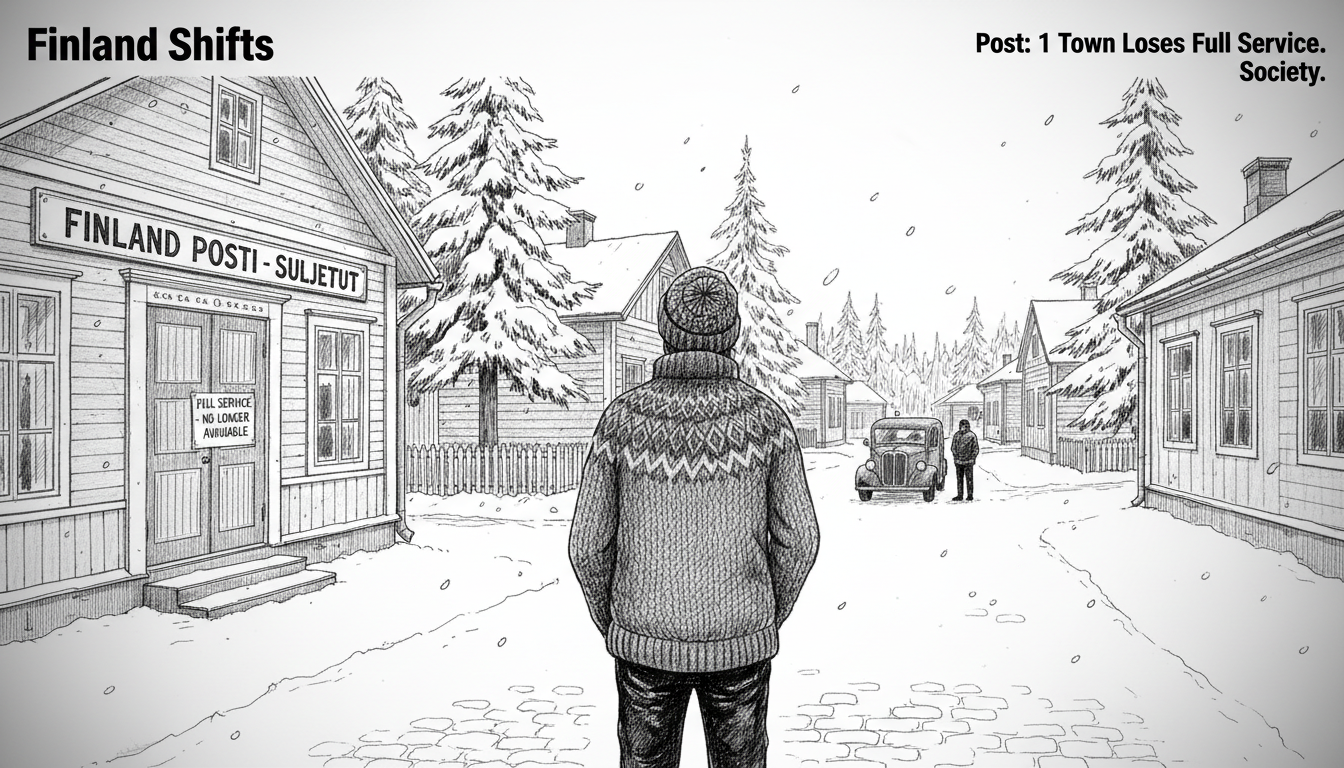
Finland's national postal service, Posti, is centralizing operations away from its smallest outlets, forcing residents of one municipality to travel for comprehensive mail services. The closure of the postal counter at the Taavetti R-kioski in Luumäki on December 29th marks the end of an era, relocating full postal services 27 kilometers away to Lappeenranta while offering only limited package services locally. This move exemplifies a strategic shift for the state-owned company as it seeks financial stability in the digital age.
For the 4,800 residents of Luumäki, the change brings immediate logistical challenges. Starting December 30th, only pre-paid package drop-off and collection will be available at the local K-Market Taavetti. To send a letter, pay for a parcel at the counter, or access any other full postal service, citizens must now travel to the K-Market Uus-Lavola post office in Lappeenranta. This represents a significant reduction in local service accessibility for a rural community.
"We are preparing for an increase in the number of packages," said K-Market Taavetti shopkeeper Sanna Riikonen, whose store already acts as a pickup point for other logistics firms like PostNord and Matkahuolto. The store's new role with Posti is limited, however, creating a clear tiered system of postal service availability across the region.
A National Strategy of Consolidation
The Luumäki adjustment is not an isolated event but part of Posti's broader network transformation. Facing years of declining traditional mail volume due to digital communication, Posti has actively pursued partnerships with retail chains to maintain a physical service footprint. The goal is to reduce fixed costs by integrating postal counters into existing commercial spaces with steady customer flow, particularly in less populous areas.
This strategy has seen Posti outlets move into K-Market, S-Market, and other grocery stores across Finland. While this maintains a form of presence, it often comes with reduced hours or limited services compared to dedicated post offices. The Finnish Ministry of Transport and Communications monitors these changes, balancing the government's requirement for universal service with the company's need to operate sustainably.
The Rural Service Equation
The core tension lies in defining 'accessibility.' Under Finland's Postal Act, Posti must ensure universal service across the country. However, the law allows for flexibility in how services are delivered. Replacing a full-service post office with a retail partnership offering basic parcel services meets regulatory requirements on paper but alters the daily reality for residents.
"The economics of maintaining a full-service counter in a low-traffic location are increasingly difficult," explains Dr. Laura Saarimaa, a researcher specializing in public service logistics at the University of Helsinki. "The retail partnership model is a pragmatic adaptation, but it inherently shifts some inconvenience and cost—like travel time and fuel—onto the customer. The social impact on non-drivers, the elderly, or those with mobility issues in rural towns requires careful consideration."
For Luumäki, the distance to Lappeenranta is manageable by car but poses a genuine hurdle for those reliant on public transport or local services. It transforms a routine errand into a planned trip, potentially reducing the frequency of postal service use.
EU Framework and National Obligations
Finland's postal service transformation occurs within a broader European context. The European Union's Postal Directive aims to ensure a universal postal service within a competitive market. While it sets broad standards, member states have discretion in implementation, especially concerning rural areas. Finland has generally pursued a model of gradual consolidation rather than aggressive privatization of core services.
The Finnish government, as Posti's owner, ultimately directs its strategic mandate. The Centre Party, with its traditional stronghold in rural constituencies, often voices concerns over service withdrawals. These tensions play out in the Eduskunta, where lawmakers debate the appropriate level of state subsidy for maintaining rural connectivity versus encouraging corporate self-sufficiency.
The Future of the Local Post Office
The Taavetti case illustrates a likely future for many small communities. The classic dedicated post office, a cornerstone of Finnish towns for generations, is becoming rare outside urban centers. In its place emerges a hybrid model where basic logistics are handled at supermarket counters, and complex transactions require a journey to a larger hub.
This mirrors trends in banking and other public-facing services, where digital platforms handle routine tasks and physical locations consolidate. The success of this model hinges on reliable digital services and affordable, accessible transport links for those occasions when an in-person visit is necessary.
Posti's ongoing challenge is to execute this transition without leaving communities feeling disconnected. Clear communication, as seen with the leaflets distributed to every Luumäki household, is a first step. The long-term test will be whether the scaled-back local presence, combined with the distant full-service hub, genuinely meets the community's needs or simply pushes problems downstream to citizens.
As the Taavetti R-kioski post counter closes its shutters for the last time, it closes a chapter in Finnish civic life. The new service model starting the very next day at the local K-Market is more economically efficient for Posti. Its ultimate value for Luumäki residents, however, will be measured in extra kilometers traveled and time spent, defining the new cost of connectivity in rural Finland.