
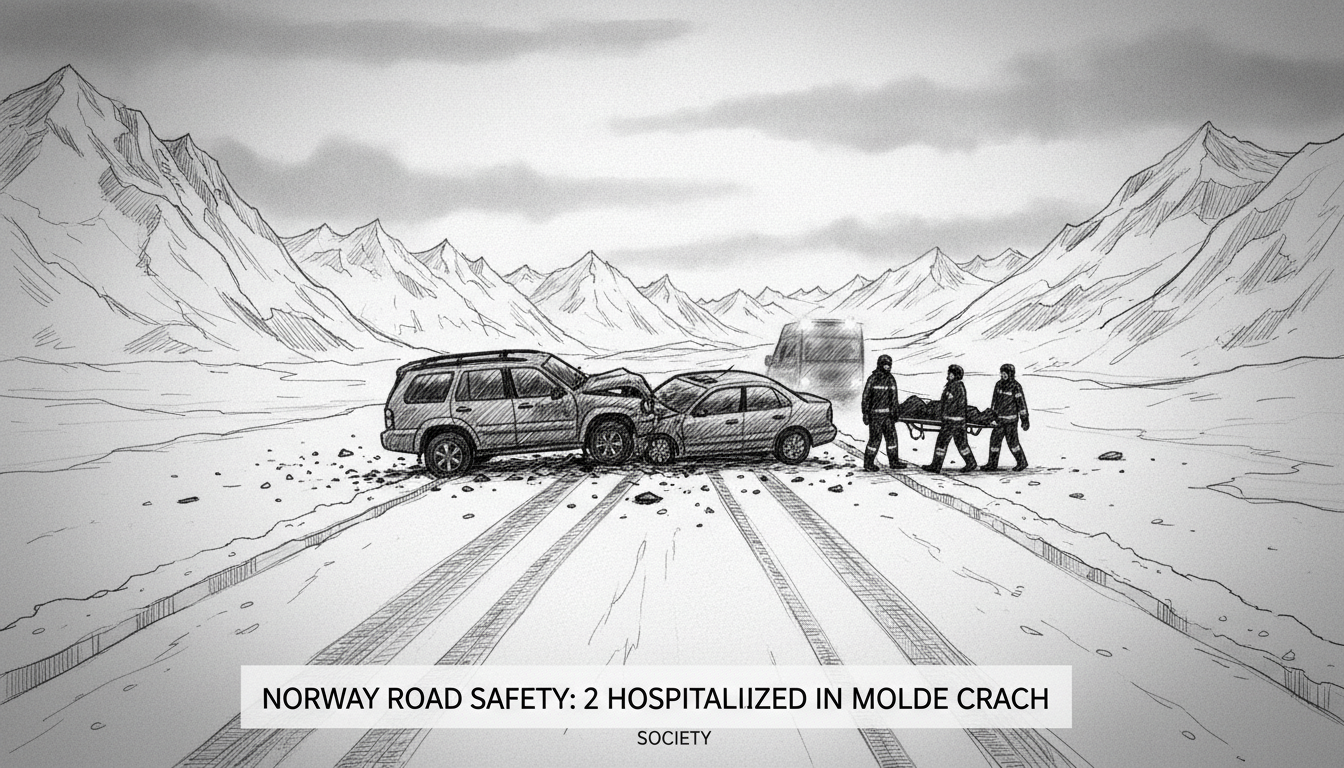
Norway road safety is under scrutiny after a serious traffic accident in Molde sent two people to the hospital. The collision, which police suspect was caused by a right-of-way violation, occurred at an intersection where one road has a 70 km/h speed limit. A third person received treatment at a local medical center. Both vehicles were damaged severely enough to require towing, and manual traffic control was implemented at the scene. The incident highlights persistent challenges on Norwegian roads, even as the country pursues an ambitious goal of reducing traffic fatalities.
A Violent Collision in Western Norway
Operational leader Tove Susann Brunvold Holst-Dyrnes described the crash as a "relatively powerful collision." Preliminary findings point to a failure to yield, known locally as a vikepliktsbrot, as the primary cause. The specific intersection where the accident happened, with its mix of speed limits and traffic flows, will be a key focus for the police investigation. Such junctions are common risk points across Norway's road network, where driver error can have immediate and severe consequences. The fact that both cars needed recovery underscores the force of the impact.
Molde, a city in Møre og Romsdal county situated on the scenic Romsdal Peninsula, is now the site of a national conversation starter. This accident disrupts the common international perception of Norway's roads as universally safe and perfectly engineered. It serves as a stark reminder that infrastructure and laws are only part of the safety equation. Human factors, including momentary lapses in judgment or attention, remain a critical and unpredictable variable.
Norway's Road Safety Ambitions and Realities
The Norwegian government has set a clear target in its National Transport Plan: reduce the number of people killed or seriously injured in traffic to below 500 by 2030. Preliminary figures from the Norwegian Public Roads Administration for 2o22 show 117 road fatalities. While this number is low compared to many nations, each incident represents a profound tragedy and is viewed as preventable. The country employs a multi-pronged strategy known as the "Vision Zero" approach, which aims to eliminate all fatal and serious injuries on the roads.
This strategy involves continuous improvements to road design, stricter enforcement of traffic laws, and public education campaigns. High-risk locations, particularly intersections on roads with higher speed limits, are often prioritized for redesign with features like roundabouts, improved signage, and better lighting. The accident in Molde will likely trigger a local review of the intersection's design to see if engineering changes could prevent a similar event in the future.
The Human Factor at Dangerous Junctions
Traffic safety experts consistently stress that intersections are among the most complex and dangerous parts of any road network. They require drivers to simultaneously navigate, interpret right-of-way rules, monitor other vehicles, and often make split-second decisions. A failure in any one of these tasks can lead to a collision. When this occurs on a road with a 70 km/h speed limit, as in Molde, the resulting crash forces are significantly higher than in a low-speed urban setting.
"The physics are unforgiving," explains a road safety analyst who preferred not to be named. "As speed increases, the energy that must be managed in a collision rises exponentially. This is why right-of-way violations at higher-speed intersections are so frequently linked to serious outcomes. The margin for error is virtually zero." The analyst notes that while automated systems in modern cars, like automatic emergency braking, are becoming better at preventing such crashes, they are not foolproof and cannot replace vigilant driving.
A Broader Look at Regional Risks
Møre og Romsdal county, with its dramatic fjords, mountains, and coastal roads, presents unique challenges for drivers. Weather conditions can change rapidly, and road geometries are often dictated by the rugged terrain. The region's roads are a mix of modern highways and older routes that wind through communities. This accident in Molde, a municipal center, occurred on the type of road that connects towns and villages—a vital artery for local residents that also carries inherent risks.
National data often shows that a significant proportion of serious accidents happen on these types of roads, not necessarily on the fastest motorways. They are roads where drivers may become complacent, where local familiarity can sometimes breed contempt for the dangers, and where traffic mixes more variably. Understanding the specific risk profile of these regional and municipal roads is a key part of Norway's safety work.
The Path Forward After a Crash
The immediate aftermath of an accident like this involves emergency response, medical care, and a police investigation. The longer-term process involves potential charges if traffic laws were broken, insurance assessments, and often, a painful recovery for those involved. For the community and the transport authorities, it must also involve learning.
Every serious accident is treated as a data point in Norway's systematic approach to road safety. The details from Molde—the intersection type, the suspected cause, the speeds involved, and the vehicle types—will feed into national statistics and risk models. This information helps authorities decide where to allocate resources for road upgrades, where to increase police patrols, and what messages to emphasize in the next public safety campaign.
Norway's goal of fewer than 500 fatalities and serious injuries by 2030 is ambitious. It will require relentless focus on engineering, enforcement, and education. But as the shattered glass is cleared from the intersection in Molde, the human element remains the hardest variable to control. The country's journey toward Vision Zero continues, one difficult lesson at a time. Can a society ever fully engineer out the risk of a momentary human mistake? Norway is determined to try, but this week's crash is a sobering checkpoint on that long road.