
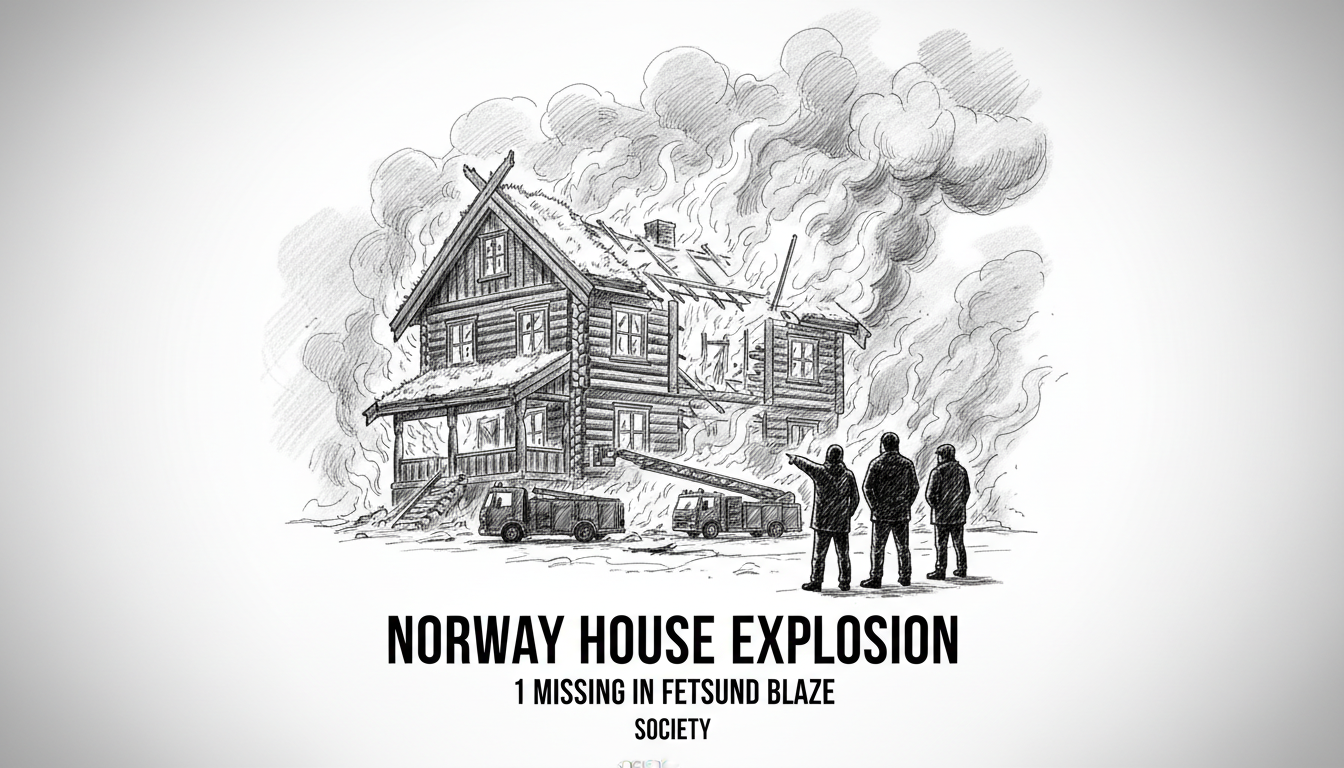
Norway emergency services are battling a major house fire in Fetsund following a powerful explosion that has left one person unaccounted for. The incident, reported at 4:40 PM local time, has sent flames shooting through the roof of a detached house and forced the evacuation of four people from neighboring properties.
Operational commander Ronny Hellerud Samuelsen confirmed the explosion occurred at the scene. He urged residents to stay away from the area. Firefighters are actively working to control the blaze, but face significant challenges due to the initial detonation and intense heat.
A Community Shaken by Sudden Blast
The quiet residential area in Fetsund, a town situated where the Glomma and Vorma rivers meet, was shattered by the sudden explosion. Police logs describe a dire scene with "full fire in the detached house, with open flames from the roof." Authorities have advised residents in the vicinity to keep windows and hatches closed due to heavy smoke spreading from the site.
One person registered at the address remains missing as emergency crews work. The immediate evacuation of a neighboring house underscores the perceived danger and instability at the scene. For the four evacuated individuals, the event means an uncertain night away from home, reliant on community or municipal support.
The Complex Task for Firefighters
Responding to a fire preceded by an explosion presents unique and severe hazards for emergency personnel. Structural integrity is the primary concern. An explosion can compromise load-bearing walls, floors, and the roof, creating a high risk of collapse for firefighters entering the building.
"The operational priorities shift dramatically after a confirmed explosion," explains Lars Holm, a former chief fire instructor with over twenty years of experience. "The first rule is to ensure no further loss of life, which means firefighters must operate from a defensive, exterior position until the structure can be assessed. The potential for secondary explosions from remaining gas lines or other materials is also a constant threat."
This defensive strategy, while necessary for safety, can limit the ability to conduct a thorough interior search for the missing individual. The intensity of the fire, described as having open flames from the roof, suggests the building may be fully involved, further complicating rescue efforts.
Investigating the Cause: A Methodical Process
Once the fire is extinguished, the meticulous work of determining the cause begins. The confirmed explosion will focus the investigation on specific potential sources. Investigators from the police and the fire service will work in tandem, often with technical experts from the Norwegian Directorate for Civil Protection (DSB).
Common causes in residential explosions include gas leaks from propane tanks or lines, which are used in some Norwegian homes for heating or cooking. Accumulated gas from a leak can ignite with devastating force. Other possibilities involve the ignition of vapors from flammable liquids, or less commonly, issues with electrical systems or chemical reactions from improperly stored substances.
"The scene is treated as a potential crime scene until evidence proves otherwise," says a police source familiar with such investigations. "We document everything meticulously. The pattern of debris, the point of origin of the fire, and the condition of appliances and gas fittings all tell a story. It is a slow, careful puzzle." The priority will be to locate and account for the missing person, with the cause investigation running parallel.
Norway's Fire Safety Framework Put to the Test
Norway has stringent building and fire safety codes, regularly updated in the wake of tragedies. The 2014 revision of the Technical Regulations (TEK) placed greater emphasis on early detection and containment. Requirements for interconnected smoke alarms in all bedrooms, hallways, and escape routes became mandatory.
Detached houses like the one in Fetsund are subject to these rules. The effectiveness of these alarms in a rapid explosion scenario, however, can be limited. The initial blast may cause immediate structural failure, bypassing the early warning stage that alarms provide for a slower-growing fire.
"Regulations are designed for probabilistic risk—addressing the most common scenarios," notes safety engineer Kari Nilsen. "A sudden explosion is a low-probability, high-consequence event. The safety discussion then shifts from containment to prevention: ensuring gas installations are certified and regularly checked, and that homeowners are aware of the risks associated with flammable materials." This incident will likely prompt local fire authorities to reinforce public safety messages around gas cylinder storage and installation checks.
The Human Cost Beyond the Flames
While the physical damage is stark, the psychological impact on the small community of Fetsund will linger long after the smoke clears. For the evacuated neighbors, the sight of a nearby home erupting in flames is profoundly traumatic. Their sense of security in their own homes has been violently disrupted.
The uncertainty surrounding the fate of the missing individual casts a pall over the entire operation. Friends, family, and community members face an agonizing wait for news. Local municipal services, including the health care system, will be prepared to offer crisis support to those affected.
Events like this resonate deeply in Norway's close-knit towns. They shatter the presumption of safety that accompanies everyday life in a peaceful suburb. The coming days will see a community grappling with shock, while pulling together to support those directly harmed.
A Long Night Ahead and Questions for Tomorrow
As night falls in Fetsund, the firefighting operation continues under floodlights. The primary goals remain unchanged: fully extinguish the fire, secure the structure to prevent further danger, and locate the missing person. The level of destruction will only become clear in daylight.
This tragedy serves as a sobering reminder of the latent dangers present in all homes. It will trigger a local review of emergency response protocols and likely a national reiteration of fire and explosion safety advice from the DSB. For now, the focus is on the grim, difficult work at the charred site on a quiet Norwegian street, where an ordinary afternoon turned into a disaster.
The final word belongs to the operational commander, Ronny Hellerud Samuelsen, whose simple, urgent plea encapsulates the immediate reality: "We ask that residents keep their distance." Behind that warning lies a complex emergency, a life in jeopardy, and a community forever changed.