
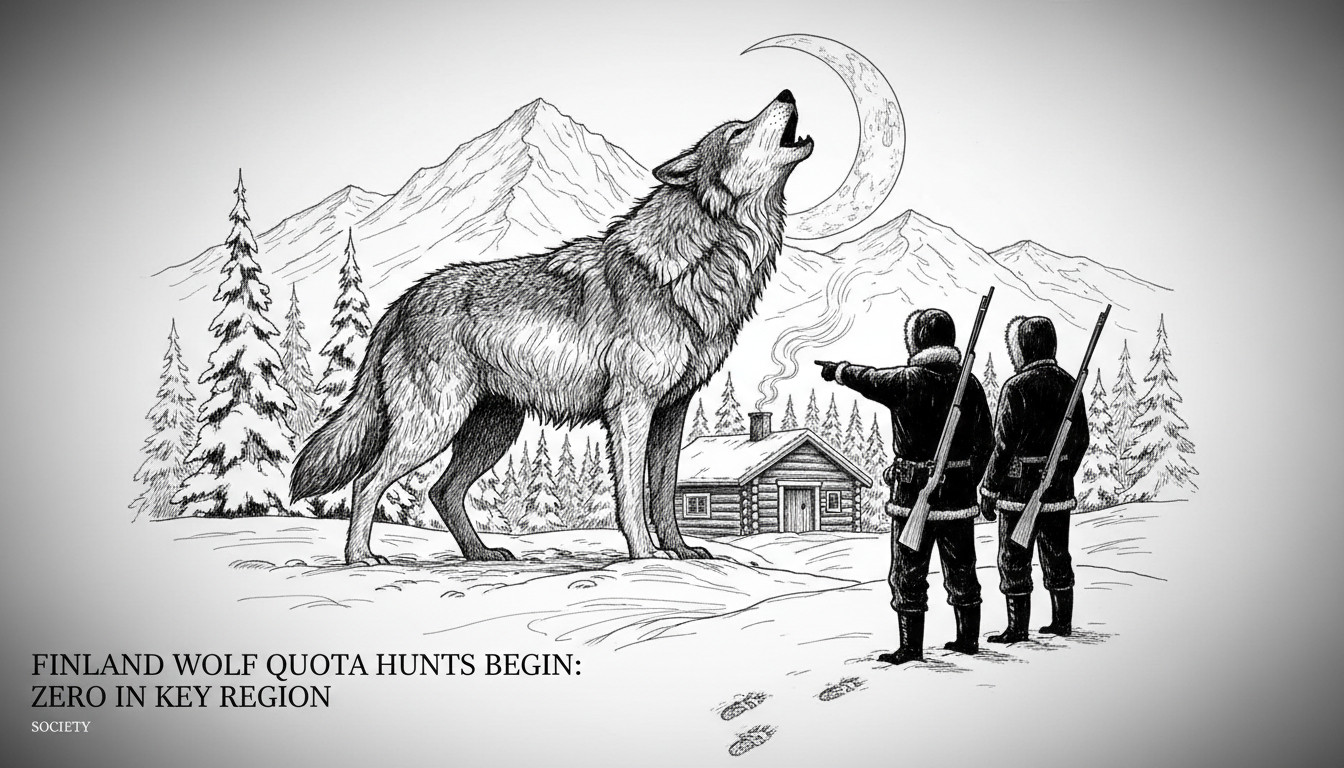
Finland's contentious wolf quota hunting season commenced on January 1st, with a stark regional disparity immediately apparent. By Thursday morning, hunters had reported culling over ten wolves nationwide according to the Finnish Wildlife Agency's real-time counter. Yet in Southeast Finland, a region with a quota of ten animals, not a single wolf had been taken. This zero-catch situation in a hotspot highlights the complex and often contradictory realities of Finland's large carnivore management.
Riistapäällikkö (Game Manager) Ohto Salo, overseeing Southeast Finland, expects most local hunting groups to begin their pursuits this weekend. He predicts efforts will concentrate near the southeastern border in Joutseno, the Etelä-Saimaa area, and Ylämaa. These zones have recorded sightings of male wolves in recent years. The focused hunt aims to meet a quota designed not just for population control, but to address specific local tensions where wolves and human activities intersect.
The National Framework of Wolf Management
The opening of the hunting season is a direct implementation of Finland's wolf management plan. This policy seeks a difficult balance between conservation obligations under the EU Habitats Directive and the legitimate concerns of rural residents. The national wolf population was last estimated by the Natural Resources Institute Finland (Luke) to be between 291 and 331 individuals in early 2023. Quotas are set regionally by the Finnish Wildlife Agency, based on these population estimates and, critically, on the level of damage caused to domestic animals like sheep and hunting dogs.
Quota hunting is one tool in a broader management toolkit. It follows a calendar where licensed hunters, typically operating in specific teams, are permitted to cull a predetermined number of wolves within a set period. The system is intended to be precise and science-led. However, the opening-day results show theory diverging from practice. While some regions see immediate action, Southeast Finland's slow start suggests local factors—wolf behavior, terrain, or hunter strategy—are playing a decisive role.
Southeast Finland's Specific Challenge
The quiet beginning in the southeast is particularly noteworthy given the region's history. It is an area where human-wolf conflicts, including livestock depredation and encounters with dogs, have fueled strong political and social demand for population management. Setting a quota of ten wolves signals an acknowledgment of these pressures by authorities. Yet the initial lack of success underscores a key fact: wolves are elusive, intelligent animals, and their localized movements do not always align neatly with management maps.
Ohto Salo's forecast for weekend activity points to the organized, communal nature of these hunts. They are not random pursuits but coordinated operations by experienced groups. The targeting of specific territories where male wolves have been tracked demonstrates an attempt at selective management. The question remains whether this targeted approach can successfully fill the quota in a region where wolves are simultaneously deemed a problem and are proving difficult to locate.
Analysis: A Policy Under Microscopic Scrutiny
Finland's wolf policy operates under constant scrutiny from opposing camps. Conservation organizations, such as the Finnish Nature League, frequently argue that quota hunting risks undermining the genetic health of a population still recovering from historical lows. They point to the EU's strict protection status for wolves and question whether national management decisions adequately fulfill Finland's conservation commitments. The fragmentation of packs through hunting, they warn, can lead to increased dispersal and unexpected conflicts.
Conversely, local communities and hunting associations assert their right to safety and to protect their livelihoods. The Central Union of Agricultural Producers and Forest Owners (MTK) has long advocated for more assertive management to prevent economic losses and fear in rural areas. For them, the quota system is a necessary, if sometimes insufficient, measure to maintain social license for wolf presence in the Finnish landscape. This tension makes every hunting season a barometer for a deeper national debate about wilderness, tradition, and modern conservation ethics.
Dr. Sauli Härkönen, a senior researcher familiar with carnivore ecology, notes the inherent challenge. 'Management must be adaptive, using the best available science on population dynamics,' he says. 'But it also must credibly address the very real experiences of people living in wolf territories. The current system tries to walk that line, but the annual controversy shows how delicate that balance is.' The Southeast Finland quota, whether filled or not, will become another data point in this ongoing evaluation.
The European Context and Future Implications
Finland's approach cannot be viewed in isolation. It exists within a broader European conversation re-ignited by the European Commission's 2023 proposal to modify the wolf's protection status from 'strictly protected' to 'protected' under the Bern Convention. This proposed change, driven by requests from countries like Finland and Sweden, would grant member states greater flexibility in managing wolf populations where conflicts are pronounced. The Finnish hunt is, in many ways, a domestic manifestation of this continental policy struggle.
The success or failure to meet regional quotas like Southeast Finland's ten wolves will inform future policy decisions. Data on hunt success rates, coupled with ongoing monitoring of livestock damage and population trends, feeds back into the model. If quotas consistently go unfilled in high-conflict areas, pressure may grow for alternative measures. These could include expanded permit hunting outside the quota season or increased resources for non-lethal prevention methods like fencing and livestock guarding dogs.
As the weekend hunts proceed in Joutseno and Etelä-Saimaa, the real-time counter on the Wildlife Agency's website will tick upward. Each reported wolf will be analyzed not just as an animal, but as a unit in a deeply political calculus. The zero in Southeast Finland at the season's opening is more than a temporary statistic; it is a silent testament to the gap between policy design on paper in Helsinki and the unpredictable reality of life—for both wolves and humans—in the vast Finnish forests. The ultimate question for policymakers is whether the current system narrows that gap or widens it.