
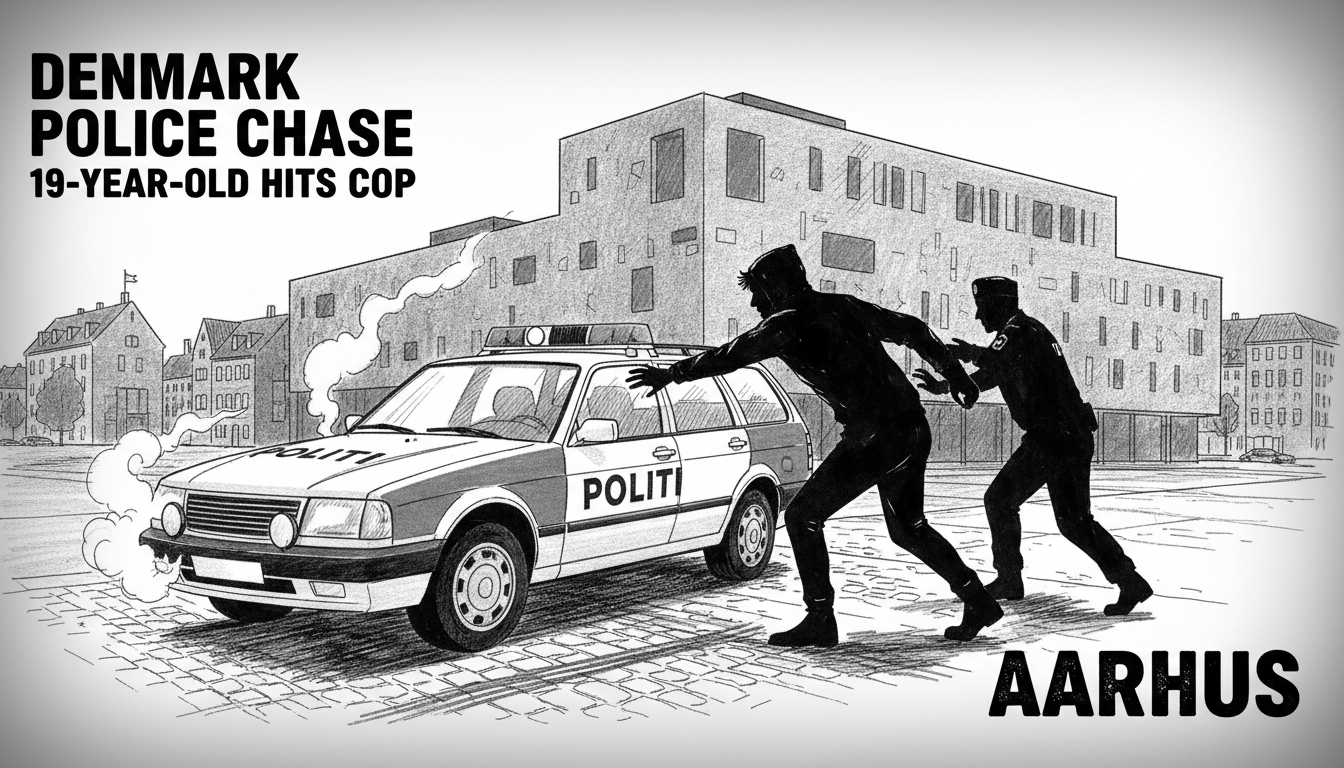
Denmark police chase incidents, though statistically uncommon, turned violent in Aarhus this week. A 19-year-old unlicensed driver struck an officer with a rental car after a pursuit, spotlighting the risks inherent in even rare confrontations. The event in the Åbyhøj district underscores a tense moment where standard traffic control escalated rapidly.
The incident began on Wednesday evening on Viby Ringvej. Police had attempted to stop the young man for prior traffic violations, including speeding and running a red light. According to the East Jutland Police daily report, one officer positioned himself in front of the vehicle while another approached the driver. The driver then accelerated, hitting the officer's leg before being apprehended.
Authorities confirmed the officer was not seriously injured. The rental car was seized immediately. Three other young men in the vehicle were released after police found they were not carrying illegal items.
A Sequence of Reckless Decisions
This case combines several serious legal violations. The driver lacked a valid license, evaded initial police attempts to stop him, and finally used the vehicle as a weapon. Legal experts note this aggregation of charges significantly increases potential penalties. Driving without a license alone can result in fines or imprisonment under Danish law.
Adding assault on a public official to the list moves the case into a more severe category. 'When a vehicle is used to intentionally hit an officer, it crosses a clear line,' said Karen Højgaard, a legal commentator on policing matters. 'The courts typically view any attack on executing officers as an attack on public order itself.' The decision to seize the vehicle is a standard procedural tool. Danish police can confiscate cars used in crimes to prevent future offenses and as part of the investigation.
The Broader Context of Police Pursuits
Car chases remain a relative anomaly in Danish policing strategy. The national approach emphasizes de-escalation and minimizing danger to the broader public. Officers are trained to assess whether a pursuit's risks outweigh the necessity of immediate apprehension. Factors like traffic density, weather, and the severity of the suspected crime are crucial.
This measured tactic contrasts with more frequent pursuits seen in some other countries. Its goal is to preserve overall public safety, even if it occasionally means discontinuing a chase. This incident, however, presents a different scenario. The initial confrontation occurred after the vehicle was already stopped, shifting the dynamic from a high-speed chase to a stationary threat.
Societal Questions Beyond the Crime Scene
As a reporter focused on integration and social dynamics, I see events like this through a dual lens. First, there is the immediate criminal act and its consequences. Second, we must consider the societal factors that sometimes lead young adults, including those from diverse backgrounds, into such destructive behavior. Reckless driving and confrontations with authority often stem from deeper issues of alienation, lack of opportunity, or peer pressure.
Criminologists point to a need for early intervention. 'Behavior that disregards societal rules and the safety of others doesn't emerge in a vacuum,' notes Dr. Lars Bengtsson, who studies youth crime. 'While personal responsibility is absolute, we should examine access to education, mentorship, and constructive community engagement as preventive tools.' Municipal social services in cities like Aarhus often work on these fronts, aiming to provide positive pathways long before a police interaction occurs.
The Practical Implications of Rental Vehicle Crime
The use of a rental car in this offense adds a practical dimension. Rental companies have procedures to verify a driver's license, but fraud or the use of another person's credentials can circumvent these checks. This case may prompt discussions between police and rental agencies about strengthening verification processes. For the industry, a seized vehicle represents a direct financial loss and operational hassle until police release it.
For law enforcement, a rental car can sometimes be harder to track initially than a privately registered vehicle. The seizure power is a key response, removing the instrument of the crime from circulation. It also serves as a tangible consequence, demonstrating that the legal system will target the assets used in criminal acts.
Navigating Justice and Prevention
The 19-year-old now faces a rigorous legal process. The system will determine his punishment, which could include a substantial prison sentence given the combined charges. The officer's lack of serious injury is a fortunate element in an otherwise dangerous act. It does not, however, diminish the seriousness of the intent.
From a social policy perspective, the aftermath is equally critical. Does this young man have access to rehabilitation programs? What support systems exist to redirect his life course post-incarceration? Denmark's welfare model is designed to offer such second-chance pathways, including education and job training within the correctional system. The effectiveness of these measures is a constant topic of debate among policymakers.
This single evening in Åbyhøj reveals a collision of individual choices and systemic structures. It shows the clear line Danish police draw against violence towards officers. It also reminds us that behind many crime headlines are young lives at a crossroads. The community's response must balance firm justice with a commitment to addressing the root causes that lead to such desperate acts. As Aarhus moves forward from this event, the challenge lies in ensuring safety today while still building a more cohesive society for tomorrow.
Will this incident lead to stricter controls on rental vehicles or simply remain a stark example of a single individual's dangerous decisions? The answer likely lies somewhere in between, in the ongoing Danish effort to maintain order while fostering inclusion.