
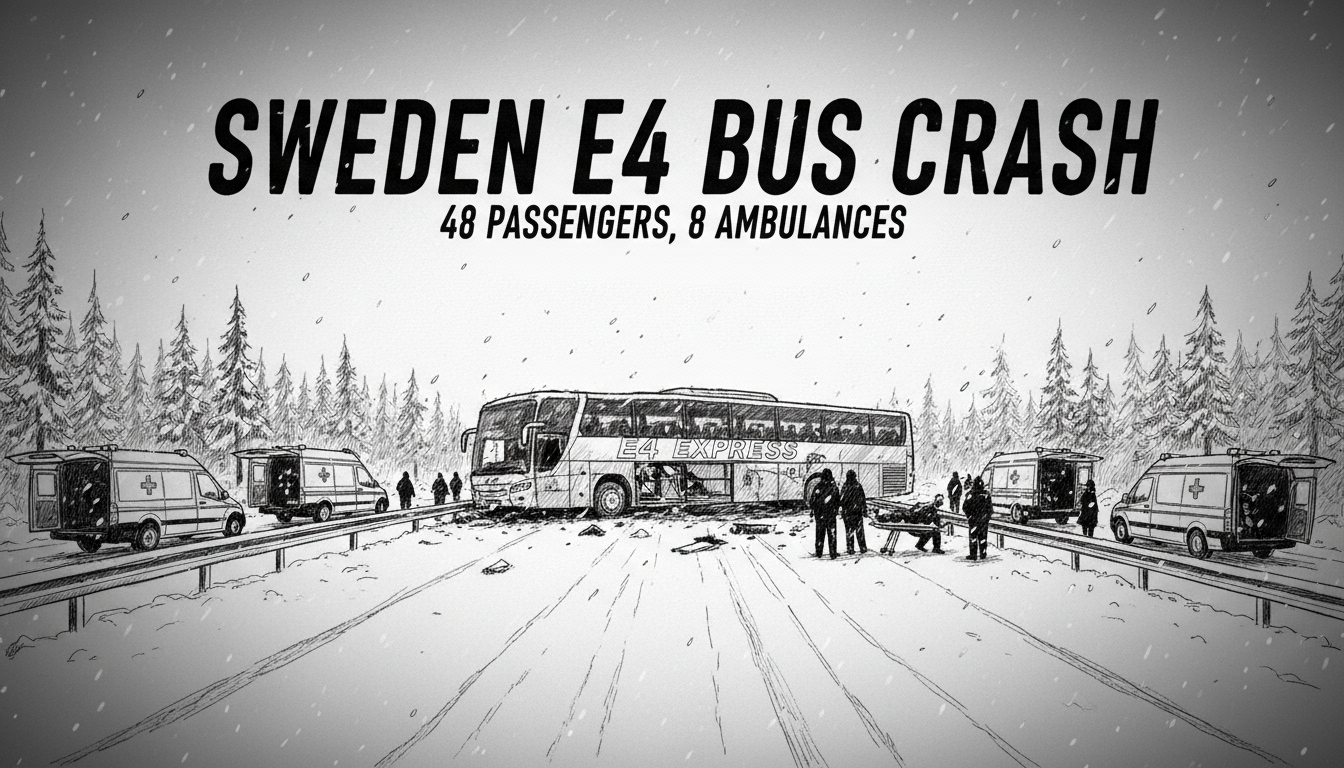
Sweden's E4 highway was the scene of a major collision Friday afternoon when a double-decker bus carrying 48 passengers overturned after being struck from behind by two cars. The accident occurred near Önnesmark, south of Skellefteå, prompting a large-scale emergency response. Eight ambulances raced to the scene, while an ambulance helicopter was forced to turn back due to severe weather conditions, complicating rescue efforts.
Emergency services received the alarm around noon. Initial reports from rescue coordination officials describe a chaotic scene on the vital north-south artery. The bus, a large double-decker, lay on its side after the impact. The two passenger cars involved sustained significant damage. Rescue teams worked urgently to secure the area and assess the condition of all involved.
"It is not possible to land it in these weather conditions," a dispatch operator for Rescue Coordination North said of the ambulance helicopter. The inability to deploy air support highlights the challenges of emergency response in northern Sweden's often harsh and unpredictable climate, especially during transitional seasons.
A Major Artery Paralyzed
The E4 is not just any road. It is a European route stretching from Helsingborg in southern Sweden to Haparanda on the Finnish border, functioning as the country's logistical backbone. The section near Lövånger and Skellefteå is crucial for regional travel and freight. This accident caused significant disruption, closing lanes and creating long traffic queues. Such incidents strain not only emergency services but also regional commerce, delaying goods and isolating communities.
For the 48 passengers on the bus, a routine journey turned to crisis in an instant. The psychological impact of such an event, involving a large vehicle overturning, is profound. While the full extent of injuries remains unclear, the dispatch of eight ground ambulances indicates rescue services were preparing for a mass casualty event. The forced reliance on ground transport alone, due to the weather, added critical minutes to evacuation timelines.
Recurring Safety Concerns on Northern Highways
This serious collision on the E4 near Skellefteå brings renewed focus to perennial road safety debates in northern Sweden. The E4 handles a high volume of mixed traffic—from passenger cars and buses to heavy freight trucks. Weather is a constant and formidable variable. While the specific cause of this crash is under investigation, experts consistently point to a combination of factors prevalent on such routes.
"Accidents involving multiple vehicles and buses often have complex causes," a road safety analyst explained, referencing typical investigation frameworks. "Investigators will look at the sequence of impacts, vehicle speeds, road surface conditions, and driver actions in the moments before the collision. The mix of vehicle types and sizes also affects crash dynamics significantly."
Potential contributing factors for this region include sudden ice patches, blowing snow reducing visibility, and driver fatigue on long, monotonous stretches of highway. The difference in mass and braking capability between a loaded double-decker bus and passenger cars can lead to catastrophic outcomes if following distances are not properly adjusted for conditions.
The Human and Systemic Impact
Beyond the immediate emergency response, an accident of this scale triggers a cascade of systemic actions. Police launched a technical investigation at the scene to determine the precise sequence of events. Traffic authorities began analyzing traffic flow data and any available camera footage. The bus operator will undergo scrutiny regarding driver schedules, vehicle maintenance, and safety protocols.
For the passengers and drivers involved, the aftermath involves trauma, medical care, and dealing with insurance and authorities. Local hospitals in Skellefteå and surrounding areas were put on alert to receive casualties. The community of Lövånger, near where the crash occurred, finds itself unexpectedly at the center of a national news story, a reminder of how quickly normalcy can shatter on a well-traveled road.
This incident also serves as a stark test of regional emergency preparedness. The coordinated response between SOS Alarm, multiple ambulance services, and the rescue service demonstrates integrated planning. However, the weather's veto over air ambulance support reveals an immutable vulnerability. It underscores why northern regions must maintain robust ground-based emergency medical capabilities, regardless of technological advances in aeromedical transport.
A Look at the Broader Nordic Context
While this accident occurred in Sweden, the safety of long-distance bus travel and major highways is a shared concern across the Nordic region. Norway's E6 and Finland's E75 face similar challenges with winter conditions, heavy freight traffic, and tourist buses. Each serious accident prompts cross-border discussions about harmonizing safety regulations, especially for commercial passenger transport.
Double-decker buses, common for long-distance routes due to their passenger capacity, have specific stability considerations. Their design and high center of gravity require careful handling, particularly in high winds or during evasive maneuvers. Accident investigators will examine this aspect closely, along with the integrity of the passenger compartment during the rollover.
The economic role of the E4 amplifies the impact of such closures. It is a key route for transporting goods from Swedish ports and industries to the rest of Scandinavia and the EU. Prolonged closures disrupt supply chains. This creates a constant balancing act for transport planners between maintaining traffic flow and ensuring investment in road safety infrastructure like better barriers, lighting, and weather monitoring systems.
The Road Ahead for Investigation and Policy
The immediate priority remains the care of the injured. In the coming days, the Swedish Transport Administration and police will continue their detailed scene investigation. They will reconstruct the collision to assign responsibility and, more importantly, identify any preventable systemic failures. Their findings will be added to the national statistics on traffic safety, which inform future policy and infrastructure spending.
Local politicians and transport safety advocates are likely to call for renewed scrutiny of the E4's specific stretch near Önnesmark. Questions will be asked about road design, speed limits appropriate for the conditions, and the frequency of winter maintenance. Public debate may also touch on regulations for bus driver rest periods and the use of advanced driver assistance systems in commercial vehicles.
For now, the community waits for updates on those injured and reflects on the fragility of safe travel. This crash on the E4 is a tragic reminder that despite advanced vehicles and infrastructure, human life on the road remains vulnerable to a moment's loss of control, a patch of ice, or a simple misjudgment. The final report from investigators will tell the technical story, but the human cost is felt long before the official documents are complete. As traffic eventually returns to normal on the E4, will the lessons from this Friday near Skellefteå lead to tangible changes, or will they fade until the next alarm sounds?