
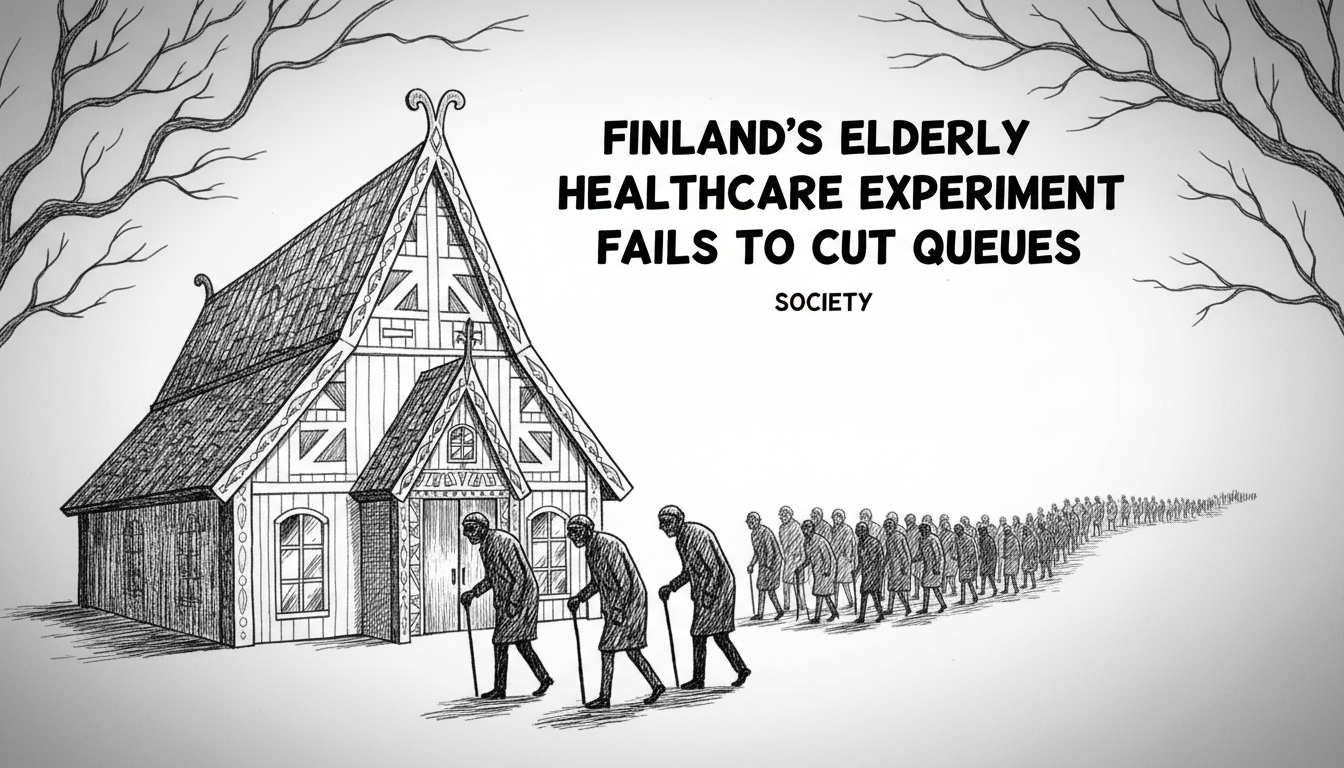
Finland's Kela reimbursement experiment for the elderly has not reduced public healthcare waiting lists, according to a comprehensive survey of the nation's wellbeing service counties. The policy, launched last September, aimed to ease pressure on the public system by subsidizing private doctor visits for people aged 65 and over. Data now shows it has instead created what experts term 'disruptive demand,' with patients returning to the public sector for costly follow-up care they cannot afford privately.
A Policy Designed for Relief, Resulting in Strain
The experiment was a central part of the government's strategy to tackle Finland's persistent healthcare queue problem. It allows seniors to visit a private general practitioner for the standard public healthcare client fee, which is 28.20 euros this year. Kela, the Social Insurance Institution of Finland, then reimburses the private provider the difference, up to a maximum price ceiling of 100 euros per visit. The goal was straightforward: divert simpler cases to the private sector, freeing up capacity in public health centers for more complex needs. All 21 wellbeing service counties that responded to the survey, including the city of Helsinki, reported the experiment has not improved queue situations or sped up access to care. This unanimous feedback from the regions responsible for providing healthcare presents a significant policy setback.
The Costly Loop of Follow-Up Care
The core failure lies in a predictable gap between initial consultation and subsequent treatment. A patient can easily book a subsidized appointment with a private GP. However, if that doctor orders blood tests, X-rays, or specialist referrals, the patient faces the full, unsubsidized cost of those procedures in the private sector. For many pensioners, these prices are prohibitive. The result is a revolving door effect. 'Participants in the experiment are seeking a private doctor's appointment only to return to the public side afterwards,' the survey findings indicate. 'Often the reason is that they do not want to pay for investigations.' This dynamic shifts the administrative burden and cost of follow-up care back to the public system without reducing the initial patient volume. It creates extra work for public coordinators who must manage these returning cases, adding a layer of inefficiency.
Expert Analysis: A Flaw in the Design
Health policy experts are not surprised by the outcome. The situation highlights a classic challenge in mixed healthcare models: fragmented care pathways. 'The situation does not surprise a THL expert,' the report notes, referencing Finland's Institute for Health and Welfare. The experiment addressed only one piece of the care continuum—the first consultation—while leaving the much more expensive diagnostic and specialist care layers untouched for the patient. This creates a perverse incentive where the private sector profits from the initial, subsidized visit while the public sector retains the financial risk for all subsequent care. Professor Ilmo Keskimäki, a health economics specialist at THL, has long cautioned that simply increasing supply without controlling costs can lead to 'induced demand,' where new services generate their own usage without improving overall population health or system efficiency. This experiment appears to be a case study in that phenomenon.
Political Reckoning and Future Reforms
The results land at a sensitive time for Finland's governing coalition, which has staked political capital on reforming the sprawling welfare service county system established just two years ago. The Minister of Social Affairs and Health, Kaisa Juuso, defended the experiment as part of a broader push for choice and efficiency. In a statement to parliament's Social Affairs and Health Committee, she argued that 'increasing freedom of choice is a principle for this government.' However, opposition MPs are seizing on the data. 'This is a costly placebo that does nothing to cure the actual disease of our healthcare system—underfunding and staffing shortages,' said Social Democratic Party health spokesperson Hanna Sarkkinen during a recent Eduskunta debate. The findings will undoubtedly fuel the ongoing political battle over whether to increase private sector involvement in Finland's traditionally public-dominated healthcare model.
The Broader Context of Finnish Healthcare
Finland's universal public healthcare system guarantees access for all residents but has struggled for years with long waiting times for non-urgent specialist care and certain surgeries. Previous governments have launched various trials with private service vouchers and subsidies, with mixed results. The current experiment targeted the elderly demographic, which uses healthcare services most intensively. The logic was that even a small shift in this group's service use could significantly impact public queues. The failure suggests that more systemic solutions are required. Many health economists argue for better resource allocation within the public system, increased funding for primary care to prevent conditions from worsening, and greater use of digital health solutions to streamline triage. The experiment's outcome strengthens the argument of those who believe investment must be directed into the public system's core capacity rather than creating parallel, subsidized private channels.
Looking Ahead: Data and Decisions
The government has committed to analyzing the experiment's full results later this year. Key metrics will include total cost to Kela, demographic data of users, and the types of conditions treated. This data is crucial for determining the experiment's next steps. Options include terminating it, modifying it to cover some diagnostic costs, or expanding it to other age groups—though the latter seems unlikely given the current findings. The debate touches on a fundamental question for Finnish society: the balance between collective solidarity and individual choice in welfare provision. As Finland's population continues to age, placing greater strain on the healthcare system, the pressure for effective solutions will only intensify. This experiment's clear failure to deliver its promised relief means the search for those solutions must continue, likely with a greater focus on integration and systemic strength rather than simple diversion.
The Kela experiment for seniors reveals a hard truth in healthcare policy. Easing queues requires more than just creating another entry point; it demands a coherent, fully-funded pathway from initial symptom to final treatment. Without that, new policies risk becoming expensive detours that lead patients right back to the crowded main road they were trying to avoid.