
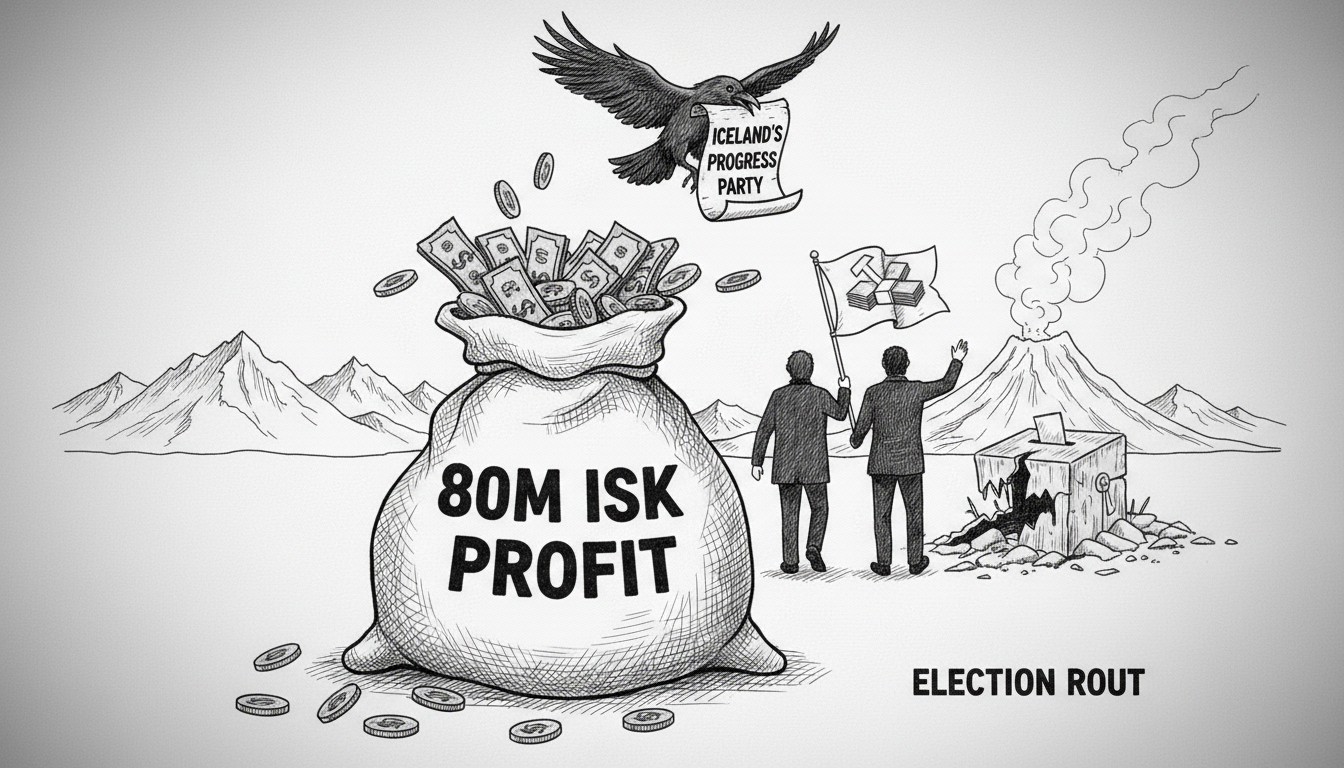
Iceland’s Progress Party recorded a 79 million ISK profit in a year it lost six parliamentary seats. The financial statement for 2024, approved and published by Iceland’s National Audit Office, reveals a party in a paradoxical financial position: flush with cash from public coffers and a property sale but decimated at the polls. The party's income surpassed 206 million ISK, while election spending exceeded 155 million ISK for a campaign that resulted in just five Althingi representatives.
A Profitable Defeat
The core irony is stark. Framsóknarflokkurinn, a centrist agrarian party historically strong in rural regions, is financially robust but politically weakened. Over 70% of its 206 million ISK income—approximately 145.5 million—came directly from state institutions: the treasury, Althingi, and municipalities. This public funding is allocated based on previous election performance and parliamentary representation, meaning it is now poised to drop significantly. “This profit is a sunset glow, not a sunrise,” noted a political science professor at the University of Iceland. “It reflects past success, not future prospects. The coming year's accounts will show the real cost of their electoral collapse.”
Individual donations accounted for just over 12.5 million ISK. More notably, donations from legal entities—corporations and organizations—surpassed 19 million ISK, a figure the audit office confirms is substantially higher than the previous year. This increase in corporate backing amidst a declining vote share raises immediate questions about influence and strategy.
The Cost of a Campaign Crash
Where did the money go? The 2024 parliamentary election was a massive financial drain. The party confirms it spent over 155 million ISK on the national campaign. This investment yielded catastrophic results: a loss of six seats, reducing their parliamentary group from eleven to five. The campaign’s focus on traditional strongholds in the Northwest and the East, alongside Reykjavik’s southern districts, failed to resonate. Voter analysis suggests a shift towards left-green and independence parties on key issues like fisheries management and energy costs.
Other significant expenditures included 14.6 million ISK for central committee meetings and 7.5 million ISK on advertising and promotions. The party’s national convention cost just over 5 million ISK. The high administrative and campaign spend, juxtaposed with the dismal result, points to a severe strategic miscalculation. “Spending 155 million to lose six seats is an extraordinary return on investment, just not the kind you want,” a Reykjavik-based political analyst said.
The Hverfisgötu Windfall
A major factor in the yearly profit was a one-time asset sale. In 2024, the party sold its headquarters at Hverfisgötu 33 in central Reykjavik. The property was officially valued at 303 million ISK. While the exact sale price is not itemized in the published summary, the transaction clearly provided a major liquidity boost, insulating the annual result from the full impact of election overspending. This sale creates a short-term financial cushion but also symbolizes a retreat, severing a physical tie to its operational history.
Public Money and Political Accountability
The system of Icelandic political party financing is now under a microscope. Parties receive public funds based on a formula tied to vote share and parliamentary seats, intended to ensure a level playing field and reduce over-reliance on private interests. The Progress Party’s case highlights a potential flaw: a lag effect where a party is richly funded for a past victory it cannot replicate. “The system guarantees stability but can also artificially sustain a party that is losing touch with voters,” explained an expert on Nordic governance. “There’s a debate to be had about quicker adjustment mechanisms.”
The surge in corporate donations, from under 10 million ISK in 2023 to over 19 million in 2024, also warrants scrutiny. While legal and declared, it prompts discussions about whether financial interests are seeking influence with a party perceived as being in a vulnerable, rebuilding phase.
A Nordic Perspective on Party Finance
Compared to its Nordic neighbors, Iceland’s party funding model shares similarities but with less stringent caps on corporate donations than, for instance, Norway. Sweden emphasizes individual membership fees, while Denmark has tighter real-time disclosure rules. The Icelandic National Audit Office’s role in publishing verified accounts is a key transparency tool. However, this episode may fuel calls for reform, such as faster reduction of public funds after electoral setbacks or greater restrictions on legal entity donations—a topic already simmering in Althingi committees.
The Road Ahead for Framsóknarflokkurinn
The party now faces a dual challenge. Politically, it must rebuild credibility with voters in the fishing and farming communities of the Westfjords, Akureyri, and the Suðurnes region that once were its bedrock. Financially, it must adapt to a new, leaner reality. Its 2025 income from the state will be slashed due to its smaller parliamentary bloc. The profit from 2024, bolstered by the property sale, will become a war chest for this rebuild. The question is whether money can buy political relevance.
“Their financial report is a snapshot of a party at a crossroads,” concluded the University of Iceland professor. “They have capital in the bank but a massive deficit in public trust. The next election will test whether they can convert one into the other.” The party’s ability to connect its economic stability to a compelling political vision for Iceland’s rural and coastal areas will determine its survival. For now, the ledgers show health, but the ballot box told a different story.