
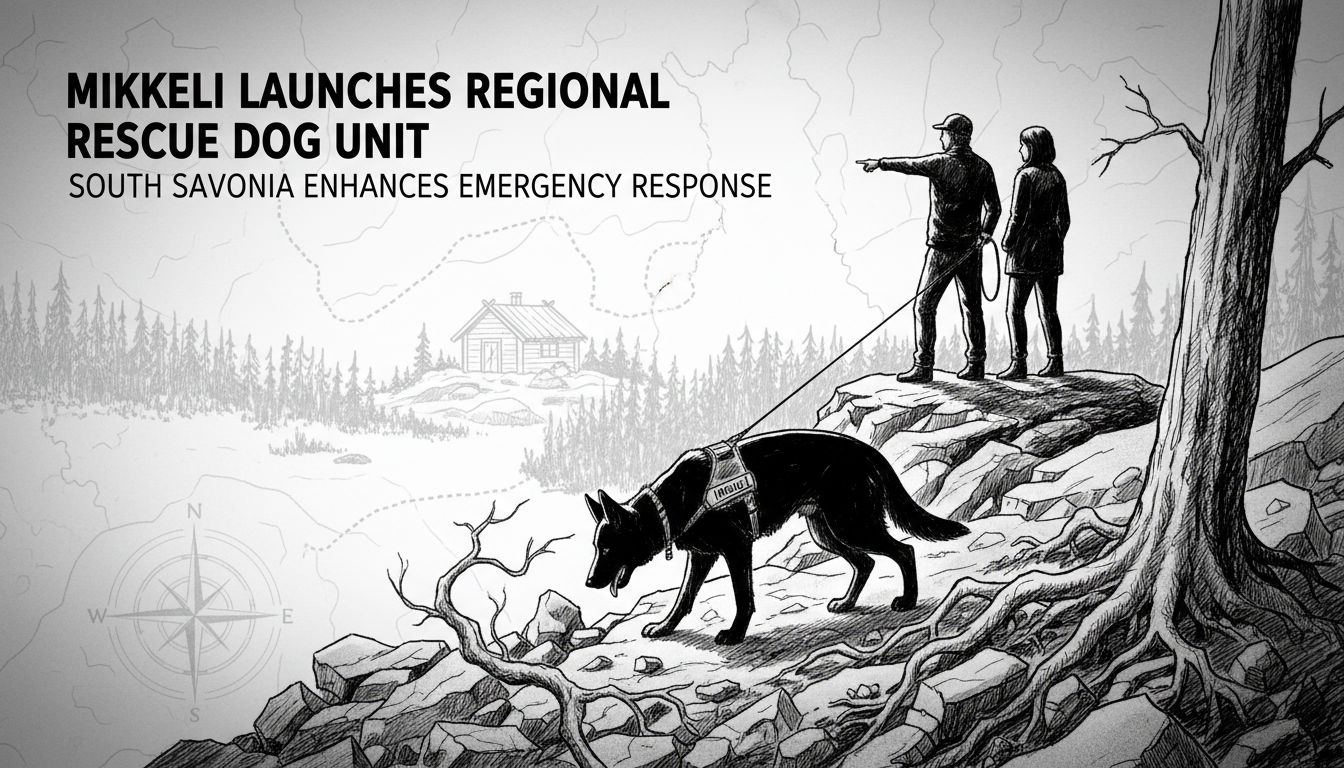
The South Savonia Rescue Department has established its own dedicated rescue dog unit this year, marking a significant enhancement to emergency response capabilities in the Finnish region. A four-year-old German Shepherd named Muru, based in Mikkeli, is training to become a specialist in locating people trapped in rubble. Muru and her handler, Reetta Koponen, are undergoing rigorous training to assist both police and fire brigade operations during complex rescue missions.
This development represents a strategic investment in regional civil security infrastructure. For years, specialized search and rescue dog teams in Finland have primarily been centralized or affiliated with larger urban units. The creation of a local unit in South Savonia indicates a shift toward building more resilient, decentralized emergency response networks. It addresses the specific challenges of the region's geography, which includes vast forested areas and a dispersed population.
The initiative connects to broader national security priorities. Finland's comprehensive security model emphasizes multi-agency cooperation and the integration of specialized resources. A rescue dog unit fits perfectly within this framework. Such dogs are invaluable for searching collapsed buildings after incidents like gas explosions or structural failures, and they can also be deployed in wilderness searches for missing persons. The unit's establishment likely followed risk assessments and planning within the South Savonia Rescue Department, possibly supported by regional funding allocations.
From a policy perspective, this move can be seen as part of a continuous effort to modernize Finland's civil protection services. It demonstrates practical implementation of the principles found in national rescue legislation, which mandates effective preparedness across all municipalities. The decision to train a dog like Muru locally, rather than relying on units from Helsinki or Tampere, reduces critical response times and builds in-house expertise. It is a tangible example of how regional authorities are exercising their operational autonomy to improve public safety.
For international observers, this story highlights the meticulous, pragmatic approach Finland takes toward safety and preparedness. It is not merely about acquiring a dog. It is about systematic training, integration into existing command structures, and long-term commitment to a specialized skill set. The investment in Muru and her handler reflects a societal value placed on every individual's safety, with resources dedicated to improving the odds of survival in the worst scenarios. The unit will become an integral part of the region's emergency response portfolio, standing ready alongside other specialized teams.