
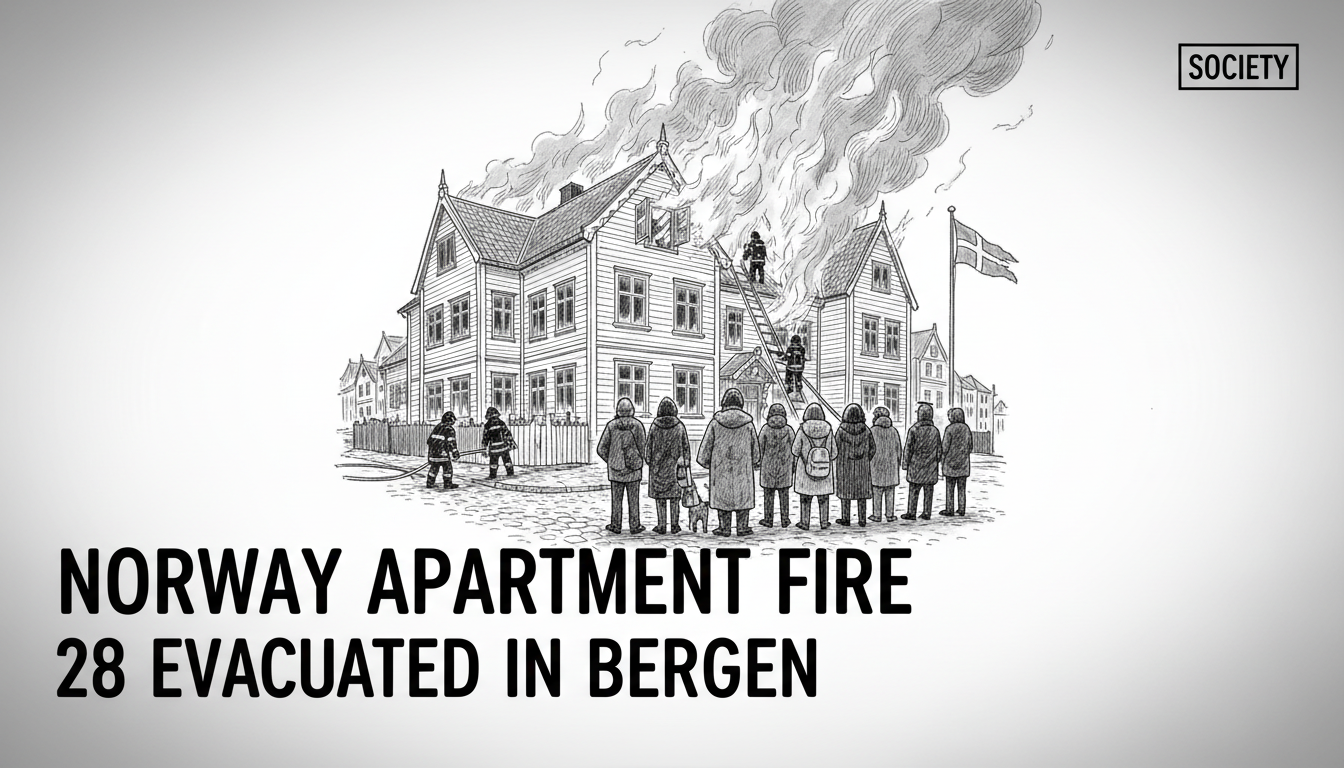
Bergen, Norway, saw 28 residents evacuated and one man hospitalized after a basement apartment fire erupted in the Årstad borough early Tuesday morning. The blaze, reported at 3:18 AM, was extinguished by 4:02 AM but left the basement unit completely gutted. Emergency services conducted a rapid evacuation, with most residents allowed to return home by dawn, though three remain displaced as police open an investigation into the cause.
A Sudden Awakening in Årstad
Residents of a quiet residential block in Årstad were jolted from sleep by alarms and commotion in the pre-dawn darkness. The call to emergency services came at 3:18 AM, reporting visible flames and smoke pouring from a basement-level apartment. Police and fire crews responded immediately. "We received a report of flames and smoke," said Operations Manager Steinar Hausvik of the West Police District. "We were quickly on the scene and began the evacuation." The coordinated effort saw all 28 residents of the building ushered to safety within minutes, a critical response in a confined, multi-occupancy structure.
The fire was declared out at 4:02 AM, less than an hour after it began. The speed of containment prevented a structural catastrophe, but the unit of origin suffered severe damage. "The apartment that burned is quite burnt out," Hausvik confirmed. The building, now secured by fire services, is undergoing ventilation and a final check for remaining hot spots—a process known as residual value security.
The Human Toll and Ongoing Response
The immediate human cost of the fire centers on one man, the occupant of the basement apartment. He was transported to Haukeland University Hospital, a major trauma center located conveniently in the same borough. Police confirmed he had suffered smoke inhalation but was conscious during the evacuation. His current condition remains undisclosed. For the other evacuees, the ordeal was thankfully shorter. Most were permitted to return to their homes once the building was deemed safe, a process completed in the early morning hours.
However, for three residents, the displacement continues. Damage from the fire, likely from smoke and water used to extinguish the blaze, has rendered their apartments temporarily uninhabitable. The Red Cross and municipal social services typically assist in such situations, providing short-term shelter and essential supplies. The police have formally opened a case to determine the fire's origin. This investigation will involve forensic technicians and fire safety experts examining the gutted basement for electrical faults, accidental causes, or other factors.
Fire Safety in the Norwegian Urban Landscape
This incident in Bergen casts a spotlight on residential fire safety, a perennial concern in densely populated urban areas. Norway has strict building codes, particularly for newer constructions, which mandate interconnected smoke alarms, fire-resistant materials, and clear escape routes. The effectiveness of these measures is often tested in older buildings, like many found in established neighborhoods such as Årstad. Basement apartments present specific challenges, including limited escape options and potential difficulty for fire crews to access the seat of a blaze.
"Every fire in a multi-family dwelling is a stark reminder of the non-negotiable importance of functional smoke detectors and a practiced evacuation plan," said a fire safety consultant familiar with Scandinavian standards, who spoke on background. "The rapid evacuation here suggests alarms functioned, but the investigation will scrutinize every aspect of the building's passive and active fire protection systems." Bergen's frequently wet climate, while reducing the risk of wildfires, does not diminish the threat from internal electrical faults or cooking accidents—two of the most common causes of residential fires nationwide.
The Årstad Context and Community Impact
Årstad is a central borough in Bergen, characterized by a mix of historic wooden houses, post-war apartment blocks, and modern developments. It is a residential hub with good amenities and transport links, home to a diverse population including students, families, and professionals. An event like an apartment fire disrupts the fabric of such a community. Neighbors who assisted in the evacuation or offered shelter to those displaced will feel the social aftershocks, even as the physical cleanup begins.
The proximity to Haukeland University Hospital undoubtedly played a role in the swift medical response for the injured man. The hospital is one of Norway's largest and is a key part of Årstad's identity. The borough's development pattern, with buildings of varying ages nestled together, is common in Norwegian cities and presents an ongoing challenge for uniform fire safety upgrades. Municipal authorities often run public awareness campaigns, especially during the dark, dry winter months when indoor fire risks peak.
Looking Ahead: Investigation and Prevention
The police investigation now underway will follow a standard protocol. Experts will methodically sift through the debris in the basement apartment, looking for ignition sources. They will examine electrical wiring, appliances, and any potential heat sources. The goal is not just to assign cause, but to gather data that can inform broader prevention efforts. If building code violations are found—such as faulty alarms or obstructed exits—the building's owner could face orders for mandatory upgrades and potential fines.
For the residents, the coming days will involve dealing with insurance companies, cleaning soot damage, and for three families, finding temporary new homes. The psychological impact of a sudden, traumatic evacuation should not be underestimated, even for those whose apartments were physically untouched. Community support services may offer counseling in the aftermath. For the building's management, the event will trigger a review of all fire safety equipment and possibly a mandatory inspection by the municipal fire chief.
This fire in Bergen, while fortunately not a mass-casualty event, serves as a critical real-world test of Norway's emergency response systems and residential safety norms. The successful evacuation of 28 people in the middle of the night points to effective first responder coordination. Yet, the hospitalization of one man and the displacement of others underline the ever-present vulnerability when fire breaks out in a home. The final report from the police investigation will answer the immediate 'how,' but the broader question of how to further harden older urban housing stock against such risks remains a continuous project for Norwegian cities.