
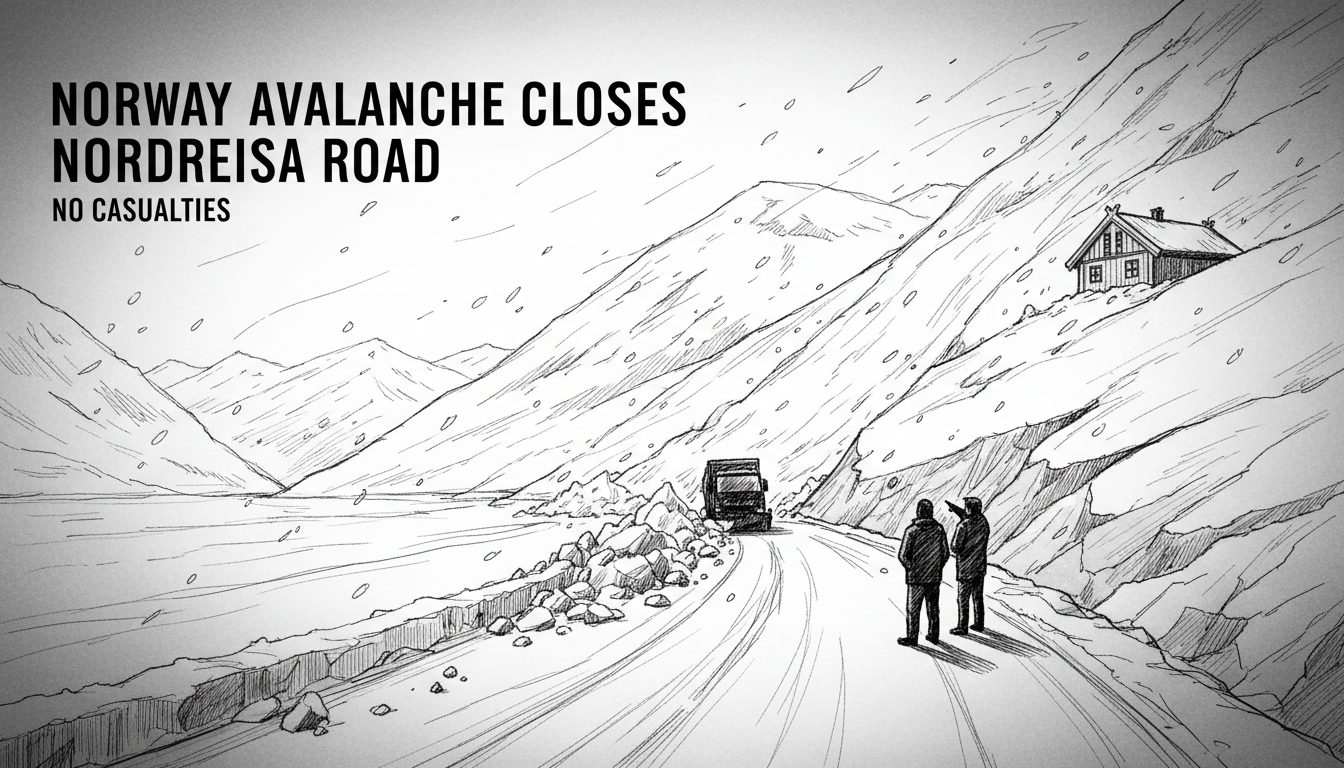
Norway's County Road 866 in Nordreisa municipality is blocked after a significant snow avalanche swept across the route between Bakkeby and Hamneidet early Saturday morning. The Troms Police District confirmed the closure, stating a geologist has been dispatched to assess the slope's stability. Initial reports indicate no persons or vehicles were caught in the slide, a stroke of fortune given the remote location and timing.
Operational leader Karl Erik Thomassen with the Troms Police District said authorities were notified immediately. The State Road Administration has been informed and will lead the clearing operation. For now, the vital local artery remains impassable, cutting off a direct link for residents in the scattered communities of this part of Troms county. The incident underscores the ever-present natural hazards facing Norway's extensive northern road network, particularly during the volatile spring transition period.
A Routine Hazard in a Rugged Landscape
Avalanches closing roads are a familiar, if disruptive, winter reality across mountainous Norway. The Norwegian Water Resources and Energy Directorate (NVE) registers several thousand avalanches annually. While most occur in unpopulated areas, hundreds impact infrastructure. The risk spikes dramatically during and after heavy snowfall or rapid temperature increases that destabilize snowpack. The Nordreisa region, with its steep fjord-side terrain, is notoriously prone to such events. Local authorities and the NVE maintain detailed avalanche forecasting and warning systems, but the dynamic nature of snow science means absolute prevention on all road stretches is impossible.
“This is precisely the type of scenario our models try to predict,” said a senior advisor from the NVE's avalanche forecasting department, speaking on background about general avalanche risks. “A road cut into a steep slope, a heavy snow load, and specific weather conditions create a predictable danger. The key is communicating that risk effectively to the public and ensuring infrastructure managers are prepared to respond.” The advisor emphasized that the absence of casualties in this event points to successful risk management, likely through prior warnings or the inherent low traffic volume at the time.
The Ripple Effect of a Closed Road
While no one was hurt, the closure of Fv. 866 creates immediate logistical headaches. This is not a major national highway but a critical county road connecting communities. For residents, it means longer, alternative routes for work, school, and supplies. For commerce, it disrupts the flow of goods. The local branch of the State Road Administration now faces a complex task: clearing thousands of tons of snow and debris without triggering secondary slides, all while ensuring the safety of their work crews.
The geologist's assessment is the first critical step. They will examine the fracture line, the stability of the remaining snow on the slope above the road, and the underlying geology. Only after they give an all-clear can heavy machinery begin work. This process can take hours or days, depending on the assessed risk and weather conditions. “Our priority is always safety, for the public and our workers,” said a road administration operations manager. “We will not send people in to clear the road if the mountain is still unstable. Patience is necessary.”
Norway's Continuous Battle with Snow
Norway invests heavily in avalanche mitigation, a national necessity. Measures range from passive land-use planning—avoiding building in high-risk zones—to active defenses. These include snow fences to prevent drift accumulation on slopes above roads, controlled avalanche triggering using explosives or artillery, and permanent defensive structures like deflection dams and snow sheds. The famous snow sheds covering sections of the E6 highway in Troms and Nordland counties are direct responses to historical avalanche threats.
For less trafficked roads like Fv. 866, such permanent, expensive infrastructure is often not feasible. Reliance falls on monitoring, forecasting, and temporary closures. The country's avalanche forecasting service, varsom.no, provides detailed daily risk levels on a five-scale map, crucial information for both road authorities and the public. Today’s incident will become another data point, informing future risk models for this specific stretch of road. It may prompt a review to see if additional mitigation, like improved avalanche zoning or signage, is warranted.
The Human Factor in Avalanche Country
Beyond the engineering and science lies a cultural adaptation. Northern Norwegians live with a deep, pragmatic awareness of avalanche risk. They check forecasts, heed road closure signs, and maintain a level of preparedness. Local knowledge is invaluable; understanding which slopes are “hungry” after certain wind directions is passed down. This incident, while disruptive, fits into a pattern of life where nature dictates terms for part of the year.
The successful response—no casualties, swift agency coordination—highlights a well-practiced system. Police, road authorities, and geologists have clear protocols. The communication chain functioned. This operational efficiency is the result of hard-learned lessons from past tragedies where avalanches have struck buildings or roads with catastrophic results. Each non-fatal event reinforces and tests the system, proving its worth.
Looking Ahead: Spring Brings Heightened Risk
The coming weeks present one of the most dangerous avalanche periods in Norway. Spring sunshine warms south-facing slopes, weakening the bond between snow layers. Rain can percolate through the snowpack, further lubricating slide planes. This wet-snow avalanche cycle is distinct from the dry powder avalanches of deep winter and can be particularly destructive. The Nordreisa avalanche serves as a timely reminder of this seasonal shift in hazard.
Authorities will be on high alert. The focus will remain on protecting life first, property second. For travelers, the advice is consistent: check road status (vegvesen.no) and avalanche forecasts (varsom.no) before any journey in mountain areas. Have emergency supplies in your vehicle, including warm clothing and food. Do not ignore closure barriers; they are placed by experts assessing a direct threat.
As the geologist surveys the scar on the hillside above Fv. 866 and crews wait for the order to move in, the community adapts. The road will reopen, likely within a day or two. Traffic will resume. But the mountain's sudden reminder of its power will linger, a quiet acknowledgment in the coffee shops and homes of Nordreisa that in this spectacular landscape, vigilance is the permanent price of admission. The real story here is not the avalanche itself, but the uneventful, professional response that prevented it from becoming a disaster. In a nation defined by its dramatic geography, that is the ultimate measure of resilience.