
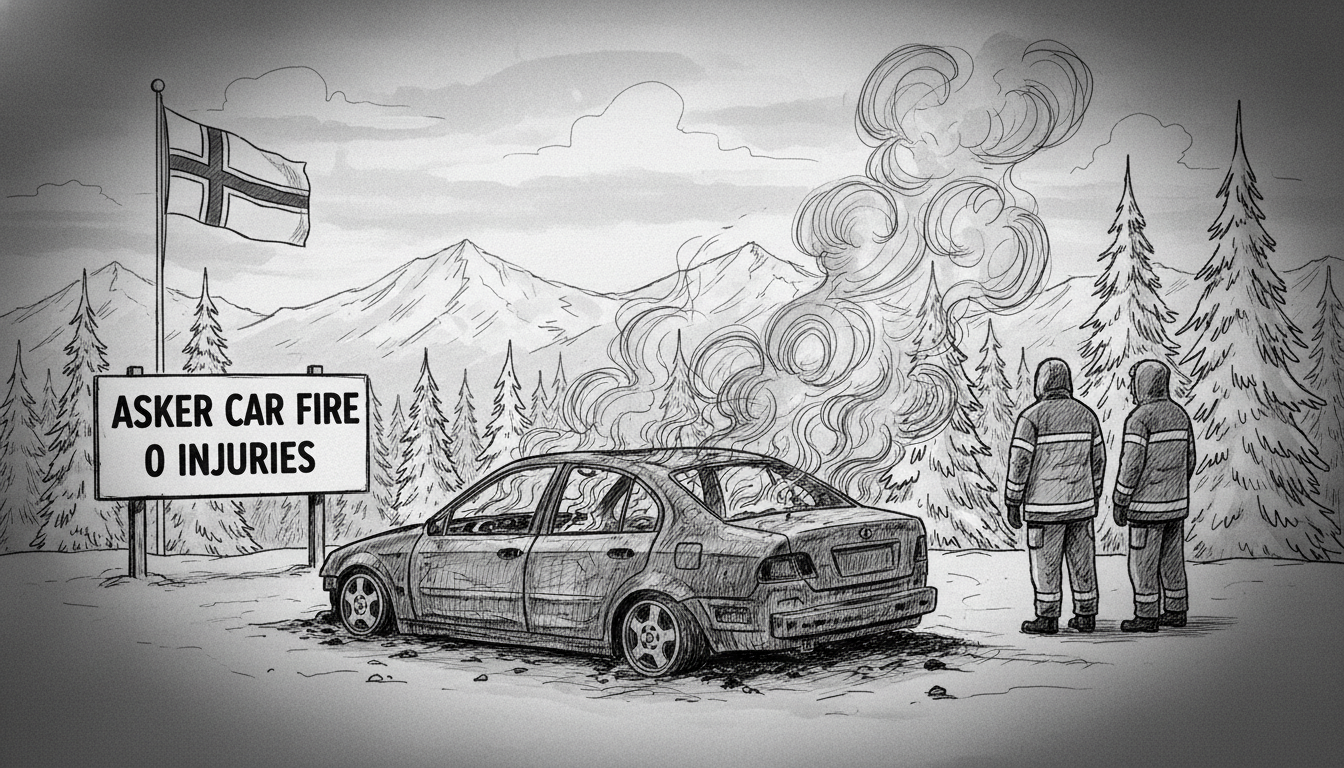
Norway police responded to a car fire in the affluent municipality of Asker, southwest of Oslo, on Tuesday evening. Operations leader Alexander Østerhaug confirmed the vehicle was parked when the blaze began and reported no personal injuries. The incident, while contained, has drawn attention to vehicle safety and emergency response protocols in one of the Oslo region's most well-known suburbs.
Fire crews from the Asker Fire and Rescue Service arrived at the scene shortly after the alarm was raised. Their quick action prevented the fire from spreading to nearby vehicles or property. The charred remains of the vehicle, described by witnesses as a mid-sized sedan, were left smoldering as investigators began their initial assessment. "Our first priority is always life safety," Østerhaug said in a statement. "With that secured, we focus on containing the damage and determining the cause."
A Routine Emergency in an Affluent Enclave
Asker, part of Viken county, is known for its high standard of living, forested hills, and coastline along the Oslofjord. Incidents like this car fire are statistically uncommon in the municipality, which typically reports lower crime rates than national averages. This contrast makes such an event more noticeable to residents accustomed to quiet, orderly streets. The fire occurred in a residential area, not far from the commercial center of Asker town, causing a brief but significant disruption.
Local resident Henrik Larsen observed the emergency response from his home. "You see the flashing lights and smell the acrid smoke, and it immediately creates a sense of unease," he said. "It's not something we're used to seeing here. Everyone's first question was if someone was hurt." The confirmation of no injuries brought relief to the neighborhood, shifting focus to material damage and cause.
The Complex Investigation into Ignition Sources
Determining the origin of a vehicle fire is a meticulous process. Investigators from both the police and the fire service will examine the wreckage. Common causes include electrical system failures, faults in the fuel line, overheating components, or problems with the battery, especially in modern vehicles with complex electronics. In Norway's climate, rodents seeking warmth sometimes chew through wiring, creating short circuits. While accidental causes are most frequent, investigators must also consider the possibility of deliberate arson.
"Every fire tells a story, and our job is to read the evidence," explained a veteran fire investigator with the Norwegian Directorate for Civil Protection, who spoke on background about general procedures. "The burn patterns, the point of origin, the state of specific components—these are all clues. In a case with no injuries, we have more time to be thorough." The vehicle will likely be transported to a secure facility for a detailed technical examination. Police have not indicated any immediate suspicion of criminal activity.
Vehicle Safety and Prevention in the Norwegian Context
This incident serves as a reminder of vehicle fire risks, albeit small. The Norwegian Public Roads Administration (Statens vegvesen) recommends regular vehicle maintenance as the primary preventative measure. Worn wiring, leaking fluids, and poor electrical repairs are significant risk factors. For electric vehicles (EVs), which have a growing market share in Norway, fire protocols differ slightly due to battery thermal runaway risks, though such fires are rare.
"Most vehicle fires start in the engine compartment or near the wheels due to friction or electrical faults," the investigator noted. "A smell of burning plastic or rubber, smoke from the dashboard, or oil leaks onto hot surfaces are warning signs. Drivers should pull over safely, turn off the ignition, evacuate, and call the emergency number 110 for the fire service immediately."
Community Response and Systemic Reliability
The efficient response in Asker highlights Norway's integrated emergency system. The 110 emergency number connects callers to police, fire, and medical services. Local fire departments, often staffed by a combination of professional and dedicated part-time personnel, maintain high readiness standards. In Asker, proximity to major roads like the E18 and the presence of the Asker Fire Station ensure short response times.
This system is tested more frequently in urban centers like Oslo or in industrial settings involving Norway's oil and gas sector. A residential car fire in a peaceful suburb is a lower-intensity test of coordination between police, who secure the scene, and fire crews, who extinguish the blaze. Their performance in this incident appears to have been seamless, limiting consequences to property damage.
The Broader Picture for Oslo Region Crime and Safety
While a single car fire is minor, it enters the ledger of daily incidents managed by Viken police. The Oslo region remains one of Norway's safest metropolitan areas by global standards. Isolated property crimes or damage do not alter that fundamental fact. However, they engage community attention and public resources.
For the vehicle's owner, the next steps involve insurance claims and dealing with a total loss. For authorities, the case file will remain open until a probable cause is established. If the cause is deemed accidental, the file will be closed. If evidence points to arson, a criminal investigation will commence, which would be an unusual event for Asker.
A Contained Incident with Standard Procedures
The Asker car fire concluded without injury or major disruption. It was a controlled emergency in a municipality well-equipped to handle it. The blackened vehicle on a tidy street will be the most lasting visual for residents, a temporary scar on the community's calm facade. By Wednesday morning, the scene was cleared, leaving only the investigation ongoing behind the scenes.
Such events, while minor, reinforce the value of emergency services often taken for granted in peaceful communities. They also underscore that mechanical failures can occur anywhere, regardless of a neighborhood's affluence or reputation. The true measure of safety is not the absence of incidents, but the capacity to manage them effectively when they arise. Asker's response provided a textbook example of that capacity in action, ensuring a small fire remained just that—a small fire, and not a tragedy.