
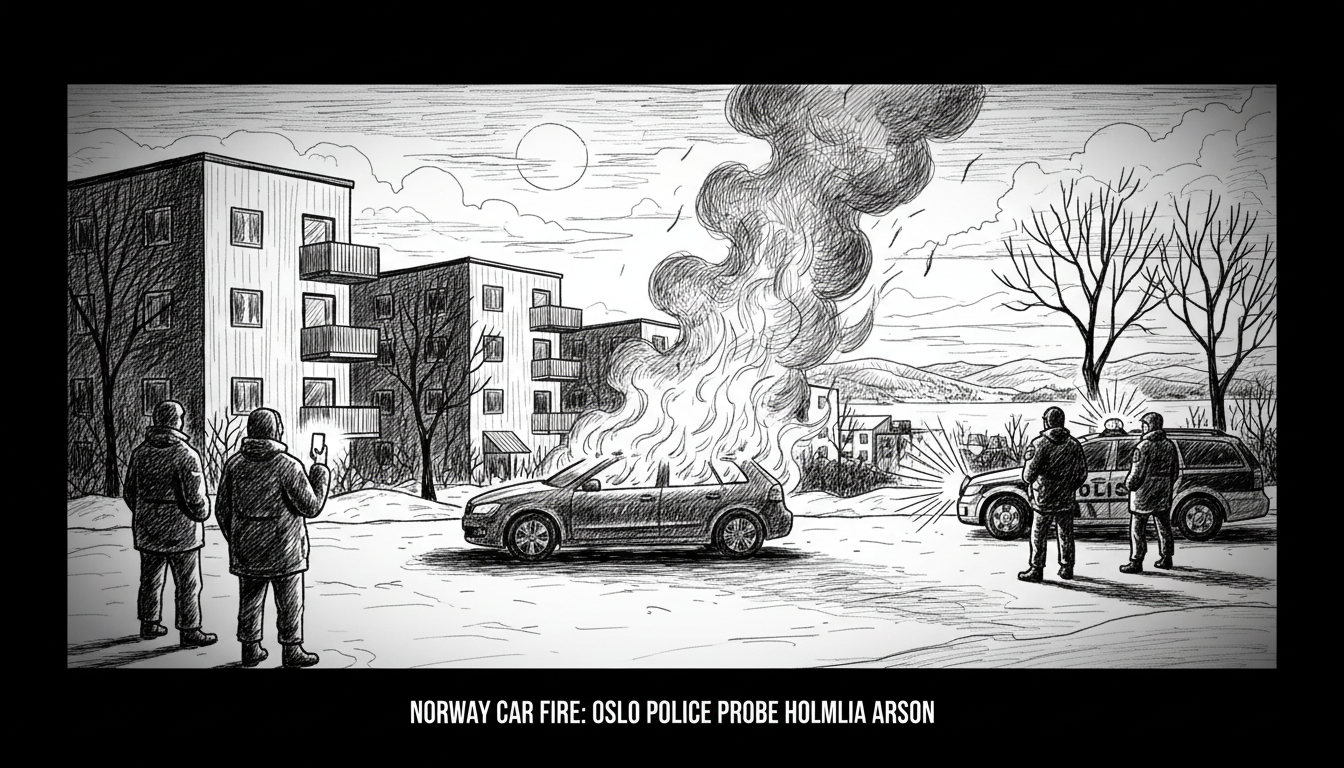
Norway's capital saw another vehicle destroyed by fire early Saturday morning in the suburban district of Holmlia. Oslo police are investigating the blaze, which erupted in a parked car near the Holmlia train station shortly after 3 AM. The fire was reported extinguished by 3:24 AM, but officials have not ruled out the possibility of arson.
"We do not know why the fire started in the car," said operations manager Bjørn Gunnar Nysæter of the Oslo Police District. He stated there were no obvious signs the fire was deliberately set, but confirmed investigators cannot exclude that scenario. The case will be formally investigated to determine its origin.
The incident occurred in a residential area south of Oslo's center, casting a brief, violent glow in the quiet night. For residents awakened by sirens, it was a jarring disruption. For police, it represents another entry in the log of vehicle fires that periodically flare up in urban and suburban neighborhoods across the country.
A Recurring Urban Challenge
Car fires are a persistent, if sporadic, issue in Norwegian cities. They occupy an ambiguous space between major crime and petty vandalism. Causes typically fall into three categories: accidental mechanical or electrical failure, deliberate acts of arson often linked to vandalism or disputes, and insurance fraud.
Determining the exact cause requires careful forensic work. "A vehicle fire can be challenging to investigate," explains a former fire investigator with the Norwegian Directorate for Civil Protection (DSB), who spoke on background about general procedures. "Modern cars contain a lot of plastic and synthetic materials that burn hot and fast, often destroying key evidence. Investigators look for ignition sources, patterns of burn spread, and signs of accelerants."
In cases where arson is suspected but not obvious, the investigation often hinges on eliminating accidental causes. This involves examining the vehicle's maintenance history, any recent repairs, and the state of its electrical systems. Without clear indicators like broken windows or the smell of gasoline, the investigation into the Holmlia fire may take time.
The Holmlia Context
The fire occurred in Søndre Nordstrand borough, one of Oslo's most diverse areas. Holmlia itself is a residential neighborhood developed primarily in the 1970s and 80s, known for its functional apartment blocks and green spaces. It has a higher-than-average proportion of immigrant residents compared to the city as a whole.
Sociologists caution against drawing quick links between demographics and crime. "Isolated incidents of vandalism or arson occur in all types of neighborhoods," says Dr. Lena Larsen, a sociologist at the University of Oslo who studies urban communities. "Attributing a single car fire to broader social factors in an area is reductive and often inaccurate. These are individual criminal acts, not neighborhood traits."
Local politicians in Søndre Nordstrand have previously focused on issues like youth activity, employment, and community building to improve overall safety and cohesion. A single car fire, while alarming for nearby residents, is unlikely to shift those broader policy discussions unless it proves to be part of a targeted pattern.
The Investigative Path Forward
The Oslo Police District's follow-up will be methodical. Officers will likely begin by securing any available CCTV footage from the Holmlia station area and nearby buildings. They will conduct a technical examination of the vehicle's remains, which may be moved to a secure facility for analysis.
Insurance companies also play a role. If the vehicle was insured, the company will conduct its own parallel investigation to rule out fraud. A total loss from a fire typically triggers a detailed review of the owner's financial circumstances and the vehicle's value.
For now, police are keeping an open mind. The absence of "obvious signs" of arson mentioned by Operations Manager Nysæter could point toward an accidental cause. However, the timing—in the early hours of Saturday morning—and the location are factors that investigators will weigh heavily. Nighttime hours often see a higher incidence of vandalism and deliberate property damage.
Broader Implications for Urban Safety
While statistically rare, car fires impact the public's sense of security. A burning vehicle is a dramatic, visceral event that suggests a breakdown of order. It can make residents question the safety of their own property parked on the street.
From a municipal resource perspective, such incidents demand a disproportionate response. Multiple emergency service units—police, fire, and sometimes ambulance—are deployed for what is ultimately a property crime. The cost of the response, investigation, and cleanup is borne by the public.
Norway does not have a specific national statistic tracking deliberately set car fires separately from accidental ones. They are generally categorized under arson or vandalism in crime reports. This makes it difficult to assess trends, though police districts monitor local patterns.
In Oslo, police have previously cracked down on serial arsonists or gangs using car fires as intimidation. There is no indication yet that the Holmlia fire is connected to any such organized activity. It currently stands as an isolated, unexplained event.
A Community's Response
The practical impact for Holmlia residents is likely minimal beyond the immediate shock. The fire was extinguished quickly, preventing spread to other vehicles or property. The train station, a key transport hub for the area, was unaffected.
However, the psychological residue of such an event lingers. It feeds into narratives about neighborhood safety, whether accurate or not. Community watch groups and local tenant associations often become more vigilant in the wake of such incidents, urging residents to report suspicious activity.
Oslo's municipal government, through its district councils, occasionally reviews street lighting and CCTV coverage in response to vandalism. A serious arson finding in this case could prompt such a review in the vicinity of Holmlia station.
The Road to a Conclusion
Police have not provided a timeline for the investigation. The process is not swift. Forensic analysis takes time, and officers must compile all available evidence before reaching a conclusion. The owner of the vehicle will be interviewed extensively.
Unless clear evidence of a crime emerges, the case may eventually be archived as "cause undetermined." This is a common outcome for vehicle fires where the evidence is too damaged to support a definitive finding. For the residents of Holmlia, the sight of a charred car shell served as a reminder of the unpredictable nature of urban life. For the authorities, it is another puzzle to solve, a small flame in the night that demands an explanation.
The final determination will carry different consequences. An accident brings closure. A finding of arson opens a criminal case, with all the scrutiny and search for a perpetrator that entails. Until then, the question hangs in the air, much like the smoke that dissipated over Holmlia before dawn.