
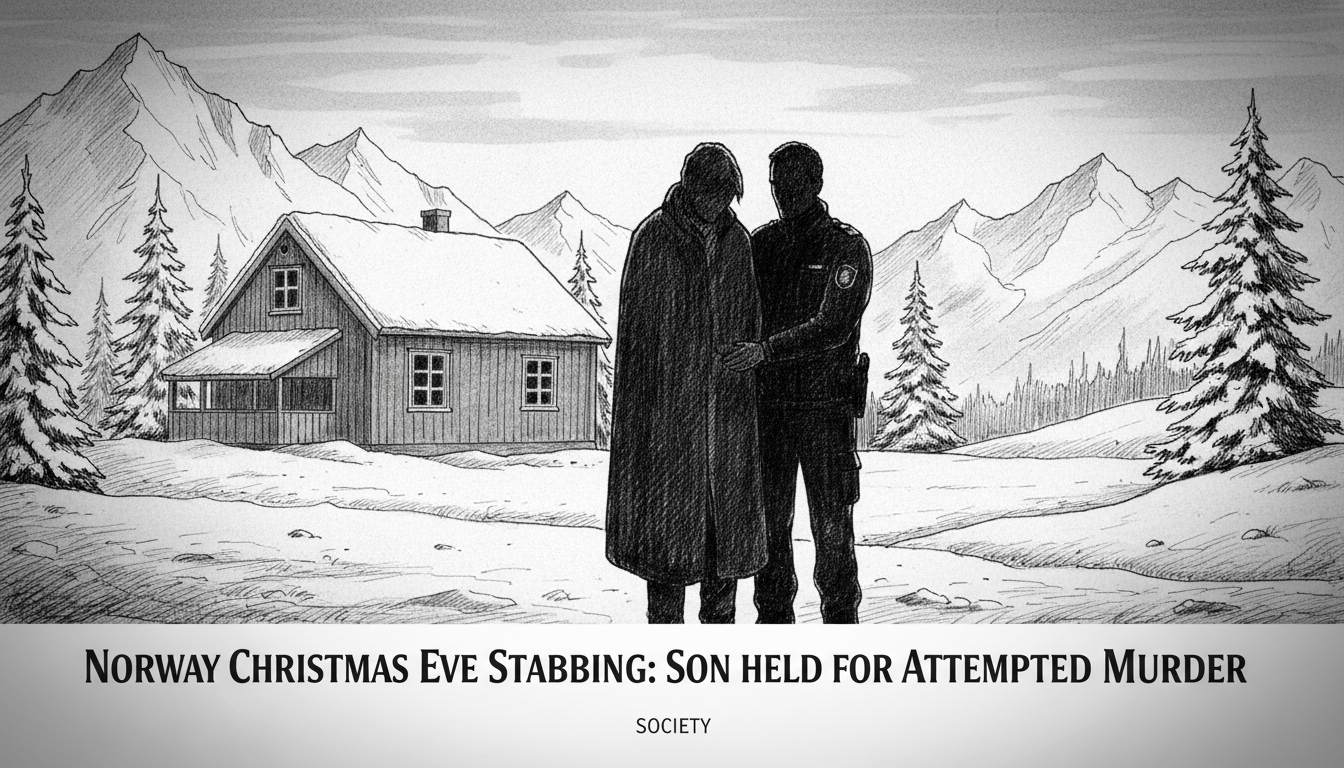
Norway's peaceful Christmas Eve was shattered by a violent family incident in the coastal city of Arendal, where a man in his 30s is now held in custody for the attempted murder of his father. The suspect, whose identity remains confidential under Norwegian law, faces a preliminary charge of attempted murder after initially being suspected of grievous bodily harm. Police prosecutor Sondre Kristian Halvorsen confirmed the upgraded charge, stating the investigation uncovered sufficient evidence to support the more serious allegation. This case presents a stark contrast to Norway's typically low violent crime statistics and raises difficult questions about domestic conflict during the holiday season.
A Festive Night Interrupted
Emergency services responded to a residence in Arendal on the evening of December 24th following reports of a violent assault. The victim, a man in his 70s, had sustained serious knife wounds. He was transported to a local hospital for emergency treatment. Police have not disclosed his current medical condition, citing privacy concerns for the victim and the ongoing investigation. The suspect was apprehended at the scene without further incident. "The charge is based on information we have obtained in connection with the investigation of the case – both when the police arrived at the scene, and statements given during questioning," Halvorsen said in a statement. The court has ordered the suspect held in custody for two weeks while the police investigation continues, a standard procedure for serious violent crimes in Norway.
The Norwegian Justice System's Approach
This case will now navigate Norway's distinctive criminal justice system, which balances punitive measures with a strong emphasis on rehabilitation. Attempted murder carries a maximum prison sentence of 21 years, though actual sentences are typically lower and heavily influenced by specific circumstances. A key component will likely be a forensic psychiatric evaluation of the suspect. Norwegian courts routinely order such assessments in serious violent cases to determine the perpetrator's mental state at the time of the crime and their current mental health needs. The outcome can significantly influence whether a sentence is served in a traditional prison or a secure psychiatric institution. "The system's first priority is public safety, which is why custody is used," explains a legal scholar familiar with Norwegian procedure. "But the subsequent focus shifts to understanding the 'why' behind the act, which informs the sentencing and rehabilitation plan."
Domestic Violence in a Low-Crime Society
Norway consistently records one of the world's lowest homicide rates, at approximately 0.5 per 100,000 inhabitants in 2022. However, like all nations, it grapples with domestic violence. Statistics Norway (SSB) data shows fluctuations in reported cases of serious bodily harm, with a portion occurring within family settings. Experts note that holiday periods can sometimes exacerbate underlying family tensions, financial stress, or mental health crises, though they caution against simplistic seasonal explanations. "A violent incident of this severity within a family is always a complex tragedy," says a researcher at the Norwegian Centre for Violence and Traumatic Stress Studies. "It points to a profound breakdown in relationships and possibly untreated mental health or substance abuse issues that have escalated over time, not merely a spontaneous Christmas argument." The privacy-focused nature of Norwegian law means detailed public information about the family's history or potential motives may never be released.
The Arendal Community and Aftermath
Arendal, a picturesque city on Norway's southern coast known for its wooden houses and archipelago, is a tight-knit community. News of the Christmas Eve stabbing has reverberated through the city of 45,000 inhabitants. Local officials have emphasized the availability of support services for those affected by the trauma, including neighbors and first responders. The case serves as a somber reminder that severe domestic violence can occur anywhere, even in societies with strong social safety nets and high overall well-being. Norway has invested significantly in public support systems, crisis centers, and intervention programs aimed at preventing domestic violence. This incident will likely prompt local discussions about whether those resources are sufficiently accessible and known to all citizens.
A Long Legal Road Ahead
The suspect's two-week custody period is just the beginning of a potentially lengthy legal process. Police will use this time to gather forensic evidence, conduct further interviews, and compile a comprehensive report for the prosecuting authority. The case will then be reviewed, and a formal indictment may be filed. Given the severity of the charge, a trial would likely take place in the Agder District Court. Both the defense and prosecution would present their cases, with the court placing heavy weight on the psychiatric evaluation and the detailed narrative of events. The focus will be on establishing intent, a crucial element for an attempted murder conviction. The court must determine if the suspect acted with the specific purpose of taking his father's life.
Rehabilitation Versus Retribution
This case encapsulates a central tension in the Norwegian justice philosophy. The public expects a firm response to a violent attempted murder, especially one violating the familial bond. Simultaneously, the system is designed to rehabilitate offenders for eventual reintegration into society. Sentencing will consider all mitigating and aggravating factors. The court will examine the suspect's background, any previous criminal record, his remorse, and the detailed circumstances leading to the attack. The victim's wishes regarding prosecution and sentencing may also be consulted, though the state ultimately prosecutes serious crimes independently. The final sentence will aim to reflect societal condemnation while holding a realistic possibility for the offender's future change. This restorative approach is a cornerstone of Norwegian law but is tested in severe cases of domestic violence.
A Sobering Start to the New Year
As Arendal and Norway move past the holiday season, this tragedy leaves a lasting mark. It disrupts the national self-image of a peaceful, orderly society and confronts the uncomfortable reality of hidden familial strife. The legal proceedings will unfold methodically over the coming months, away from the intense media spotlight common in other countries. The victim faces a physical and psychological recovery journey, while the accused son confronts the consequences of his alleged actions within a justice system that will also seek to understand him. This Christmas Eve stabbing is more than a crime statistic; it is a human story of catastrophic failure within a family, set against the backdrop of a society that believes deeply in the possibility of healing and second chances, even for the gravest of acts. The question for Norway is not just how to punish this act, but how to prevent similar familial ruptures from reaching such a violent point in the future.