
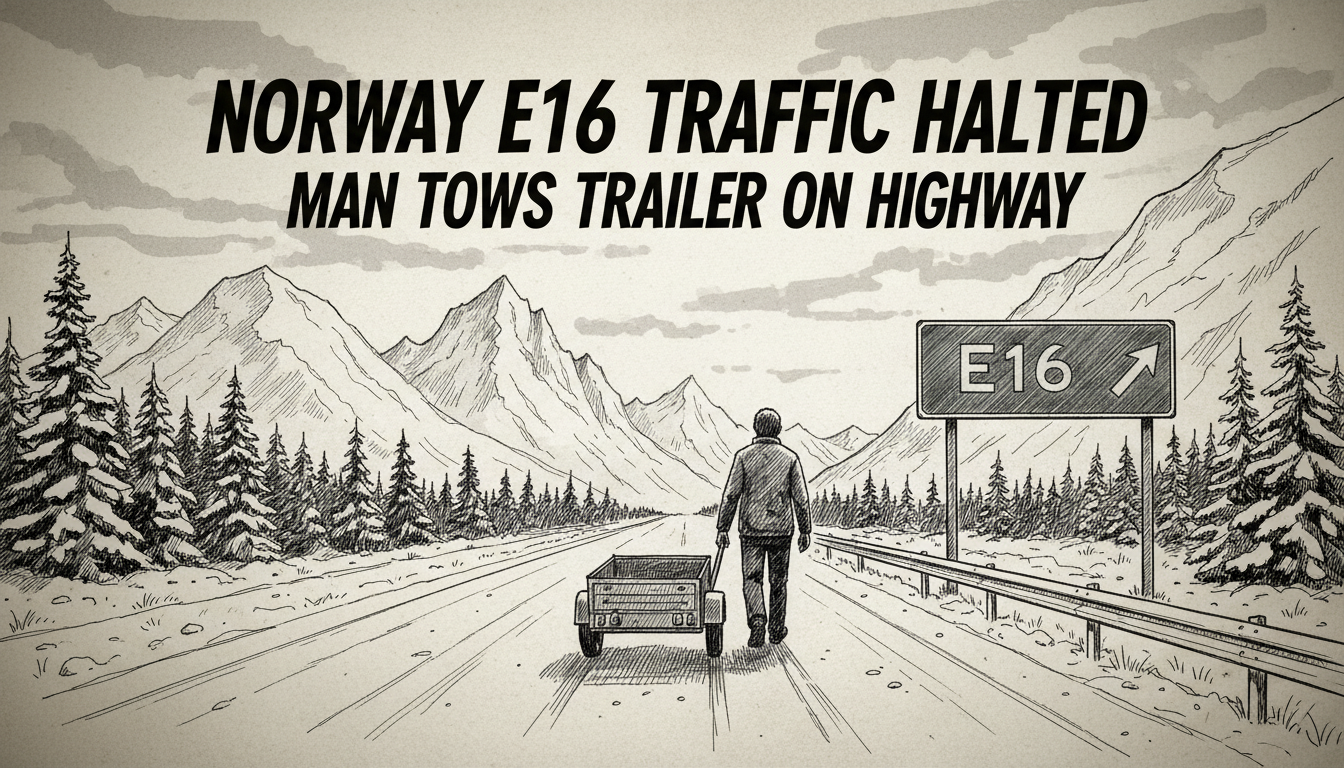
Norway's E16 highway faced major disruptions Tuesday morning after a man was seen towing a trailer by hand along the busy roadway near Kongsvinger. The Innlandet Police District received multiple reports of the individual walking along the highway near the railway station, prompting an immediate response. Police stated the incident would create significant traffic challenges as they moved to assist.
A Major Artery Brought to a Crawl
The E16 is one of Norway's most critical transport corridors, stretching approximately 630 kilometers from Oslo to Bergen. It serves as a vital link for freight, tourism, and daily commuters, particularly through the eastern regions. The incident near Kongsvinger, a municipality in Innlandet county close to the Swedish border, occurred on a section of road that typically handles dense, high-speed traffic. Even minor obstructions on such routes can cause kilometers of tailbacks and substantial economic knock-on effects due to delayed logistics.
Police did not immediately disclose the man's motives or what the trailer contained. Their primary concern was securing the scene to prevent a serious accident. "This will create some traffic challenges. We are on our way to see what we can assist with," the Innlandet Police District wrote in their official log. The response likely involved patrol cars with flashing lights slowing traffic, potentially creating a rolling roadblock to ensure the man's safety and that of other road users.
Expert Analysis of the Extreme Risk
Road safety experts express profound concern over such incidents. "Walking on a motorway like the E16 is illegal and exceptionally dangerous," said a traffic safety consultant familiar with Norwegian roads, who requested anonymity as they were not directly involved in the case. "The speed differential is enormous. Drivers are not expecting a pedestrian, especially one moving slowly with a large object. The risk of a catastrophic collision is extremely high."
The consultant explained that highways like the E16 are engineered for vehicular traffic, with design elements that can actually reduce a driver's ability to spot stationary or slow-moving obstacles on the shoulder. Combine this with high speeds and potential driver fatigue, and the situation becomes a recipe for disaster. The trailer itself would have compounded the danger, making the individual less maneuverable and more visible, but also a larger target.
From a traffic management perspective, the incident highlights the vulnerability of key infrastructure. "Norway's geography means we rely heavily on a few major routes," the consultant added. "The E16, E6, and E18 are like the country's main arteries. A blockage, even a partial one, causes immediate congestion and has a ripple effect on connecting roads and local networks around towns like Kongsvinger."
Police Protocol and Public Responsibility
The Innlandet Police District's handling of the situation follows standard Norwegian protocol for hazardous obstructions on major roads. The priority is always human safety—first for the individual at risk, then for motorists. Officers are trained to secure such scenes methodically, often requiring a full or partial closure of lanes to create a safe perimeter. This protocol, while necessary, is precisely what leads to the significant delays mentioned in the police statement.
This incident also raises questions about public intervention. The fact that police received "several reports" from other drivers is a positive sign of civic responsibility. In Norway, drivers are encouraged to report dangerous situations immediately via the emergency number 112 or the non-emergency police line 02800. Providing clear information about location, direction of travel, and a description of the hazard is crucial for a swift response.
However, experts strongly advise against civilians attempting to intervene directly on a high-speed road. The correct action is to call authorities from a safe location, such as a rest area or after exiting the highway. Well-intentioned but unsafe actions by other drivers—like stopping on the roadway—can create additional hazards.
The Broader Context of Roadside Vulnerabilities
While uniquely bizarre, this event touches on broader issues of roadside vulnerability in Norway. It intersects with ongoing discussions about mental health crises, homelessness, and the infrastructure for pedestrian safety. Not all who walk on highways are doing so for transportation; some are in acute psychological distress. Police responses are increasingly integrating mental health first aid and crisis negotiation techniques, though the immediate imperative on a highway remains traffic safety.
Furthermore, Norway's extensive highway network sometimes traverses areas with limited alternative pedestrian routes, a legacy of its challenging terrain. While it is illegal and never safe to walk on motorways, gaps in local pedestrian infrastructure can sometimes lead to desperate or ill-advised decisions, though this does not appear to be a factor in this specific Kongsvinger case.
The incident also serves as a stark reminder for all drivers. It underscores the importance of maintaining full attention, especially on seemingly open roads. An unexpected obstacle can appear with little warning. Defensive driving principles, like scanning ahead and being prepared for the unpredictable, are essential.
Resolution and Lingering Questions
By Tuesday afternoon, the situation on the E16 was resolved. Police successfully removed the man and his trailer from the roadway. Traffic normalized, though likely after hours of delays for thousands of motorists. The police have not released further details about the individual's identity or condition, nor any potential charges he might face. Charges could range from violating the Road Traffic Act by endangering others to more serious citations depending on the circumstances.
The lack of initial information is standard; Norwegian authorities typically release personal details only if there is a pressing public interest or after legal proceedings have begun. The focus of their public communication was on managing the traffic hazard and public safety, which is the correct priority.
This peculiar event on the E16 near the Swedish border will likely be a brief, curious item in the local news cycle. Yet it perfectly illustrates how fragile our complex transport systems can be. A single individual, making a profoundly dangerous choice, can disrupt the daily rhythm of an entire region. It forces us to consider the balance between individual action and collective safety on the shared spaces we all depend upon. What drives a person to such a risky act on one of Norway's busiest roads, and how can systems be designed to be both efficient and resilient to the utterly unexpected? The people stuck in Tuesday's traffic jam were certainly asking the first question. Transport planners must grapple with the second.