
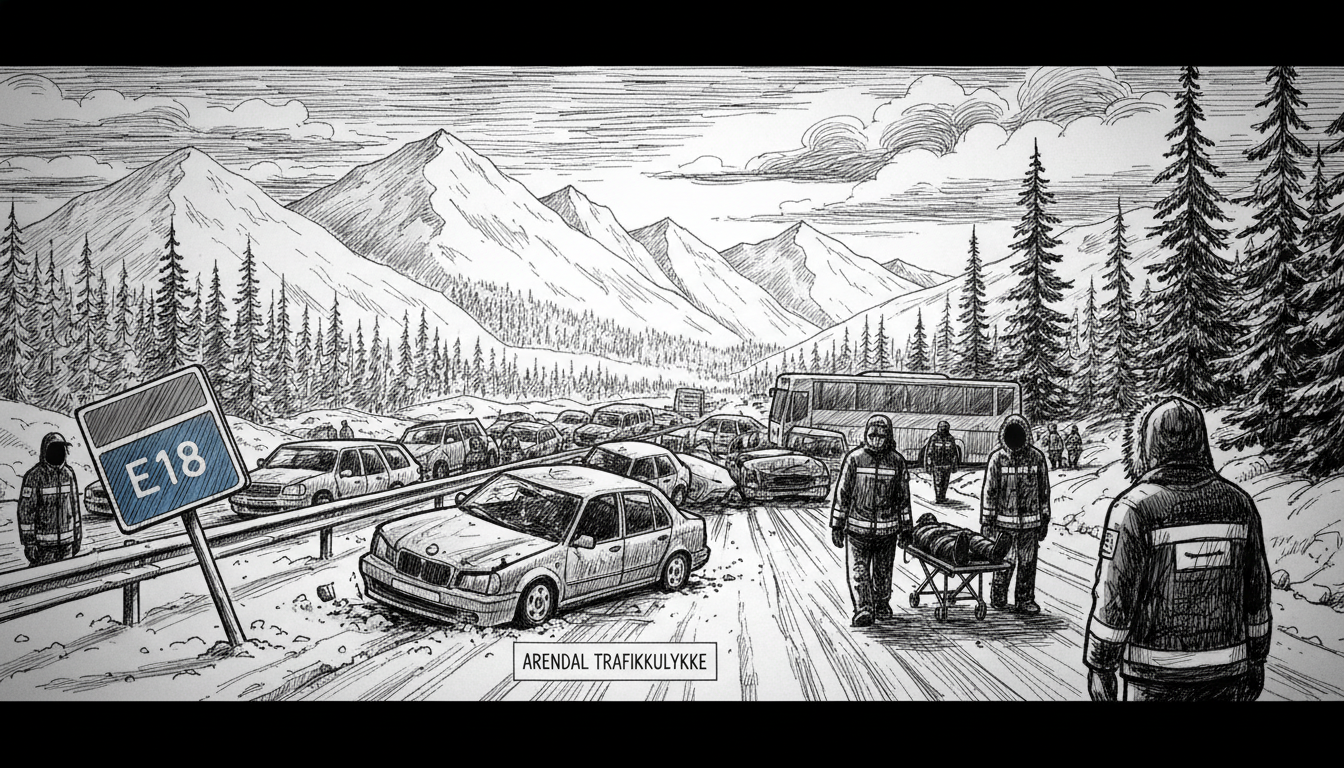
Norway's E18 highway saw a serious crash in Arendal when a single vehicle drove into stationary traffic. One person sustained what police described as potentially serious injuries and was transported to hospital. The incident highlights persistent safety challenges on one of the nation's busiest roads.
Operational manager Frode Vang of the Agder Police District confirmed the details in a police log. The driver was alone in the vehicle that collided with the queue. Emergency services responded quickly, managing the scene and facilitating the medical transfer. The crash caused significant delays on the vital southern corridor during a busy period.
A Recurring Hazard on a Vital Artery
The E18 is a cornerstone of Norway's southern infrastructure, connecting Oslo to Kristiansand and serving as a European route. Its high traffic volume, especially during holidays and peak commuting times, makes stationary queues a common and dangerous hazard. Accidents like this one disrupt freight, travel, and daily life across several counties.
In 2022, Norway recorded 117 fatal road accidents. While the country maintains a strong overall safety record, the Norwegian Public Roads Administration (Statens vegvesen) continuously works to reduce severe crashes. Their strategy combines targeted infrastructure upgrades with public awareness campaigns focusing on driver behavior.
The Sudden Stop Scenario
Road safety experts point to accidents involving stationary traffic as particularly preventable. "These are often high-energy impacts," explains a traffic safety researcher from the Institute of Transport Economics, who requested anonymity as the investigation is ongoing. "The differential speed between a moving vehicle and a stopped queue is severe. It demands constant vigilance, safe following distances, and speed appropriate to conditions."
Common contributing factors investigators will consider include driver distraction, fatigue, and excessive speed for the prevailing traffic flow. Road conditions, including visibility and surface quality at the specific Arendal location, will also form part of the official police review. The psychological impact on other motorists witnessing the collision is another, often overlooked, consequence.
Infrastructure and the Human Factor
Norway invests heavily in road safety engineering. This includes improved signage, rumble strips, and the development of motorway-standard sections with divided carriageways. However, the E18 still contains older sections where traffic flows mix more freely, creating potential conflict points. The stretch near Arendal features a mix of landscapes, from open roads to more constrained passages.
The human element remains the most variable factor. Norwegian driver education emphasizes defensive driving, but complacency on familiar routes can set in. "We adapt to our daily routes," the researcher notes. "The brain can go on autopilot. A sudden, unexpected stop requires immediate cognitive processing and physical reaction. Sometimes, that reaction comes too late."
Economic and Social Ripple Effects
Beyond the immediate human cost, such accidents have tangible economic impacts. The E18 is a critical logistics route for goods moving between Oslo and the southern ports. Delays caused by accident investigation and cleanup ripple through supply chains. For local commuters and travelers, hours lost in congestion represent lost productivity and personal time.
The incident also strains emergency service resources. Police, ambulance, and potentially fire crews are deployed, while traffic management teams must redirect vehicles. In coastal regions like Agder, alternative routes are often limited, amplifying the disruption across the regional road network.
A National Focus on Vision Zero
Norway, like its Nordic neighbors, adheres to the Vision Zero policy, which aims to eliminate all traffic fatalities and serious injuries. While ambitious, it frames every serious accident as a system failure to be analyzed and addressed. Data from this crash will feed into national statistics, influencing future policy and investment decisions.
The Public Roads Administration analyzes accident blackspots, but unpredictable human error makes every kilometer a potential risk zone. Technological aids like adaptive cruise control and automatic emergency braking are becoming more common in new vehicles, offering potential to mitigate such crashes. However, the fleet turnover takes time, and driver attention is still paramount.
The Road Ahead for Safety
As the investigation in Arendal continues, the conversation returns to core principles. Maintaining a safe distance—at least three seconds in good conditions—is the most effective defense against rear-ending stationary traffic. Adjusting speed to match flow and visibility, and minimizing distractions inside the vehicle, are responsibilities shared by every driver.
For authorities, the work involves continuous improvement: considering where additional dynamic warning signs could be placed, reviewing speed limits on approach to known congestion points, and reinforcing safety messages through media campaigns. The beautiful but often challenging Norwegian terrain, with its fjords, mountains, and variable weather, adds another layer of complexity to the task of keeping roads safe.
The injured driver's condition remains the primary concern. This single moment on the E18 serves as a stark reminder. On a road network celebrated for its engineering, the ultimate safeguard rests with the person behind the wheel. How can Norway further bridge the gap between its advanced infrastructure and the unpredictable nature of human attention?