
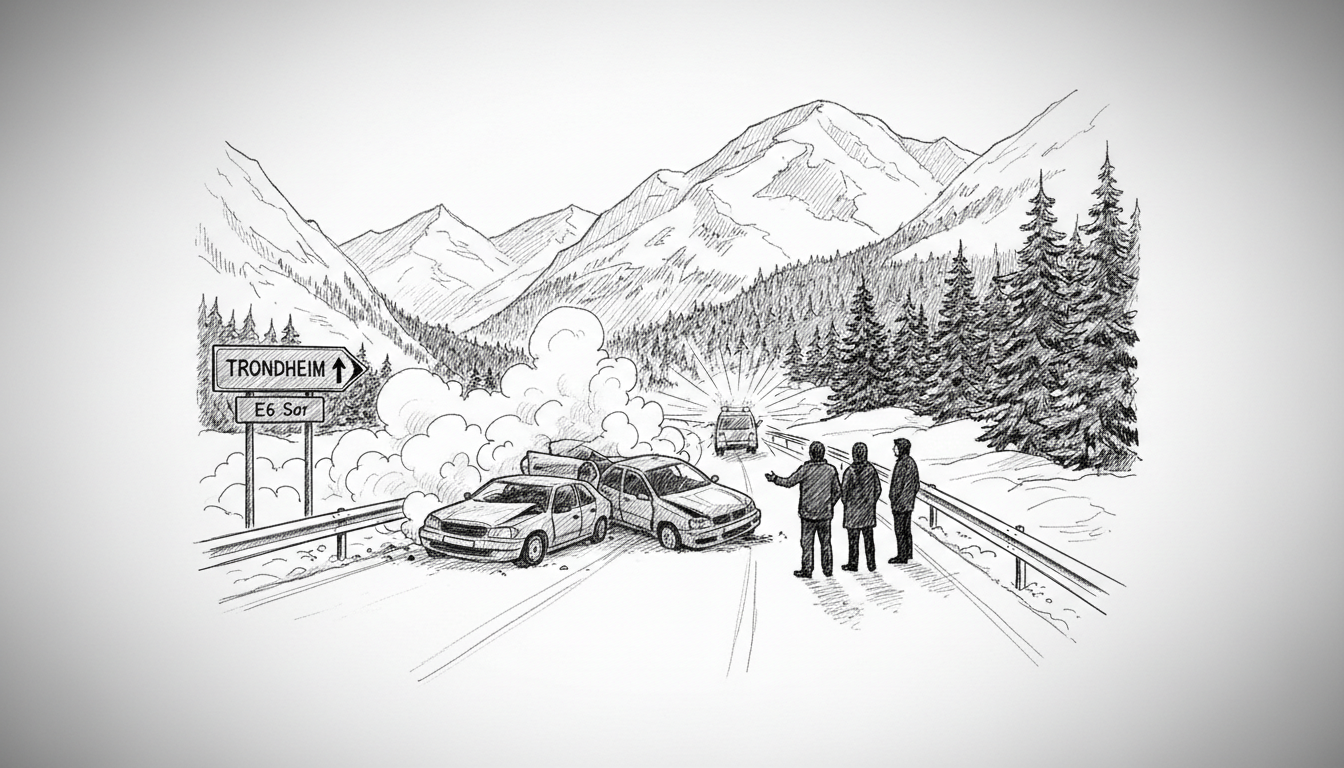
Norway's E6 highway south of Trondheim was the scene of a serious multi-vehicle collision on Thursday afternoon. Three cars collided near the village of Ler in Melhus municipality, with one vehicle reportedly crossing into oncoming traffic. Police confirmed all individuals involved were conscious and speaking at the scene, though the crash caused significant disruption along this vital national artery.
Emergency services responded quickly to the incident on the E6, a road that functions as the country's main north-south spine. Officers secured electronic evidence and conducted initial interviews with those involved. Police have also temporarily confiscated the driver's license of one motorist as part of their standard investigative procedure following a serious collision.
A Narrow Escape on a Vital Corridor
While details remain under investigation, the preliminary report suggests a dramatic sequence. One car entered the opposing lane, resulting in a direct collision with oncoming traffic. The fact that all individuals were reported as 'oppegående'—awake and responsive—points to a fortunate outcome given the potential severity of a head-on impact on a high-speed road.
This stretch of the E6, just south of Norway's third-largest city, Trondheim, carries heavy daily traffic. It connects central Norway with the southern regions and is a crucial route for freight transport. Any closure or major delay on this road has immediate economic and logistical consequences across a wide region.
The E6: Norway's Artery and Its Risks
The E6 is more than just a highway; it is a 3,170-kilometer lifeline running from the southern border with Sweden all the way to Kirkenes in the far north. The section through Trøndelag, where Melhus is located, is a modern, mostly four-lane motorway, but it still presents risks. High speeds, changing weather conditions, and driver fatigue are constant challenges.
Road safety experts note that accidents involving lane departure are among the most dangerous. "When a vehicle crosses the central reservation or into an oncoming lane, the energy of a collision is dramatically increased," explains a traffic safety researcher from the Institute of Transport Economics, who spoke on background. "The design of modern roads like the E6 includes barriers to prevent this, but no system is foolproof against certain driver errors or extreme conditions."
Norway's Road Safety Context
This incident occurs against the backdrop of Norway's ambitious road safety targets. The country recorded 117 road fatalities in 2022, a number authorities are committed to reducing through the Vision Zero strategy. This policy aims to eliminate all serious road injuries and fatalities through improved infrastructure, vehicle safety, and enforcement.
The Norwegian Public Roads Administration (Statens vegvesen) has systematically worked to upgrade the E6, including installing median barriers and improving intersection design. The Melhus area has seen significant road investment in recent years. Yet, as this crash demonstrates, human factors remain a critical variable.
"Technical improvements save lives, but they must be matched with responsible driver behavior," the researcher adds. "Maintaining focus, adhering to speed limits, and adjusting to conditions are the final, irreplaceable layers of safety."
The Investigation and Its Implications
Police have not released the names of those involved or speculated on a cause. Their investigation will be thorough. Securing electronic data is a standard and crucial step; modern vehicles record a wealth of information that can reconstruct speed, braking, and steering inputs in the moments before a crash.
The temporary seizure of a driver's license is also a common preventive measure in Norway following a serious accident, allowing authorities to assess a driver's condition and fitness before they return to the road. It is not an indication of guilt but a standard administrative procedure.
Investigators will examine multiple angles: road surface conditions at the time, potential vehicle malfunctions, driver attention, and whether weather played a role. The findings contribute to national accident databases, which inform future safety campaigns and engineering decisions.
Community and Commuter Impact
For residents of Ler and the wider Melhus municipality, the E6 is a daily reality. The sound of traffic is a constant, and accidents are a feared disruption. Local news outlets quickly covered the story, reflecting the community's connection to this transportation corridor.
Commuters between Melhus and Trondheim faced delays and diversions as police worked to clear the scene, conduct their investigation, and restore normal traffic flow. Such disruptions highlight the region's dependency on this single route, despite investments in alternative roads and public transport.
A Reminder of Vulnerability
While the outcome of this crash appears to have been less severe than it might have been, it serves as a stark reminder. Even on Scandinavia's safest roads, a moment of inattention, a misjudgment, or a technical failure can have immediate and serious consequences. The E6 enables Norway's connectivity and economic activity, but it also demands constant respect from those who use it.
The Norwegian model of post-accident response—combining immediate medical care, detailed forensic investigation, and systemic learning—is designed to extract lessons from every incident. The data from Melhus will be added to that pool, quietly influencing future road designs and safety messages.
As traffic returns to normal on the E6 south of Ler, the questions linger. What precise sequence of events led one car into the path of another? The answers, once found, will form a small but important part of Norway's ongoing journey towards safer roads. For now, the community is left with the image of mangled metal on a familiar road, and the relief that, this time, everyone walked away.