
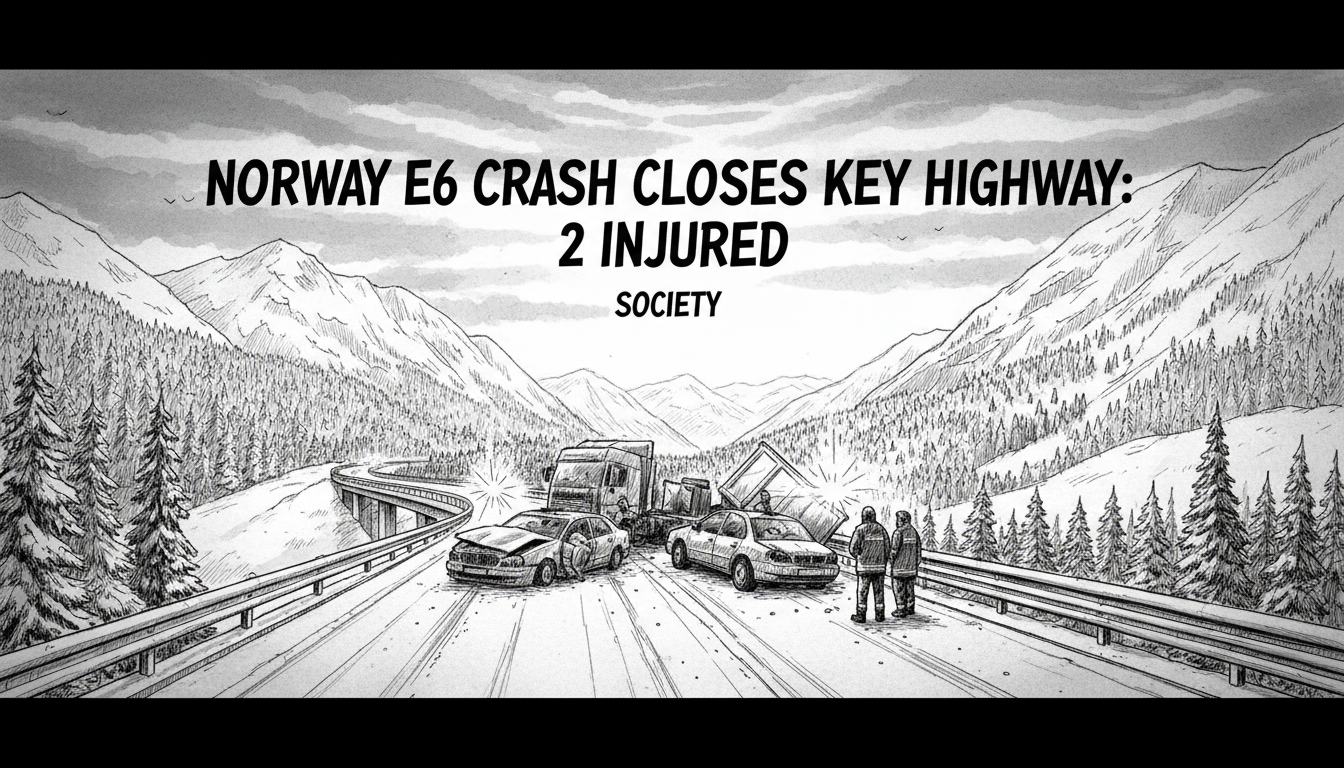
Norway's vital E6 highway was shut down in both directions following a serious two-car collision at Gråmyra in Levanger. Two people were transported to Levanger Hospital for treatment. The cause of the crash is not yet known.
The Norwegian Public Roads Administration's traffic center reported the closure at 4:13 PM, stating traffic was being diverted via Nossum. By 4:33 PM, just twenty minutes later, the agency confirmed the E6 had reopened. The rapid resolution prevented a lengthy disruption on one of the nation's most critical transport corridors.
A Vital Artery Briefly Severed
The E6 highway is the backbone of Norwegian land transportation. It stretches approximately 3,000 kilometers from Trelleborg in southern Sweden all the way to Kirkenes in Norway's far north-east, near the Russian border. This makes it the primary road link connecting the country's southern regions with its central and Arctic areas. A closure, even a short one, has immediate ripple effects. The stretch through Levanger in Trøndelag county is a key segment for freight moving between Trondheim and points north, as well as for regional commuters.
“Any incident on the E6 commands an immediate and full response,” said a regional traffic operations manager, who asked not to be named as they were not authorized to speak publicly. “Our priority is always the injured, followed by clearing the roadway safely but as quickly as possible. The economic and logistical cost of a prolonged closure on this road is immense.”
Norway's Road Safety Context
The incident at Gråmyra occurs within a national framework of generally strong road safety. In 2022, Norway recorded 97 fatal road accidents. The country's consistent investment in safety measures—including stricter enforcement, vehicle safety standards, and road engineering—has given it one of the lowest traffic fatality rates in the world. However, this record is maintained only through constant vigilance and rapid response to incidents when they do occur.
Road safety experts note that the outcome of collisions heavily depends on the speed and quality of emergency medical response. “The first hour after a trauma is often called the ‘golden hour’,” explains Dr. Ingrid Solberg, a trauma consultant at a major Norwegian hospital. “Rapid extraction from the scene, stabilization, and transport to a definitive care facility like Levanger Hospital are critical links in the chain of survival. Efficient coordination between police, fire, and medical services on major roads is a cornerstone of our system.”
The quick reopening of the E6 suggests this coordination functioned as intended, addressing both the human emergency and the infrastructural blockage with minimal delay.
The Economic Pulse of a Highway
Beyond the immediate human cost, an E6 closure strikes at Norway's economic pulse. The highway is not just for cars; it is a crucial route for heavy goods vehicles supplying everything from groceries to building materials across long distances. The Trøndelag region, where Levanger is situated, is a significant agricultural and industrial hub. Delays here can disrupt supply chains to entire towns and communities further north, where alternative routes are often long, mountainous, and less efficient.
Logistics companies factor in the reliability of the E6 when planning deliveries. “A twenty-minute closure is a manageable delay,” said Per Strand, a manager for a Nordic transport firm. “We monitor the traffic centers closely. If a closure looks extended, we must immediately reroute drivers, which adds hours to journeys and increases costs significantly. The E6 is the spine, and when it’s blocked, everything feels it.”
The Local Impact in Levanger
For the municipality of Levanger, the crash on its doorstep is a local event with national implications. The town of approximately 20,000 residents sits on the Trondheimsfjord and relies on the E6 for connectivity. Local emergency services from Levanger would have been first responders. The hospital that received the patients is a key healthcare facility for the wider region, highlighting how regional infrastructure supports national network resilience.
Local politicians often balance the need for efficient through-traffic with community safety. “Our focus is always on preventing these incidents through good road design and safety campaigns,” said a municipal official from the Levanger area. “But when an accident happens, we rely on the expertise of our responders and the national traffic management systems to handle it. Today, that system worked under pressure.”
A Look at the Broader Network
This brief incident underscores a national vulnerability. Norway’s challenging geography, with its fjords and mountains, means there are often few viable alternatives to main routes like the E6. The specified detour via Nossum is a local road, unsuited for the volume or type of traffic that typically uses the highway. This inherent lack of redundancy is why the Norwegian Public Roads Administration prioritizes rapid clearance.
Investment continues in making this artery safer and more reliable, including ongoing projects for new passing lanes, improved barriers, and real-time traffic monitoring systems. Each serious crash provides data that informs future safety upgrades. The goal remains to prevent accidents while ensuring that when they occur, the consequences are minimized.
The Unanswered Questions and Moving Forward
As the two individuals receive care at Levanger Hospital, the official investigation into the cause of the collision begins. Police will examine factors ranging from vehicle condition and driver behavior to road surface quality and weather conditions at the time. The findings contribute to the broader statistical and analytical work aimed at saving lives.
The swift handling of the E6 crash at Gråmyra serves as a compact case study in Norwegian crisis management: a rapid, coordinated response that prioritized human life while swiftly restoring a piece of critical national infrastructure. It is a reminder that the safety of this long, scenic highway is maintained one incident at a time, through a well-practiced protocol that links local responders to national systems. As Norway continues to grapple with its geography and climate, the reliability of the E6 remains a testament to both engineering and emergency planning. Will the push for ever-better safety records meet the challenge of increasing traffic volumes on this essential road?