
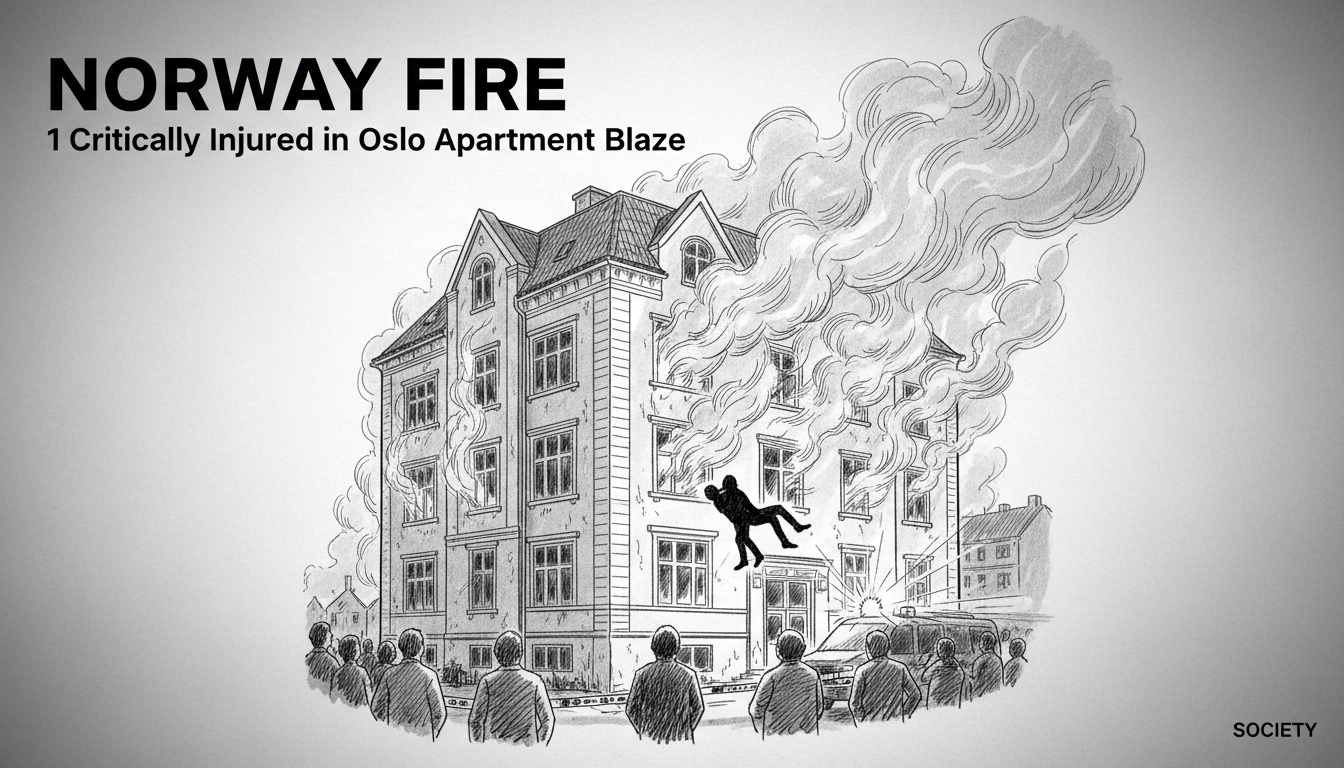
Norway's emergency services responded to a serious apartment fire in Oslo's Ila district early Monday morning. One person suffered critical burn injuries in the blaze, which police initially linked to cooking before retracting that assessment. The incident has shifted focus to broader fire safety concerns in residential neighborhoods across the capital.
Fire and ambulance crews rushed to the residential building in Ila, a neighborhood within the Grünerløkka borough, shortly after 1:00 AM. Police confirmed the critically injured individual was found inside an apartment. Initial police communications stated the fire outbreak was connected to cooking activities. That statement was later revised, leaving the cause officially undetermined.
"The police have examined the scene, and the emergency services have concluded their work," said operations manager Christer Martinsen in an updated statement. "It is uncertain what caused the fire, and it is not certain that it has anything to do with cooking." The reversal highlights the complex initial phase of fire investigations, where first impressions can be misleading.
A Neighborhood Awakened
The fire disrupted the quiet of Ila, an area north of Oslo's city center known for its mix of older apartment blocks and newer developments. Residents reported being awakened by sirens and the activity of emergency vehicles. The speed of the response from Oslo's fire brigade likely prevented a more severe outcome, though the condition of the injured person remains grave.
Such incidents, while relatively rare in Norway's modern building stock, trigger automatic reviews of safety protocols. Norwegian building codes are stringent, particularly regarding fire containment and escape routes in multi-unit dwellings. The immediate focus for investigators will be the specific apartment's interior, potential ignition sources, and the functionality of any installed safety devices like smoke alarms.
The Investigation Begins
Determining the origin and cause of a fire is a meticulous forensic process. Specialists from the police and fire service will examine electrical systems, appliances, and any potential accelerants. They will map burn patterns to locate the point of origin. The critical injury of the occupant complicates the investigation, as they cannot provide immediate testimony about the events leading to the blaze.
Fire safety experts stress that most residential fires start accidentally. Common causes include faulty electrical wiring, overheated appliances, unattended candles, and improper disposal of smoking materials. Even with Norway's high safety standards, human error and unforeseen technical failures remain persistent risks. The retraction of the cooking-related cause underscores the need for a thorough, evidence-based investigation before conclusions are drawn.
"Every serious fire is a tragedy and a lesson," said a veteran fire prevention officer, speaking on background about general procedures. "Our job is to piece together a sequence from physical evidence. The goal is not just to find a cause for this fire, but to gather data that can prevent the next one." The findings will be compiled into a report for both police records and the Norwegian Directorate for Civil Protection (DSB).
A Broader Look at Fire Safety
This incident places a spotlight on residential fire safety in Oslo. Norwegian law mandates working smoke detectors in all homes. Regular checks are the responsibility of the homeowner or tenant. In apartment buildings, additional systems like fire doors, sprinklers in common areas, and clear escape plans are standard. The effectiveness of these measures relies on both proper installation and resident awareness.
Statistics from the DSB show that while fire fatalities in Norway are low by international comparison, the majority occur in homes. The most vulnerable groups include the elderly and those living alone. A critical injury from burns suggests the fire may have developed rapidly or the victim was unable to escape quickly, factors that will be central to the official inquiry.
Local authorities in Grünerløkka may face questions about building inspections and public safety outreach. However, Norway's decentralized model places primary responsibility for fire prevention on individual municipalities and property owners. The state sets the regulatory framework through the Planning and Building Act and the Fire and Explosion Prevention Act.
The Human Cost and Community Response
Behind the official statements and investigative protocols lies a profound human drama. A person is fighting for their life with critical injuries. Neighbors are confronted with the vulnerability of their own homes. The emergency responders who handled the call carry the weight of a traumatic scene.
Community response in tight-knit areas like Ila often involves support for affected residents. While the fire appears confined to one unit, the psychological impact on the building and neighborhood can be significant. Questions about structural safety, smoke damage, and temporary displacement for other residents may arise as building managers assess the aftermath.
Norway's social safety net, including its healthcare system, will be critical for the injured individual's long-term recovery. Treatment for severe burns is intensive and prolonged, often requiring specialized care at hospitals like Oslo University Hospital's national burn center. The path from critical injury to rehabilitation is a long one.
Lessons from a Midnight Emergency
As dawn broke over Ila, the immediate crisis transitioned into a phase of analysis and recovery. The Oslo Police District's careful correction of its initial statement demonstrates a commitment to factual accuracy over early speculation. This is crucial for public trust and for ensuring the investigation is not led astray.
For the public, the fire serves as a stark reminder. It prompts checks of smoke detector batteries, reviews of household fire escape plans, and renewed caution with potential ignition sources. Fire departments across Norway consistently advocate for these simple, proactive measures, which save lives.
The coming days will bring more clarity. Investigators will work to provide answers for the injured person's family, for other residents, and for the authorities tasked with public safety. Their report will contribute to the continuous effort to make Norwegian homes safer. For now, the community's thoughts are with the individual whose life was dramatically altered in the early hours of a Monday morning. This single event in an Oslo apartment block reverberates as a somber note on the essential, fragile nature of safety we often take for granted.