
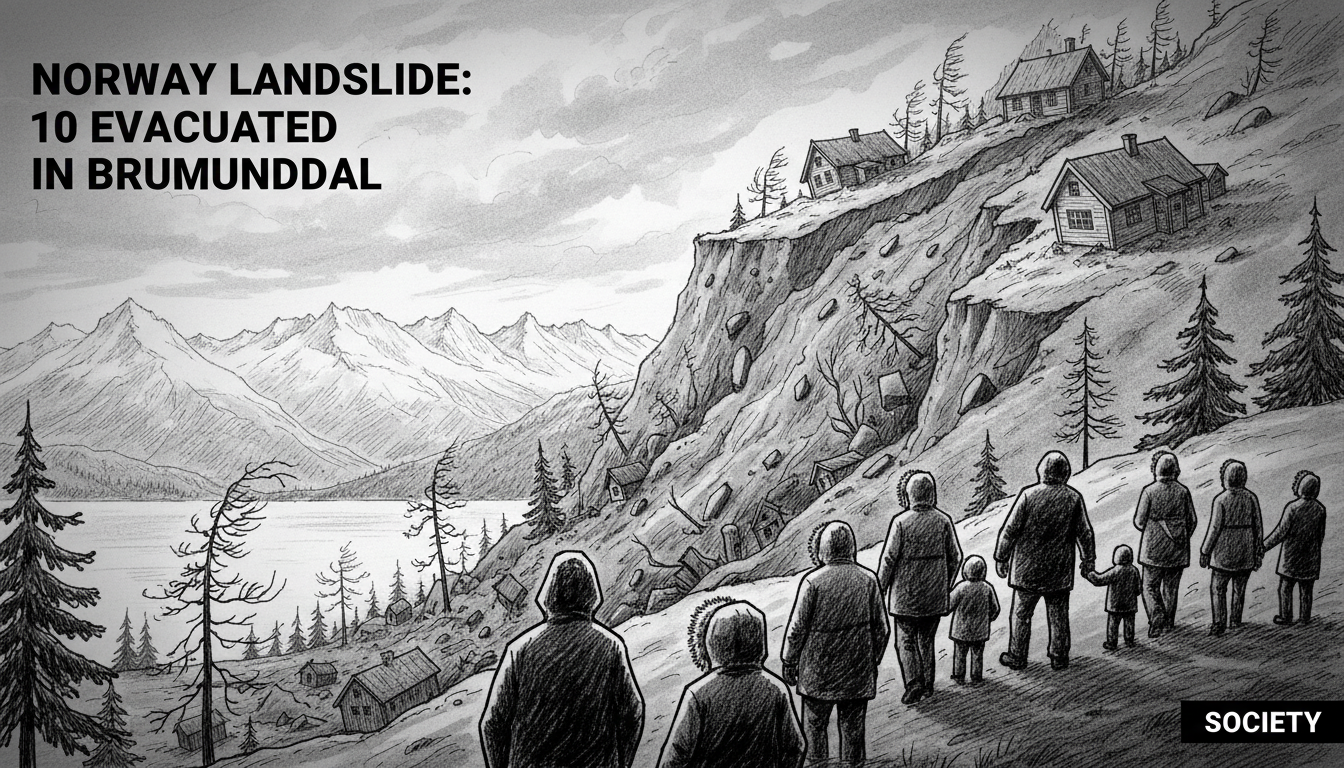
Norway landslide evacuations have forced ten people from their homes in Ringsaker municipality. A minor but significant mudslide occurred outside the town of Brumunddal on Monday, prompting emergency services to evacuate three households. The incident, while causing no reported injuries, has reignited national conversations about landslide risk and preparedness in vulnerable Norwegian communities.
A Community on Alert
Emergency responders secured the area immediately after the slide was reported. Authorities have not released details on the extent of property damage, but the primary focus remains on human safety and ground stability. The evacuated residents are being assisted by local municipal services, which are providing temporary accommodation and support. This event follows a familiar pattern in Norway's rugged landscape, where quick clay, heavy rainfall, and snowmelt can rapidly destabilize slopes.
Geologists from the Norwegian Water Resources and Energy Directorate (NVE) are expected to assess the site. Their investigation will analyze soil composition, groundwater levels, and recent weather data. "Every slide provides critical data," said a geotechnical engineer familiar with Norwegian landslide risks, who spoke on background. "We look at the trigger—was it precipitation, frost thaw, or something else—and then map the failure zone to understand the risk of further movement."
The Shadow of Gjerdrum
This latest evacuation inevitably draws comparisons to the catastrophic event in Ask, Gjerdrum, in December 2020. That quick clay landslide claimed ten lives, destroyed multiple homes, and became one of Norway's deadliest natural disasters in decades. The Gjerdrum tragedy led to a major overhaul of national landslide risk mapping and stricter zoning regulations in areas identified as high-risk.
The NVE subsequently intensified its monitoring and public warning systems. However, the challenge remains vast. Norway's long coastline, deep valleys, and specific geological conditions create thousands of potential risk zones. Municipalities like Ringsaker now operate with heightened awareness, balancing development needs with updated risk assessments.
The Science of Sliding Ground
Landslides in Norway typically fall into two broad categories: debris flows triggered by intense rainfall in steep terrain, and larger, more dramatic quick clay slides. Quick clay, known as 'sensitive marine clay,' is a hallmark of Norway's geology, particularly in the regions around the Oslofjord and Trondheimsfjord. This material appears solid but can liquefy instantly when disturbed, leading to rapid and extensive collapses.
While the Ringsaker slide appears smaller in scale, determining its type is crucial for the response. A debris flow might indicate localized drainage issues, while evidence of quick clay would necessitate a much broader area assessment. The NVE's national database, which catalogues over 45,000 registered landslides, will be a key tool for investigators placing this event in a historical context.
"The key question is always about residual risk," the geotechnical engineer explained. "Once a slope has moved, is it now stable, or has it been preconditioned for a larger failure? Monitoring with ground-based radar and instruments in the following days is essential."
Policy and Preparedness in the Aftermath
The immediate municipal response will soon give way to longer-term questions. Ringsaker's municipal council, led by Mayor Anita Ihle Steen, must now review safety protocols for the affected area. They will rely on expert reports from the NVE to decide if the evacuations are temporary or permanent. Norwegian law provides clear frameworks for such situations, often involving property acquisition by the state if land is deemed uninhabitably dangerous.
This event also tests Norway's updated 'zero vision' approach to landslide fatalities, a policy ambition stemming from the Gjerdrum commission's recommendations. It involves better early warning systems, public education campaigns, and more conservative construction limits. The effectiveness of these measures is proven not in quiet periods, but during incidents like the one in Brumunddal.
Funding for preventive measures, such as drainage improvements or slope stabilization, is a constant topic in the Storting. Each incident adds weight to arguments for increased infrastructure grants to municipalities sitting on unstable ground. The cost of prevention is invariably measured against the immense human and financial cost of a major disaster.
Living with Instability
For Norwegians, the reality of landslides is a part of life in a breathtaking but demanding landscape. The country's infrastructure, from railway lines connecting Oslo to Bergen to roads threading through western fjords, is routinely challenged by rockfalls and mudslides. Homeowners in certain areas must conduct mandatory geotechnical surveys before building or renovating.
The evacuees in Ringsaker now face an uncertain wait. They embody the human dimension of geological risk—a waiting game for expert verdicts that will determine the future of their homes. Community solidarity, a strong feature of Norwegian society, will be as important as governmental support in the coming weeks.
As climate models predict increased precipitation and more frequent extreme weather events for Scandinavia, the pressure on Norway's slope stability will likely grow. This makes the lessons learned from each slide, even minor ones, increasingly valuable. The data collected at Brumunddal will feed into models that aim to predict and prevent the next one.
Does Norway's advanced monitoring and reformed policy framework make its communities safe, or does the inherent unpredictability of the ground beneath them mean true security is an illusion? The ten evacuated residents, waiting to return to their homes, are now living that question. Their experience is a stark reminder that in Norway's dramatic nature, beauty and risk are forever intertwined.