
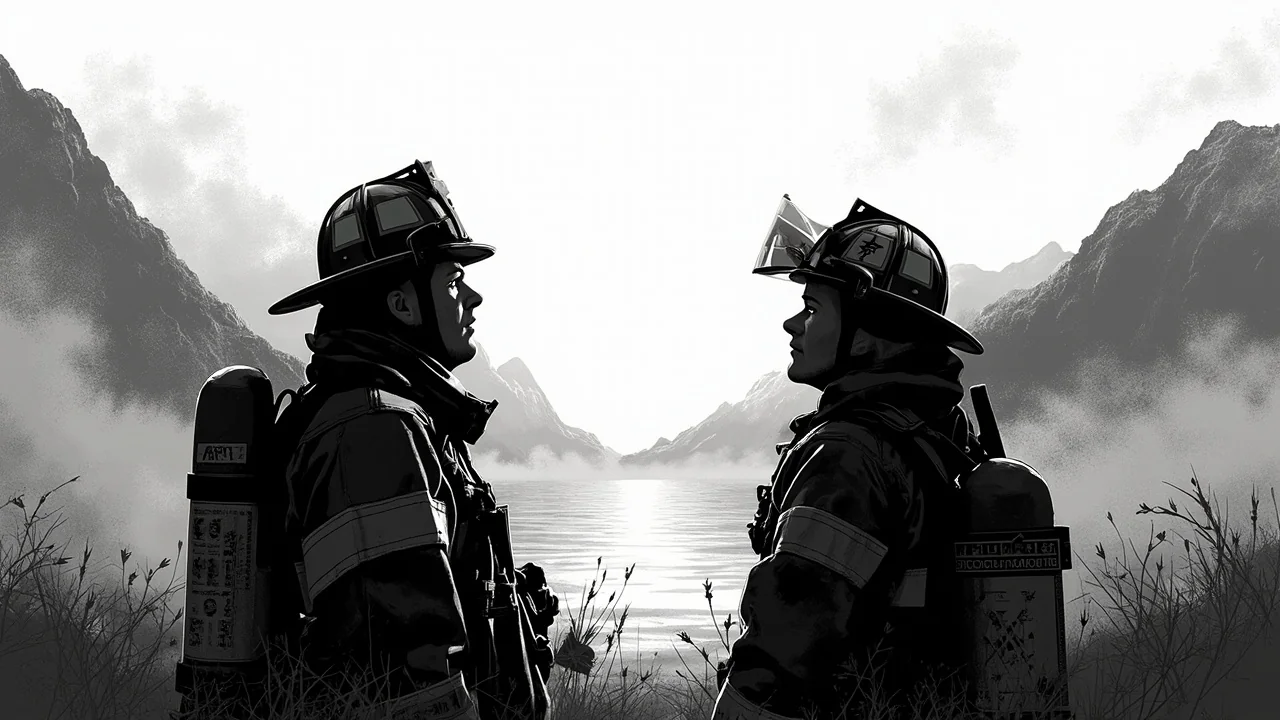
Norway's firefighting community is in mourning after two volunteer smoke divers died battling a house fire in Verdal. Four firefighters entered the building believing they faced a routine, contained blaze. Only two came out alive, leaving colleagues and investigators asking a single, haunting question: What went so catastrophically wrong in those final moments?
Fire Chief Håvard Bye of Innherred IKS articulated the collective shock and confusion. "We are left wondering what it is that makes the fire become so powerful?" he said. "It must have happened something." The victims, identified as part-time firefighters Roger Kvello Hansen and Geir Otto Lein Johnson, were described as highly skilled smoke divers. Their deaths have sent waves of grief through the small community of Verdal in Trøndelag county and across Norway's emergency services.
A Routine Call Turns Tragic
The incident began in the early hours of Wednesday morning. Initial assessments at the scene indicated a standard residential fire with limited risk of spreading. Standard operating procedures were followed. "It was assessed by the crew that here we have a good opportunity to go in and extinguish the fire," Chief Bye explained. Based on this evaluation, a team of four smoke divers entered the structure. They operated in two pairs, approaching the fire from different sides of the house to tackle it effectively.
Both pairs shared the initial impression that the situation was manageable. "The other smoke diving pair also went into the house from another side. They also had the impression that it was a limited fire," Bye stated. For a time, the operation proceeded as planned. Then, the situation changed with terrifying speed. "At one point something suddenly happens," the Chief said, describing the abrupt shift. The house fire developed rapidly into an extremely intense blaze.
The Moment Contact Was Lost
As conditions deteriorated, all firefighters were ordered to evacuate. The crew outside maintained contact, directing the retreat. Two of the smoke divers successfully made it out. Simultaneously, the crew on the outside lost contact with Hansen and Johnson. The fire's intensity escalated so quickly that it became impossible for anyone to re-enter the building to attempt a rescue. The operation instantly transformed from firefighting to a desperate search for two missing colleagues trapped inside an inferno.
By Wednesday evening, the grim discovery was made. The bodies of Roger Kvello Hansen and Geir Otto Lein Johnson were found in the ruins. "Of the crews, no one had any other perception than that here we can go in and relatively simply extinguish the fire," Bye reflected, emphasizing the shocking deviation from their professional assessment. "But it is then that something must have happened. All routines were followed."
A Community and a Profession in Mourn
The fire station in Verdal has become a focal point for communal grief. Flowers from near and far cover the station's exterior. The national outpouring of support has been profound. "It is touching that so much care and support is shared. It comes from the whole country and also from abroad," representatives noted. On Friday, colleagues gathered at the scene for a memorial, a somber moment of remembrance for the two men who lost their lives in the line of duty.
The entire municipality of Verdal is grieving. The loss is deeply personal for Norway's close-knit fire services, where part-time volunteers like Hansen and Johnson are pillars of local safety, often serving the communities where they live and work. Their deaths are a stark reminder of the inherent dangers faced by first responders, even during calls that initially seem routine.
The Search for Answers Begins
With the immediate emergency over, the difficult work of understanding the tragedy has begun. The police have launched an investigation, with forensic technicians and specialists from the National Criminal Investigation Service (Kripos) examining the fire ruins. Their task is to piece together the sequence of events and identify the specific cause of the fire's sudden and deadly flashover or backdraft—the "something" that Chief Bye referenced.
This investigation is critical for several reasons. It will provide answers to the grieving families and colleagues. It will also inform national fire service protocols, potentially leading to updated safety procedures or training to prevent a similar tragedy. Every firefighter's death in Norway is scrutinized to extract lessons that might save lives in the future.
A History of Sacrifice
The Verdal tragedy brings into sharp focus the risks of firefighting in Norway. While statistically a safe profession relative to its dangers, these deaths are not isolated. In the past 25 years, five firefighters have now lost their lives in the line of duty. Each incident leads to reviews of equipment, tactics, and building material safety standards. The nature of modern construction, with synthetic materials that burn hotter and faster, is a constant topic of discussion among safety experts.
The analysis following this event will likely examine communication protocols during interior attacks, the indicators for potential rapid fire development, and the decision-making matrix for when to commit personnel inside a structure. The fact that experienced crews perceived minimal risk makes this incident particularly troubling for the firefighting community, challenging assumptions about predictability and control.
The Human Cost of Service
Beyond the protocols and investigations lies the profound human cost. Two families have lost loved ones. A station has lost brothers. The firefighters who survived the incident, particularly the two who exited the building, now carry the weight of that survival. The psychological impact on the entire crew and the wider first responder network in the region will be significant and require long-term support.
The role of part-time firefighters in Norway's emergency response system is also highlighted. These volunteers, who balance their service with other jobs and family life, form the backbone of fire protection in many rural and semi-rural areas. Their dedication and willingness to face danger for their community make their loss especially poignant.
As the formal investigations proceed slowly and methodically, the community's process of mourning continues. The flowers at the Verdal station will eventually wilt, but the questions from this night will persist. What unseen factor turned a controlled interior attack into a death trap? How can such a risk be identified sooner? And for the colleagues left behind, the memory of that night—of four men going in and only two coming out—will forever shape their understanding of the profession they serve. The ultimate tribute to Roger Kvello Hansen and Geir Otto Lein Johnson will be a thorough, honest inquiry that makes every firefighter who enters a smoky doorway in the future that much safer.