
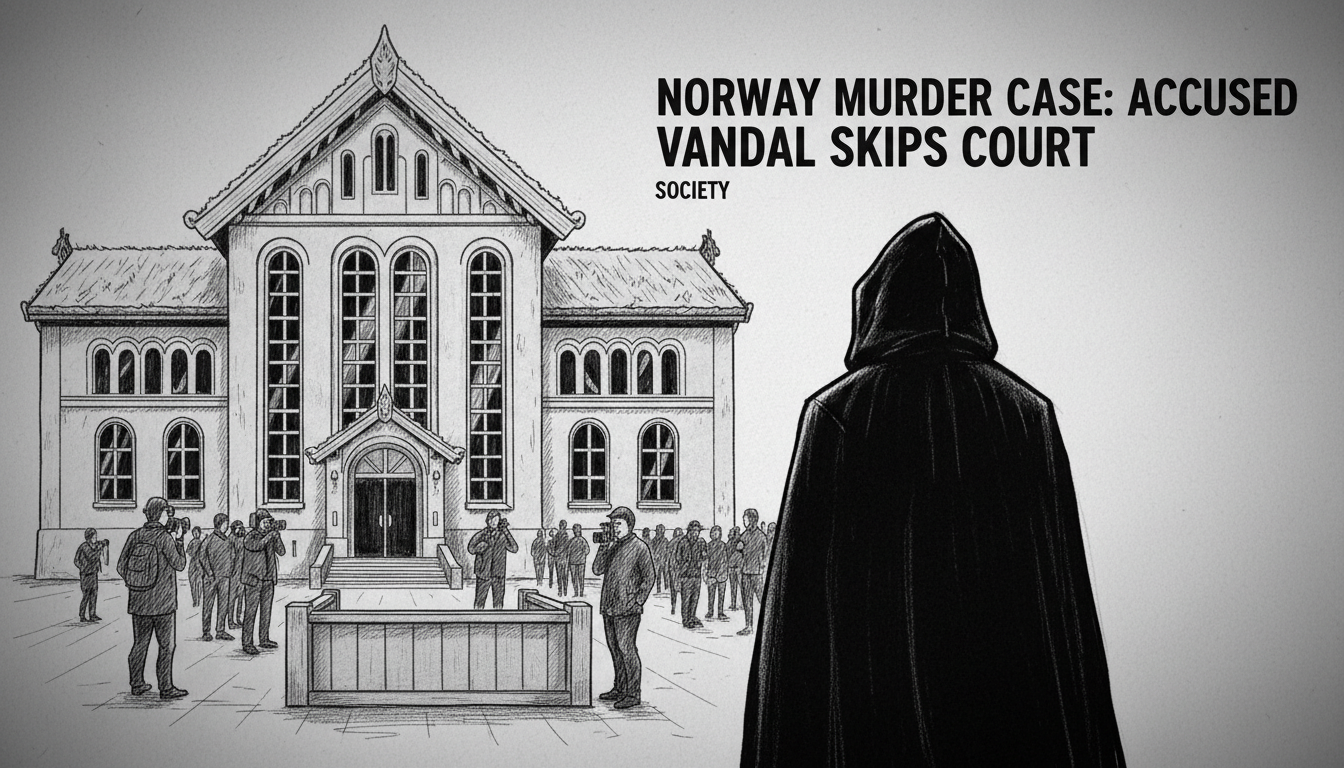
Norway's judicial system faces a direct challenge as a man charged with harassing murder victim Jonas Aarseth Henriksen failed to appear for his trial. Police prosecutor Odd Kostveit immediately requested an arrest warrant to compel the 30-year-old defendant to court. This development casts a stark light on a case that has gripped the nation, probing the limits of Norway's typically orderly legal processes in the shadow of a brutal killing.
Jonas Aarseth Henriksen was found dead on August 17, 2023, in a remote area of Ringerike. Prior to his death, he reported a sustained campaign of threats, vandalism, and violence against him. The absent defendant faces seven specific counts of vandalism, or 'hærverk', targeting Henriksen in the period leading up to the murder. His non-appearance on Monday halted proceedings before they could begin, forcing the court and police to react.
A System Tested by Absence
The Ringerike courtroom expected a procedural hearing, not a confrontation with absence. Police prosecutor Odd Kostveit's statement was concise and procedural. "We will decide to have him arrested, so that he can appear in court," Kostveit told the presiding judge. This move shifts the case's immediate focus from the allegations of vandalism to the defendant's defiance of a court order to attend. Norwegian law allows for the arrest of defendants who fail to appear without a valid excuse, ensuring trials can proceed. The court is expected to rule on the arrest request swiftly.
Legal experts note that while failure to appear is not uncommon in minor cases, it carries greater significance in a case linked to a high-profile murder. "The court's authority is fundamental," said Professor Lena Fossum, a criminal procedure expert at the University of Oslo. "When a defendant in a case with this level of public and media scrutiny does not show up, it forces the system to assert its power. The arrest warrant is the necessary tool to maintain the integrity of the process." The efficiency of the police in locating and detaining the man will now be closely watched.
The Shadow of the Jonas Murder
The vandalism case exists in the overwhelming shadow of the unsolved murder of Jonas Aarseth Henriksen. Henriksen's death shocked the local community and generated national headlines. The seven vandalism charges represent a documented pattern of alleged harassment that the victim himself reported. Investigators have not stated whether the same individual is a suspect in the murder, but the connection is the subject of intense speculation and investigation.
This context makes the defendant's absence more than a simple breach of court protocol. It is seen as an act that delays justice for a victim who can no longer speak for himself. The family of Jonas Aarseth Henriksen, who have endured months of anguish since his death, now face another painful postponement in a related legal matter. Community leaders in Ringerike have expressed frustration, emphasizing the need for closure and thoroughness in all aspects of the case.
Norway's Crime Paradox in Focus
This incident highlights a paradox within Norway's society. The country consistently ranks among the safest in the world with a very low homicide rate. Most judicial proceedings are characterized by order and predictability. Yet, when a severe, violent crime occurs, it captures the national consciousness and tests institutions in unique ways. The public's trust in the police and courts to handle such cases effectively is high, but that trust depends on visible competence and resolution.
The response to the defendant's non-appearance is a test of that systemic competence. "Norway's system is built on the expectation of compliance," Fossum explained. "Protocols for non-compliance exist, but they are rarely front-page news. This case demonstrates how the machinery works when that basic expectation is broken. The public will judge whether it works quickly and firmly enough." The contrast between Norway's peaceful reputation and the brutal nature of Henriksen's murder, followed by this courtroom defiance, creates a narrative of unsettling disruption.
The Path Forward for Justice
The immediate path is clear: police must execute the arrest warrant and bring the defendant before the court. Once he is in custody, the trial on the seven vandalism charges can proceed. Each charge will be examined based on the evidence collected by police during their investigation into Henriksen's reports. A conviction for systematic vandalism could carry a significant penalty, separate from any other proceedings.
However, the larger question remains unanswered. The primary investigation into the murder of Jonas Aarseth Henriksen continues. Police have released few details, stating the investigation is extensive and complex. Whether the evidence in the vandalism case will provide a crucial link for homicide detectives is unknown. The two processes—the vandalism trial and the murder investigation—are legally separate but inextricably linked in the eyes of the public and the victim's family.
A Waiting Nation
As police search for the 30-year-old defendant, Norway is reminded that even in the most orderly societies, justice can encounter obstacles. The case underscores that legal processes are human systems, vulnerable to individual actions like a failure to appear in court. The system's strength is shown not by the absence of such challenges, but by its calibrated, firm response to them.
The coming days will reveal how swiftly that response unfolds. Will the defendant be located and arrested within hours, or will his absence prolong the agony for a grieving family? The answer will write the next chapter in a case that has become a somber benchmark for how Norway handles its gravest crimes. The nation waits, watching to see if the calm, procedural machinery of justice can manage the weight of a tragedy and the defiance of a single man.