
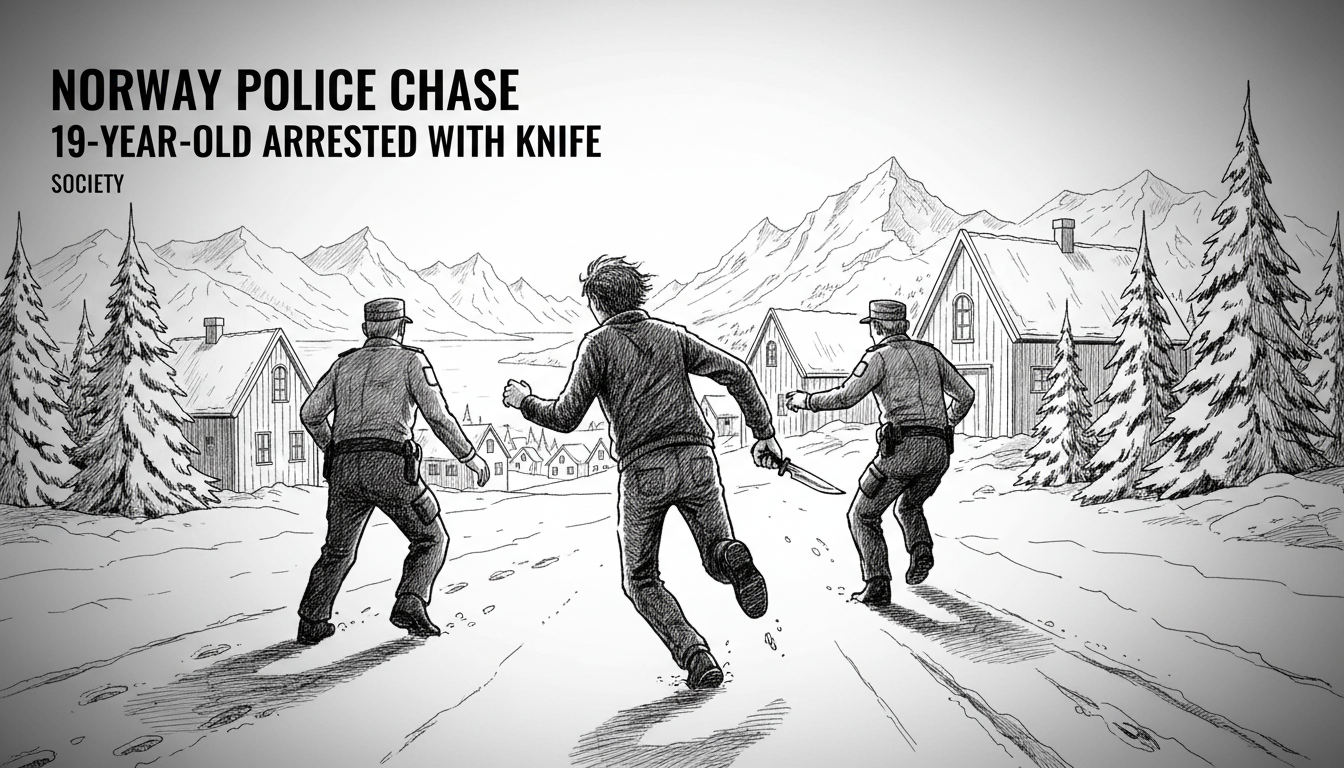
Norway police have arrested a 19-year-old man in Oslo after a brief chase that began with a near-collision and ended with the discovery of a knife. The incident on Lindeberg started when the young driver's car almost hit a police vehicle during an overtaking maneuver. When officers turned to reprimand the driver, he fled, driving onto a pedestrian walkway before being stopped. The 19-year-old now faces charges for reckless driving, evading police control, and illegal knife possession. Police also confiscated his driver's license on the spot, an action he reportedly did not consent to, according to operational commander Bjarne Pedersen's report.
A Fleeting Chase on a Pedestrian Path
The sequence of events was short but packed with violations. According to the police log, the driver's initial error—a dangerous overtaking move that nearly caused a crash with a marked patrol car—was a clear traffic offense. Instead of accepting a reprimand, the driver chose to accelerate away. This decision escalated a simple traffic stop into a more serious case of evading police. His route onto a gangvei, or pedestrian walkway, created significant risk for pedestrians and showed a blatant disregard for public safety. The police managed to stop the car quickly on the walkway, preventing a prolonged pursuit. The subsequent discovery of a knife on the 19-year-old added a grave criminal dimension to what began as a traffic violation.
The Legal Weight of a Confiscated License
A key immediate consequence was the confiscation of the driver's license. Under Norwegian traffic law, police have the authority to seize a license immediately for serious violations. This power is typically used in cases involving excessive speed, reckless driving, or driving under the influence. The driver's refusal to consent, as noted in the log, is legally irrelevant in such situations. The confiscation is an administrative decision made by the officer based on the observed danger. The license is now part of the evidence, and the 19-year-old faces a formal driving ban. A court will later determine the final length of this ban, which could range from months to years depending on prior record and the severity of the act.
Understanding Norway's Strict Knife Laws
The knife possession charge carries substantial legal weight. Norway has clear and restrictive laws governing knives in public. It is generally illegal to carry a knife that can be used as a weapon without a valid purpose, such as for work, fishing, hunting, or other recreational activities. The law does not specify a universal legal blade length but assesses the knife's type, the context of carrying it, and the bearer's intent. A folding knife with a blade under 7 cm might be permissible if the carrier has a legitimate reason. However, carrying any fixed-blade knife or a knife deemed a weapon without justification is a criminal offense. The police did not specify the type of knife found, but the mere act of carrying it during a traffic evasion incident strongly suggests it will be treated as an illegal weapon.
A Pattern of Youthful Risk-Taking?
While a single incident, this case touches on broader concerns for Norwegian authorities. Traffic safety organizations frequently highlight young male drivers as a high-risk group. Statistics often show higher rates of speeding and risk-taking behavior among drivers under 25. The decision to flee from police, compounded by carrying a weapon, points to a severe lapse in judgment. Experts in youth behavior and traffic psychology might argue this reflects a dangerous combination of impulsivity and a failure to grasp consequences. For Oslo police, such incidents are part of a challenging pattern of dealing with young adults who test legal boundaries, both on the road and in public spaces.
The Path Forward: Legal Proceedings and Implications
The 19-year-old now navigates a multi-faceted legal process. He will be formally charged, and the case will be handed over to the Norwegian Prosecution Authority. The charges of uforsvarlig kjøring (reckless driving) and å stikke fra kontrollen (evading control) fall under the Road Traffic Act. The bæring av kniv (carrying a knife) charge is prosecuted under the Penal Code. Convictions can result in heavy fines, a confirmed lengthy driving ban, and potentially a custodial sentence for the knife offense, especially if the court views it as preparation for violence. The case serves as a stark reminder: a single poor decision can trigger a rapid cascade of legal troubles, upending a young person's life.
Policing in Oslo: Balancing Intervention and Safety
This arrest also offers a window into daily police work in the Norwegian capital. Officers must constantly shift from routine patrols to high-stakes interventions. The decision to pursue a fleeing vehicle, especially onto a pedestrian area, requires split-second risk assessment. The priority is always to end the chase quickly to protect the public. The successful resolution of this incident—with no reported injuries—demonstrates standard procedure. Police training emphasizes de-escalation and controlled engagement. Confiscating the license immediately is a standard tool to neutralize an immediate threat, ensuring the driver cannot repeat the behavior moments after police leave.
A Community's Perspective on Safety
For residents of Lindeberg and similar Oslo neighborhoods, incidents like this affect the perception of public safety. Pedestrian walkways are meant to be safe zones, free from vehicle traffic. The sight of a car fleeing police through such a space is deeply unsettling. It shatters the expected social contract of shared public areas. While Norway enjoys low crime rates overall, episodes involving weapons and reckless driving resonate strongly. They prompt community discussions about police presence, youth engagement programs, and the underlying causes of such brazen acts. The question lingers: what drives a young person to make such a series of escalating, self-destructive choices?
The case of the 19-year-old on Lindeberg is more than a police log entry. It is a chain of poor decisions with lasting repercussions. It highlights the efficient, if severe, mechanisms of Norwegian traffic and weapon law. It underscores the challenges police face in maintaining order. Most importantly, it serves as a cautionary tale about how quickly a moment of recklessness can alter a life's course. As the legal system takes over, the incident fades from headlines but leaves behind enduring questions about risk, responsibility, and the path to adulthood in modern Norway.