
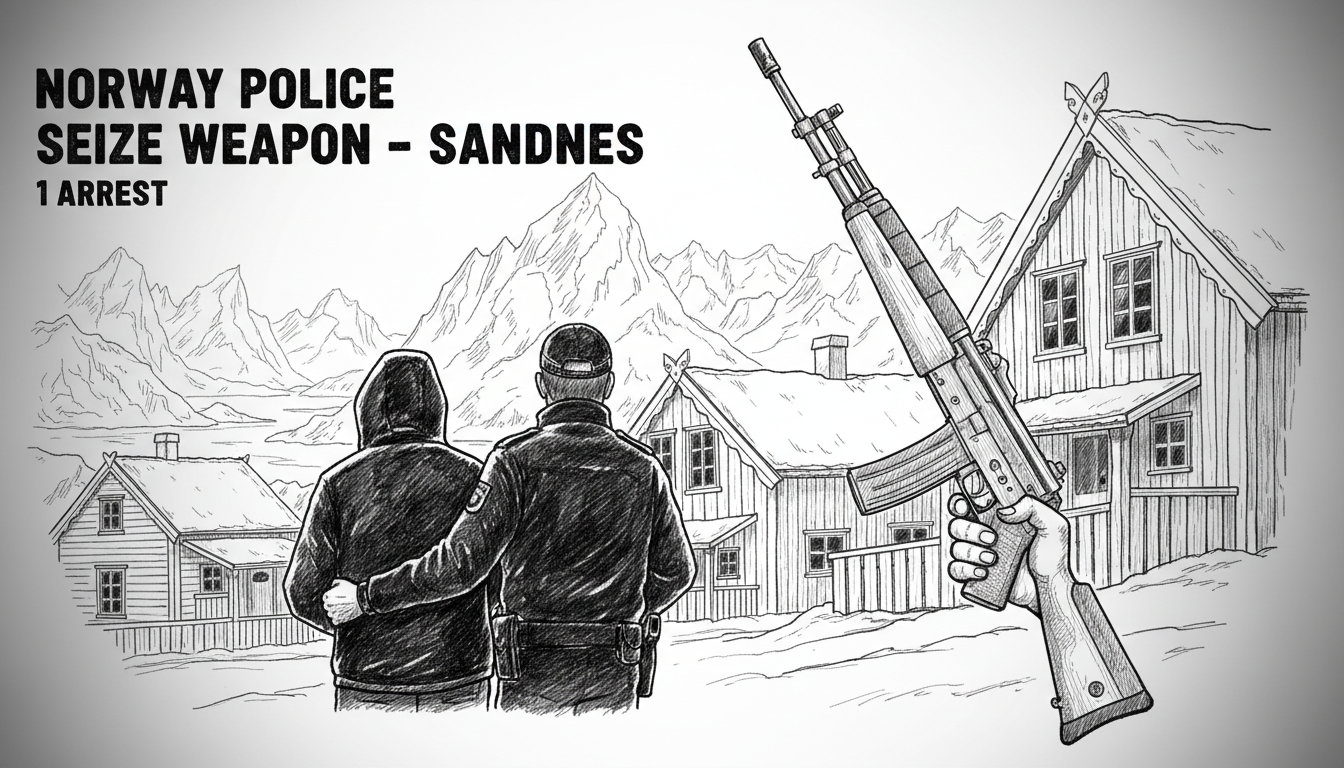
Norway police arrested one person and seized a weapon in Sandnes on Tuesday evening following a public tip. A major police operation unfolded in the Lura district after reports a person was displaying a suspicious object. Authorities later confirmed the item was a firearm, though its authenticity remains under investigation.
"We have control of the person," operations manager Helen Rygg Ims stated during the incident. Multiple armed patrols responded to the scene. Police emphasized there was no known prior threat situation that prompted the large-scale deployment. The response highlights Norway's stringent protocols for any potential firearm incident.
A Calibrated Response to a Potential Threat
The police mobilization in Sandnes involved significant resources for a single suspect. Officers cordoned off areas in Lura, a residential and commercial district within the Stavanger/Sandnes metropolitan region. This city of over 80,000 people is part of Rogaland county, Norway's energy heartland. The sight of armed police units is uncommon here, reflecting the seriousness with which such tips are treated.
Norwegian police operate under a principle of normalized, unarmed patrols. Officers routinely carry firearms only in their vehicles, not on their person. Authorization to deploy armed officers requires a specific assessment of threat level. The decision to send multiple armed patrols to Lura indicates the tip was deemed credible and high-risk. This system balances public accessibility with a capacity for rapid armed response.
The Framework of Norwegian Firearm Control
Any incident involving illegal weapons triggers a robust response because it strikes at the core of Norway's social contract on gun ownership. The country maintains some of the world's strictest firearm regulations. Legal ownership is primarily limited to hunting and sport shooting, with rigorous background checks, mandatory safety courses, and secure storage laws.
"The police response in Sandnes is a direct reflection of our legal and cultural approach to guns," said a security policy researcher at the University of Stavanger, who spoke on background. "An illegal firearm represents a fundamental breach of public trust. The system is designed to isolate and neutralize such threats immediately."
Public possession of any firearm, replica or real, in a manner causing alarm is a criminal offense. If the weapon is confirmed as real and illegally held, the suspect faces severe penalties under the Firearms Act. This legal backdrop explains why a single report can mobilize a disproportionate-seeming police force. The goal is definitive containment.
Contextualizing Violence in a Low-Crime Society
While dramatic, the Sandnes incident is an outlier in Norwegian crime statistics. The nation has one of the lowest homicide rates globally. In 2022, there were 32 homicides across the entire country. Gun violence constitutes a small fraction of these crimes. Most firearms used in criminal acts are illegally smuggled into the country.
This low baseline makes any weapon-related police operation major news. It also shapes police tactics. With officers less routinely exposed to armed threats than in many countries, protocols emphasize overwhelming force and caution to protect both the public and responding personnel. The Sandnes operation followed this textbook model: contain, assess, and secure.
Community tips, like the one that sparked Tuesday's event, are a cornerstone of crime prevention in Norway's closely-knit communities. The high level of public trust in police encourages reporting suspicious activity. This relationship is crucial in a policing model where officers are not a constant visible armed presence.
The Broader Implications for Public Safety
The incident concludes without reported injury, a outcome authorities will view as a success. The focus now shifts to the forensic examination of the weapon and the suspect's motives. Police will trace the firearm's origin, a key step in disrupting supply chains for illegal weapons.
Such operations also serve as live drills for inter-agency coordination. Rogaland police district would have coordinated with nearby Stavanger and potentially national resources. Each event refines responses for more critical scenarios, a necessary practice in an era where isolated violent acts, though rare, remain a persistent concern.
For residents of Lura and greater Sandnes, the event is a jarring reminder that no community is entirely insulated from potential threats. Yet the rapid, controlled police response also reinforces the safety net provided by Norway's preventive model. It demonstrates a system designed to intercept threats before they escalate into violence.
A Model Tested and Validated
The Sandnes arrest offers a case study in Norway's balanced approach to security. The police response was swift and decisive, yet proportionate and controlled. It began with a citizen's tip and ended with a suspect in custody without a shot fired. This aligns with the fundamental goal: de-escalation and the preservation of life.
As the investigation continues, questions will focus on the source of the weapon and the individual's intent. The judicial process will determine the appropriate penalty. Meanwhile, the operational response stands as a testament to a system that treats any illegal firearm with utmost gravity. In a society built on trust, such breaches are met with unwavering resolve.
Ultimately, the quiet return to normal in Lura is the desired result. The marked police vehicles depart, the cordons are removed, and the unarmed patrols resume their beats. The system's strength lies not in perpetual show of force, but in its latent capacity to activate overwhelming force when trust is violated. Last night in Sandnes, that system worked as designed.