
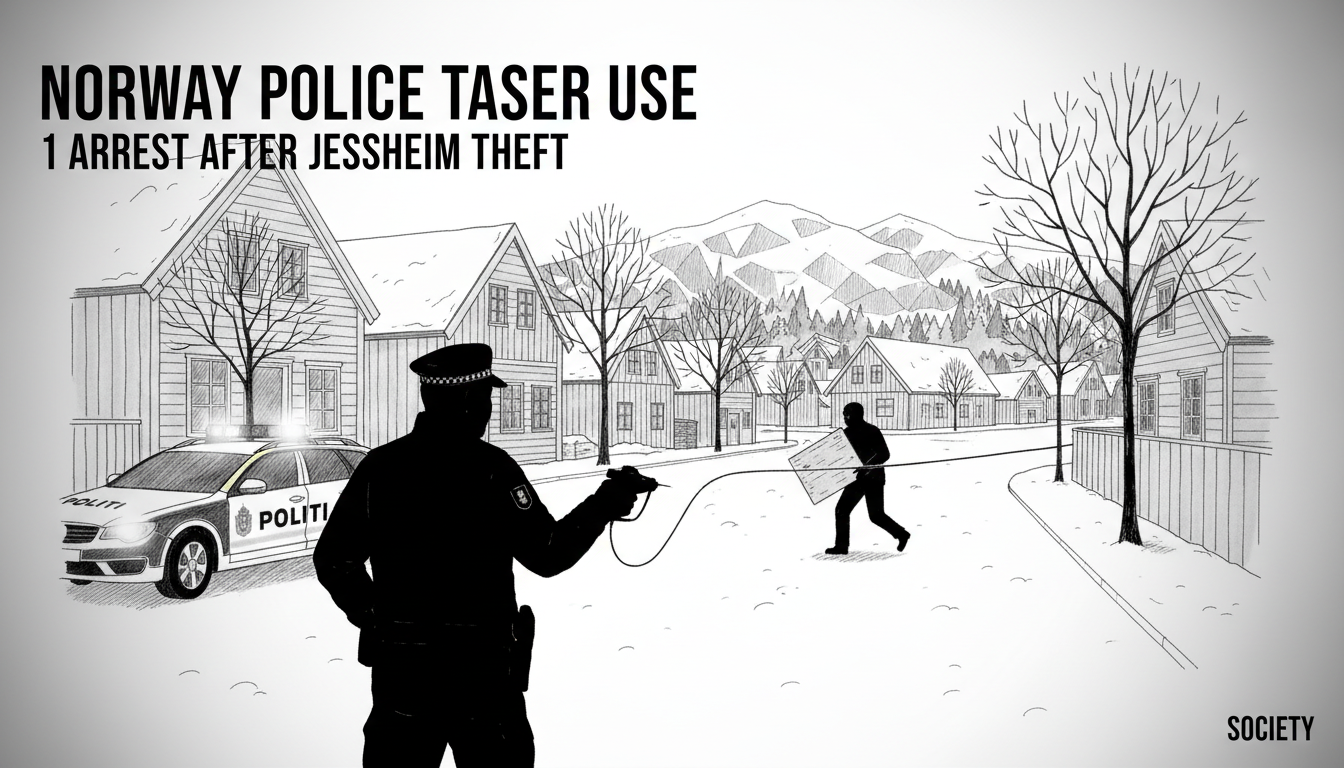
Norwegian police used a conducted electrical weapon, commonly known as a taser, to subdue a suspect following a mobile phone theft at Jessheim station. The incident, which escalated when the man became threatening towards officers, has resulted in multiple charges including violence against police and drug possession. This arrest highlights ongoing challenges with public order and the strict protocols governing police use of force in Norway.
A patrol responded to a report from a man in his thirties who said his mobile phone had been stolen. The suspect, a man in his forties from Lillestrøm, was still at the scene. According to police operations leader Atle Vesttorp of the East Police District, the man's threatening behavior towards officers led to the decision to use the taser to gain control. The suspect was then taken into custody.
"He is reported for violence against the police, obstruction of the police, theft, and vandalism. The violence against police charge stems from spitting at the patrol," said mission leader Kjetil Elnan Ringseth. Police also found a small quantity of narcotics on the man during the arrest process, leading to an additional charge for drug possession.
A Measured Response Under Scrutiny
The deployment of a taser, or elektrosjokkvåpen, by Norwegian police is not a routine action. Norwegian law enforcement operates under a principle of proportional force, with de-escalation as a primary tactic. The use of such weapons is typically reserved for situations where there is a clear and immediate risk of violence or serious harm, and where lesser measures are deemed insufficient. The decision at Jessheim station suggests officers perceived a direct threat to their safety.
"The guidelines are very clear," explains a former police instructor who now consults on use-of-force protocols. He asked not to be named as he is not directly involved in the case. "A taser is considered an intermediate use of force. It is an alternative to physical struggle or baton use, intended to resolve a dangerous situation with a lower risk of serious injury to all parties. The key question investigators will ask is whether the officer's assessment of an imminent threat was reasonable."
In this instance, the suspect's alleged spitting constitutes a direct assault under Norwegian law, classified as violence against an official. This act, combined with reported threatening behavior, likely formed the basis for the escalated response. All such uses of force are subject to mandatory internal review.
The Broader Context of Station Security
Jessheim station, located in the municipality of Ullensaker in Viken county, is a key public transport hub north of Oslo. Incidents of theft and public disorder, particularly those involving intoxicants, place a significant operational burden on local police patrols. The East Police District has repeatedly highlighted resource allocation challenges in covering vast geographic areas with multiple population centers.
The presence of narcotics in this case adds a familiar layer of complexity. Drug-related crime often intersects with petty theft and public disturbances, creating volatile situations for responding officers. Norway's approach to drug possession, while still punitive, has shifted in recent years toward a greater emphasis on public health. However, possession remains illegal, and when combined with other criminal acts, it compounds the legal consequences for suspects.
Local residents express mixed feelings. "You want to feel safe taking the train, especially in the evening," said one commuter at the station. "It's good the police responded quickly, but it's also worrying that it came to that point. It makes you wonder what's happening."
Legal Ramifications and Police Procedure
The suspect now faces a catalogue of charges that reflect the sequence of the event. Theft of the mobile phone is the originating crime. His subsequent actions toward the police—obstruction, spitting (charged as violence), and any vandalism—are separate offenses that arose during the intervention. The drug possession charge, while discovered during processing, is a distinct violation.
Conviction for violence against a public official carries potentially severe penalties, including imprisonment. Each charge will be investigated separately, though they will likely be heard together in court. The police's use of the taser will not be part of the criminal case against the suspect but will be examined internally to ensure compliance with the Police Directorate's regulations.
This internal review is standard. It will assess whether the use of force was necessary, proportionate, and conducted according to training. Officers must file a detailed report, and any injuries to the suspect are documented. The independent Norwegian Bureau for the Investigation of Police Affairs (Specialenheten for politisaker) would only become involved if there were allegations of serious misconduct or significant injury.
Balancing Force and Public Trust
Norway's police model prides itself on civic trust and a generally unarmed presence. The sight of an officer drawing a taser is therefore a notable event. It signifies a breakdown in de-escalation and a transition to a higher-risk intervention. Public perception of such acts is crucial for maintaining the legitimacy of the police force.
Experts note that these tools, when used correctly, can prevent worse outcomes. "A successful taser deployment can end a confrontation without the broken bones or head trauma that can come from a physical fight or a baton strike," the former instructor noted. "But it is a potent tool. Its use is, and should be, controversial every single time. Complacency is dangerous."
The incident at Jessheim serves as a microcosm of wider debates about policing, public safety, and social issues. It involves theft, drugs, and a confrontation with authority, all playing out in a public space essential to community function. The police response, while dramatic, was framed within a strict legal and procedural framework designed to minimize harm.
As the case moves through the legal system, it will test the boundaries of that framework. Did the circumstances justify the voltage? The answer will depend on the evidence of the threat the officers faced in that moment on the platform. For the people of Jessheim, the answer will also shape their feeling of security at their local station, where the ordinary act of catching a train briefly collided with a flash of controlled electricity and the complex realities of modern policing.
Will the detailed review of this incident reinforce public confidence in police restraint, or will it raise questions about the thresholds for using such force in crowded public spaces? The outcome may influence patrol strategies at transport hubs across Viken county.