
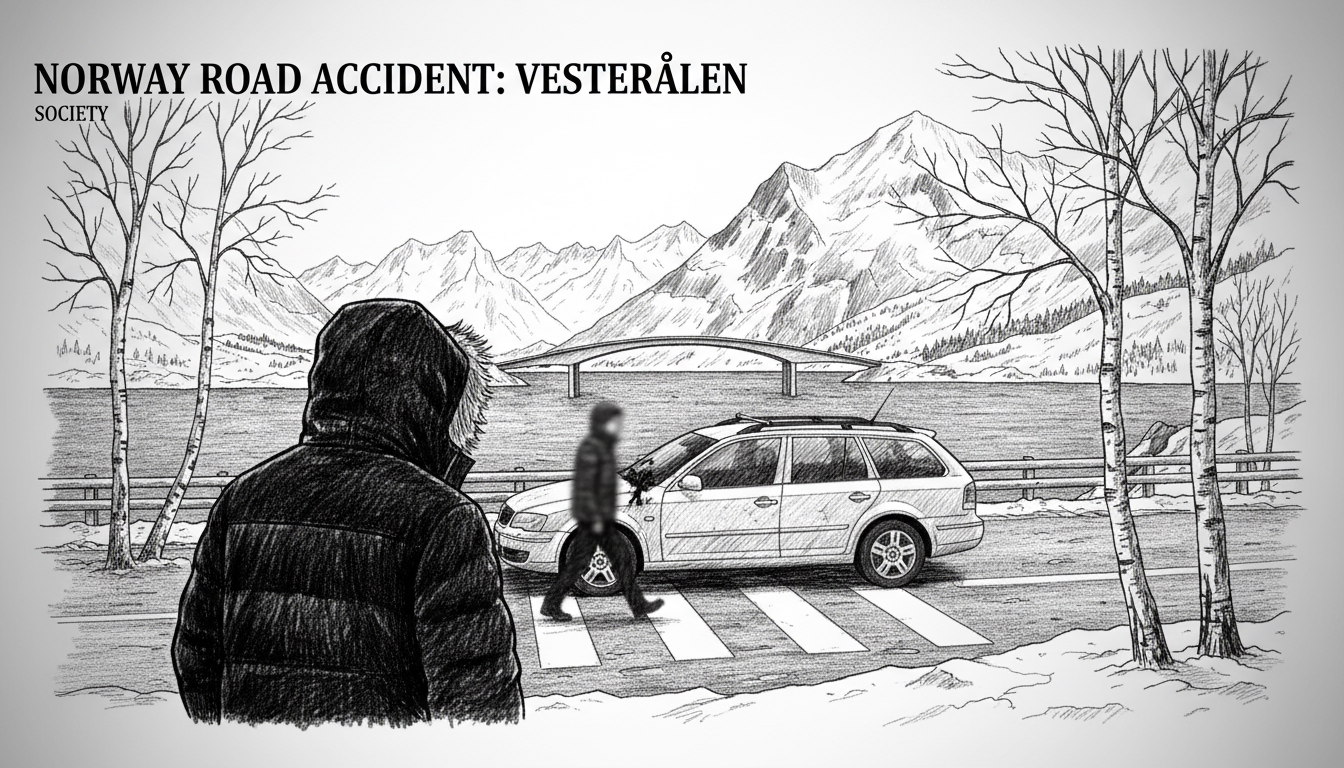
Norway road safety faces a critical test after a pedestrian was hit by a car in Hadsel municipality Tuesday afternoon. The serious accident in Nordland county has closed a local road, prompting an immediate police investigation. This incident strikes at the heart of Norway's ambitious Vision Zero policy, which aims to eliminate all traffic fatalities and serious injuries.
Emergency services responded to the scene in the Vesterålen archipelago following the alert. Police confirmed the collision involved a single vehicle and a pedestrian, describing it as a serious accident. The road closure is a standard procedure to allow for a thorough forensic investigation and to give emergency crews unimpeded access. Such measures are routine in Norway, where every fatal or serious crash triggers a detailed analysis to find systemic causes.
A Remote Archipelago Presents Unique Challenges
Hadsel municipality is situated in the distinctive Vesterålen district, north of the more famous Lofoten islands. The region is known for its dramatic coastal scenery, fishing villages, and a population spread across islands and fjords. This geography directly impacts road safety and emergency response. Nordland county has a lower population density than southern Norway, which can mean longer travel times for ambulances and police.
Road conditions in northern Norway present specific hazards, especially as the region moves deeper into autumn. The period of polar night is approaching, bringing extended darkness that reduces visibility for drivers and pedestrians alike. Weather can change rapidly, with rain, frost, and high winds creating slippery surfaces. Road safety experts consistently highlight visibility and adaptation to conditions as paramount in preventing accidents in these regions.
Vision Zero Under Scrutiny After Serious Crash
This accident will be examined within the framework of Norway's Vision Zero strategy, adopted from Sweden. The policy is a cornerstone of Norwegian transport planning, asserting that no loss of life on the roads is acceptable. It shifts responsibility from individual road users to system designers—planners, engineers, and policymakers. Every serious accident is treated not as an inevitable 'accident' but as a failure of the system that can be corrected.
In 2022, Norway recorded 115 road fatalities, a number that has generally trended downward over decades due to concerted safety efforts. Each incident, however, represents a profound personal tragedy and a policy challenge. Investigations by the Norwegian Public Roads Administration and police will now seek to answer key questions. Was the road design adequate? Were speed limits appropriate? Were there sufficient pedestrian crossings and lighting? The answers will inform future safety upgrades in Hadsel and similar communities.
The Human and Community Impact
Beyond the statistics and policy, a serious traffic accident reverberates through a small community. In close-knit districts like Vesterålen, such events are deeply felt. The identity of the injured pedestrian has not been released, in line with Norwegian privacy practices following traumatic incidents. The driver of the vehicle is also receiving support as investigations determine the circumstances.
Local officials will be tasked with reviewing safety measures on the involved stretch of road. Municipalities in Norway have significant responsibility for local road maintenance and safety interventions. This can include installing new street lighting, creating better-marked pedestrian crossings, adding traffic calming measures like speed bumps, or adjusting speed limits. The findings from the police report will directly guide these potential actions.
A National Conversation on Rural Road Safety
This incident in Nordland feeds into a broader national discussion about equity in road safety. A significant portion of Norway's traffic fatalities occur on rural roads, which may have lower safety standards than main highways. Resources for continuous safety upgrades are finite, forcing difficult prioritization decisions. Should a frequently used rural road in the north get guardrails before a moderately used one in the south? These are the practical dilemmas behind Vision Zero.
Expert analysis of such accidents often focuses on a chain of factors rather than a single cause. Was the pedestrian wearing reflective clothing during the dim afternoon light? Was the driver's view obstructed? Was the vehicle's speed appropriate for the setting? Norwegian law requires pedestrians and cyclists to use reflectors in the dark, and drivers must adjust speed to maintain control and stopping distance within their field of vision. Enforcement and public education on these rules are ongoing challenges.
The road closure, while necessary, also underscores the fragility of transport networks in archipelago communities. With fewer alternative routes, a single accident can isolate areas, delaying deliveries and complicating daily life. This adds another layer of consequence to traffic incidents in regions like Vesterålen, where the road is often a lifeline.
Looking Ahead: From Investigation to Action
The immediate focus remains on the investigation and the condition of the injured pedestrian. In the weeks ahead, the relevant authorities will compile their findings. The goal is not merely to assign blame but to understand the sequence of events with clinical precision. This data becomes part of Norway's extensive road safety database, used to identify trends and develop targeted countermeasures.
For the residents of Hadsel, the hope will be that this tragedy leads to tangible improvements that prevent a repeat. It might mean a new pedestrian crossing, improved street lighting before winter's darkness fully sets in, or enhanced signage. Norway's commitment to Vision Zero means that every serious accident must yield lessons and trigger a response. The system failed a pedestrian in Vesterålen on a Tuesday afternoon. The nation's pledge is to ensure that failure makes the roads safer for everyone tomorrow. Can a policy that aims for zero fatalities ever truly succeed, or is it a necessary, driving ideal in the face of human and mechanical fallibility? The response to this accident in Nordland will provide a partial answer.