
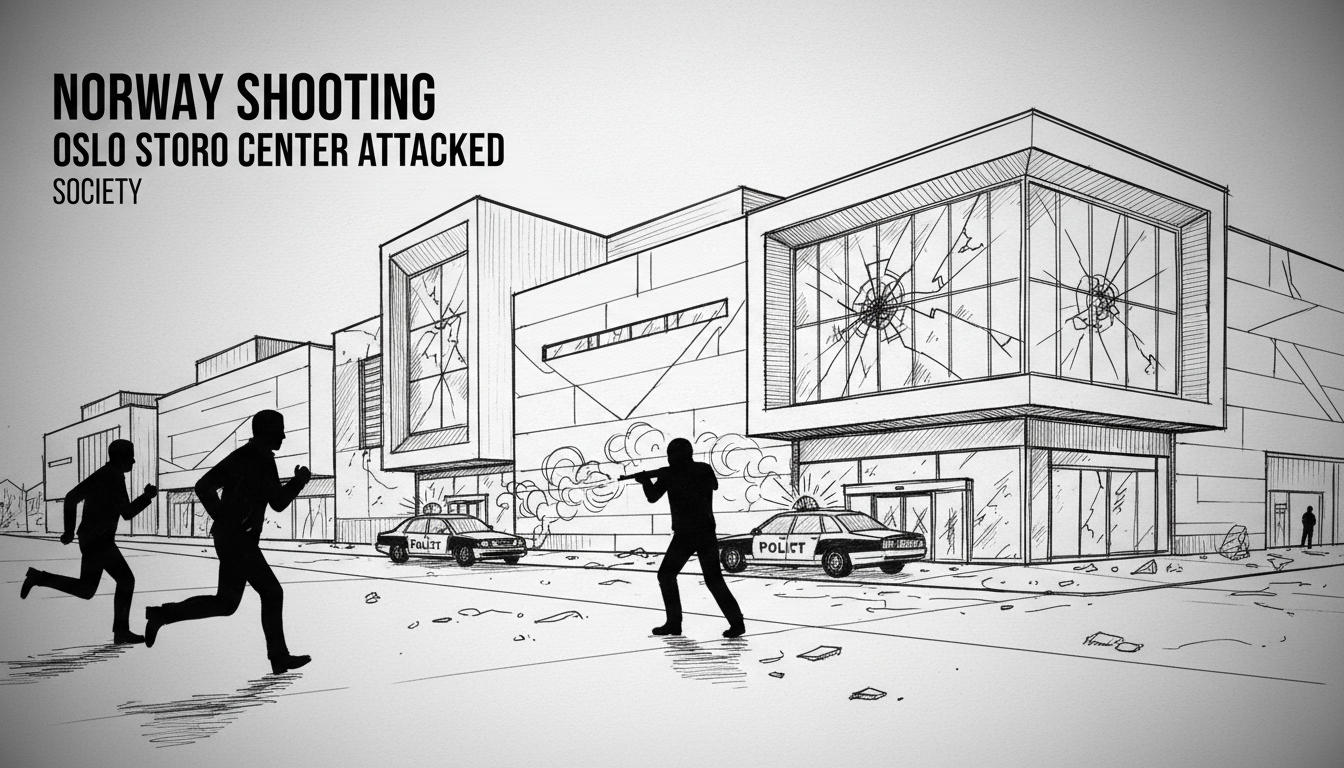
Norway police have a suspected shooter in custody after shots were fired inside the Storo shopping center in Oslo. The incident, which occurred on a weekday morning, has sent shockwaves through a nation where such public gun violence remains exceptionally rare. Police operations leader Eirik Sannes confirmed the response in a log entry at 10:56 AM, stating authorities had control of the shooter and were searching for additional injured or involved parties. Witnesses reported a heavy emergency service presence with multiple police cars and ambulances outside the bustling retail complex.
A Nation Confronts a Rare Trauma
For Norwegians, the immediate news from Storo Senter triggers a profound and collective anxiety. The country maintains some of the world's strictest firearm regulations, resulting in a firearm homicide rate that is a fraction of that seen in many other developed nations. Public shootings, particularly in crowded civilian spaces like shopping malls, are statistical anomalies. This context makes Tuesday's event not just a local crime, but a national psychological event, inevitably drawing comparisons to the darkest day in modern Norwegian history: the July 22, 2011 attacks.
“Any event like this immediately reactivates the trauma of 2011 for the entire society,” said Dr. Kari Pettersen, a clinical psychologist specializing in collective trauma at the University of Oslo. “The setting—a place of everyday normalcy, of commerce and community—is violently transformed. The sense of safety, which Norwegians highly value and largely experience, is punctured. The coming days will involve a complex public process of managing fear while reaffirming social cohesion.”
The Immediate Response and Investigation
Oslo Police District mobilized rapidly to the scene in the Storo district, a major transport hub and residential area. The operational priority, successfully achieved, was to isolate and detain the suspect. With the shooter in custody, the investigation phase intensifies. Police will now work to establish a definitive motive, whether the act was targeted or random, and if any other individuals were involved in planning or execution. Forensic teams will meticulously process the scene inside the center.
Security protocols at Norwegian shopping centers, which typically focus on retail theft and general public order rather than armed attack, will come under immediate scrutiny. “While Norway’s threat level is carefully assessed, the reality is that soft targets like malls are challenging to secure completely against determined, illegal violence,” noted security analyst Henrik Lunde. “The focus will be on emergency response coordination, public alert systems, and how quickly an area can be locked down. The performance of the police first responders will be analyzed in minute detail.”
The Stark Contrast of Norwegian Gun Laws
The incident throws Norway’s rigorous approach to gun ownership into sharp relief. To legally own a firearm, applicants must pass a thorough background check, demonstrate a valid reason such as hunting or sport shooting, and complete mandatory safety training. Handguns and semi-automatic rifles are particularly heavily restricted. This framework is supported by broad political and public consensus and is credited for the nation's low rates of gun violence.
A 2021 study by the Norwegian Institute of Public Health found that the rate of firearm homicides in Norway is approximately 0.1 per 100,000 inhabitants, one of the lowest figures globally. This statistic underscores why each incident is met with such profound disruption. The violence at Storo Senter is not normalized; it is a glaring exception to the peaceful daily reality for millions of Norwegians.
Community Impact and the Road Ahead
Beyond the police tape, the impact radiates through the local community. Shoppers, retail workers, and residents in the surrounding apartments are directly affected. Crisis psychology teams from the municipal health service will likely be deployed to offer support to witnesses and those who were inside the center. Parents may grapple with how to discuss the event with children, and the center's management will face the difficult task of reopening a space now associated with trauma.
The political reaction in the coming days will be measured. Parliament members will likely call for briefings from the Justice and Public Security Ministry. The debate will center on whether existing laws are sufficient or if additional preventive measures are needed, all while avoiding a reaction that fundamentally alters the open nature of Norwegian society. The shadow of the 2011 reforms, which strengthened police and security service capacities, looms over this discussion.
For now, Oslo is left with unanswered questions and a renewed sense of vulnerability. The Storo Senter, a symbol of mundane urban life, has become the latest site where a nation's resilience is tested. The full story of what happened inside its doors is still being pieced together by investigators. The broader story—how Norway processes, responds to, and heals from this violation of its peace—will unfold in the weeks and months to come. Can a society built on trust maintain its openness in the face of sporadic, shocking violence? The answer will define Norway's path forward.