
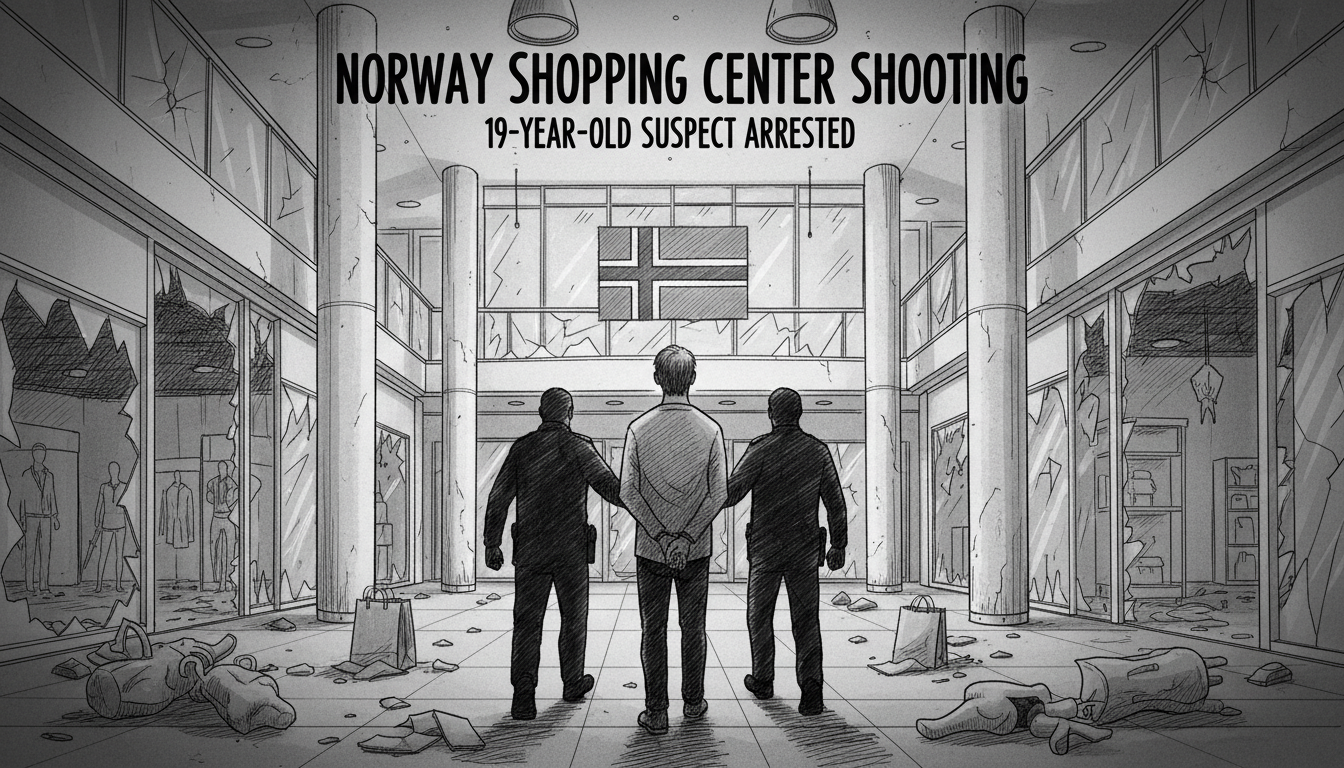
Norway police arrested a 19-year-old man after a single gunshot was fired at the Storo Storsenter shopping mall in Oslo on Monday morning. The incident, which triggered a mass evacuation and sent shockwaves through the capital, ended without physical injuries but left deep psychological scars on employees and shoppers. The suspect, an Oslo resident not previously known to police, reportedly called the authorities himself before the shot was fired.
"It's just completely awful. Nobody wants that," said Linda Rød, an employee at the Musti pet store, describing the moment she heard the loud gunshot while at work. Her raw statement, "helt jævlig," captures the visceral fear that disrupted an ordinary Monday. Police operations leader Tomm Berger confirmed the sequence, stating the emergency call was disconnected after the suspect reported having a weapon on the premises.
A Morning Shattered by a Single Shot
The incident unfolded just before 11 a.m. at one of Oslo's busier suburban retail hubs. For the staff and customers inside, the morning transformed from routine to terror in an instant. Bara Safar, working at Krogh Optikk near where the shot was fired, described hearing a scream, then a bang, and seeing a person fall. That moment ignited panic. "People started screaming 'run, run!' Everyone started screaming at each other," Safar recounted.
The sound of the single gunshot was unmistakable. Linda Rød initially dismissed it as an improbability. "When I first heard it, I thought: 'Wow, that was very loud.'" The reality set in only when her store manager entered and ordered an evacuation. "I felt the adrenaline starting to kick in and I got evacuated," she said, adding she was left trembling and anxious.
Evacuation and a Harrowing Wait
The police response was swift, moving to secure the suspect and the weapon quickly. For those hiding inside locked store rooms, however, the minutes stretched into an agonizing void of information. Karima Garbacz, a 33-year-old hairdresser, described a client fleeing into her salon shouting about a man with a gun. "We rinsed the hair of the customers as fast as possible and hid in the back room," she said. The fear was primal. "I thought someone was going to come and shoot us. We were a bit in a panic.
Garbacz emphasized the psychological torment of the lockdown. "It was the worst. We didn't know anything. When we were finally allowed to go out it was very uncomfortable. We didn't know if someone would suddenly appear. It was a traumatic experience." Her account highlights a critical aspect of such crises: the profound stress inflicted by uncertainty and isolation, even after the immediate threat is neutralized.
A Nation's Fraught Relationship with Gun Violence
While Norway maintains strict gun control laws and experiences far fewer firearm incidents than many nations, any shooting reverberates with particular intensity. The national psyche remains marked by the trauma of July 22, 2011, when a far-right extremist killed 77 people in a bombing and shooting rampage. That attack fundamentally altered Norway's approach to security, emergency preparedness, and societal cohesion.
Monday's event at Storo, while isolated and ending without loss of life, inevitably taps into that collective memory. It challenges the perceived safety of everyday spaces like shopping centers. "We came quickly to the scene and got control of him and the weapon," said Police Operations Leader Berger, underscoring the effective police response. Yet, the ease with which fear spread through the mall underscores how fragile that sense of security can be.
The Suspect and the Unanswered Questions
The identity and motives of the 19-year-old suspect remain under investigation by Oslo police. The fact that he is not previously known to law enforcement and that he allegedly initiated contact with police presents a complex picture. This detail suggests the act may have been a cry for help or an expression of severe personal distress, rather than a planned attack on others.
Criminologists and security experts will likely examine this case through the lenses of mental health support systems and intervention protocols. Norway has robust social services, but gaps can persist. The incident raises difficult questions about how societies identify and assist young individuals in crisis before they reach a breaking point that endangers public order.
The Aftermath: Trauma and Resilience
In the immediate aftermath, the focus for authorities shifted from containment to care. Dozens of people witnessed the event or endured the stressful evacuation. The Oslo police and municipal health services typically deploy crisis teams following such incidents to offer psychological first aid and longer-term support referrals. The impact on employees like Linda Rød and Karima Garbacz can be lasting, potentially manifesting as anxiety, sleep disturbances, or reluctance to return to work.
The shopping center management now faces the task of restoring a sense of normalcy and safety for both tenants and customers. Security procedures may be reviewed. For the local community in the Storo district, the mall is a central everyday space; its violation feels personal.
A Comparative Look at Security and Society
Norway's gun homicide rate is among the lowest in the world, a fact attributed to its stringent firearm legislation, which requires licensing based on documented need (like hunting or sport shooting), background checks, and safe storage rules. Incidents like the Storo shooting are statistical anomalies, which is why they command such intense attention.
This contrasts sharply with countries where mass shootings are frequent. The Norwegian response is characterized by a focus on policing efficiency, mental health context, and community recovery, rather than political debates over gun ownership. The system's design aims to prevent individuals from obtaining weapons for malicious intent, though, as this case shows, no framework is entirely impervious.
Looking Ahead: Policy and Prevention
The Oslo police will continue their investigation, examining the suspect's background, how he obtained the firearm, and his precise motivations. The incident will likely prompt internal reviews of emergency communication protocols, especially regarding how information is relayed to people in lockdown situations, a point of distress highlighted by the hairdresser's testimony.
On a broader level, the event may renew discussions about youth mental health services and early warning systems. It serves as a somber reminder that public safety relies not only on effective policing but also on a social infrastructure capable of supporting individuals before they escalate to violence. The suspect's alleged phone call to police is a paradoxical detail—an act that created a crisis, yet also signaled a potential plea for intervention.
Norway has been tested by violence before and has consciously built its response around both justice and healing. The Storo Storsenter shooting, while limited in scope, is another test of that resolve. It proves that safety can be fractured in a moment by a single act, and that rebuilding it requires addressing both the immediate threat and the deeper human fractures that may lie beneath.