
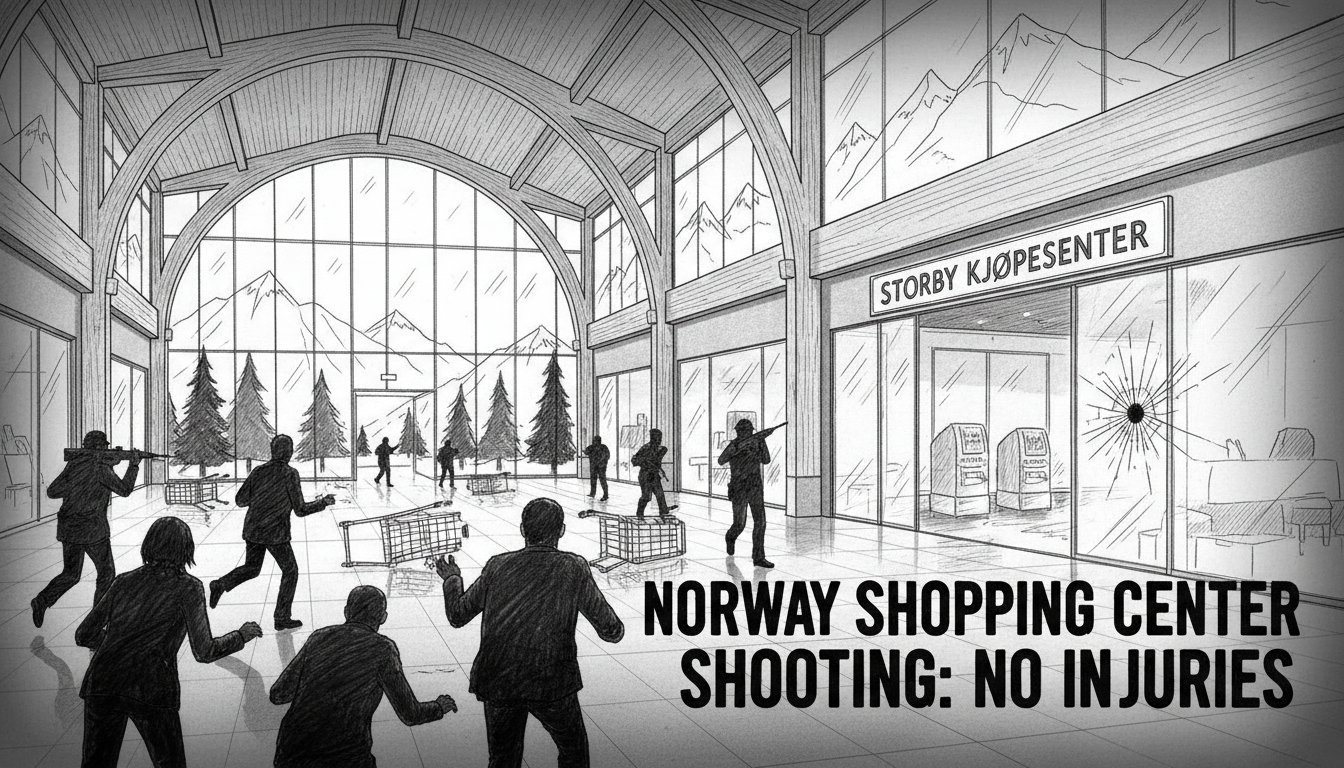
Norway records fewer than 10 gun homicides in a typical year, a statistic that framed the shock when a shotgun blast tore through the ceiling of a busy Oslo mall Thursday. Shoppers at Storo Storsenter scrambled for cover as a man armed with multiple weapons fired a single round into the air. Police swiftly contained the situation, arresting a suspect who possessed two handguns, a shotgun, a baseball bat, and a possible knife. No injuries were reported in an incident that has ignited a fresh debate on public safety and the efficacy of the country's strict firearm controls.
Panic at a Public Hub
Thursday afternoon's normalcy at Storo Storsenter, a major retail hub in Oslo's north, shattered with the sound of gunfire. Witnesses described a moment of confusion followed by controlled evacuation as police units arrived. The incident commander on site clarified the nature of the threat. “It is a shot in the ceiling. There is nothing to indicate that he attempted to hurt anyone,” the leader said. The center resumed normal operations within hours, but the psychological impact on patrons and staff lingered. The event disrupted one of Oslo's busiest commercial areas, a place where violent crime is exceptionally uncommon.
The suspect's arsenal was particularly alarming to authorities. In addition to the discharged shotgun, he was carrying two handguns and a baseball bat. The presence of multiple firearms, especially handguns which are tightly restricted, immediately raised questions about their origin. Norwegian police have launched a full investigation into how the individual amassed this collection. Initial reports suggest the man acted alone, with no clear political or terror-related motive disclosed at this early stage.
Scrutiny on Firearm Controls
This incident directly tests Norway's comprehensive gun control framework. Obtaining a firearm license here is a rigorous process. Applicants must demonstrate a “genuine need,” such as hunting or certified sports shooting, and pass thorough background checks conducted by police. Mental health assessments are part of the evaluation. Ownership of handguns is particularly limited, primarily to competitive shooters. The illegal possession of firearms carries a severe penalty, reflecting the societal consensus against weapon proliferation.
“This case will inevitably lead to a review of how such weapons ended up in a public space,” said a legal scholar familiar with Norwegian justice policy, who spoke on condition of anonymity ahead of the formal investigation. “The system is designed to prevent this, so a breach, however isolated, demands explanation.” The last major public shooting in Norway, the 2011 Utøya attack, led to a further tightening of regulations. Today's event at a shopping center—a soft target—brings different security concerns to the fore.
Experts Weigh In on Security and Motive
Security analysts point to the rarity of such events in the Nordic region. “Norway has one of the lowest rates of gun violence in the world,” said an expert in public safety at the University of Oslo. “This incident is an outlier, but it stresses that no system is infallible. The focus now must be on the security response in crowded spaces and the perpetrator's access to weapons.” The psychological profile of individuals who commit such acts of public disruption, without an apparent intent to harm, is also a key area of inquiry. Experts suggest it can stem from a desire for attention, a cry for help, or an expression of personal crisis.
The police response is now under examination. Their ability to secure the area and arrest the suspect without escalation is being praised. However, the broader question is whether current security measures at malls and transport hubs are sufficient. Unlike airports or government buildings, shopping centers in Norway typically rely on private security and visible police patrols rather than metal detectors or extensive screening.
Implications for Oslo and Beyond
For Oslo residents, the shooting at Storo is a jarring reminder of vulnerability. While the risk remains statistically minuscule, the perception of safety in everyday spaces is crucial. City officials have assured the public that police presence will be heightened in key areas in the coming days. The incident also arrives during a period of national discussion on organized crime and illegal weapons trafficking, though no link has been suggested in this case.
The Storting, Norway's parliament, may see renewed calls to examine enforcement aspects of gun laws. “Every incident like this forces us to look at our controls again,” a member of the parliamentary justice committee said. “The laws are strong, but we must always ensure enforcement and monitoring are equally strong.” The debate will likely balance liberty and security, a delicate equation in a society deeply proud of its open and trusting nature.
As the investigation continues, the core facts offer little comfort: a man walked into a crowded mall with a small arsenal and fired a weapon. That no one was physically hurt is a relief, but the sound of that shot echoes through Norway's conscience. It challenges the nation's self-image and tests the resilience of its social contract. In the days ahead, the focus will be on the police findings and whether this event remains a frightening anomaly or a sign of something requiring new vigilance.