
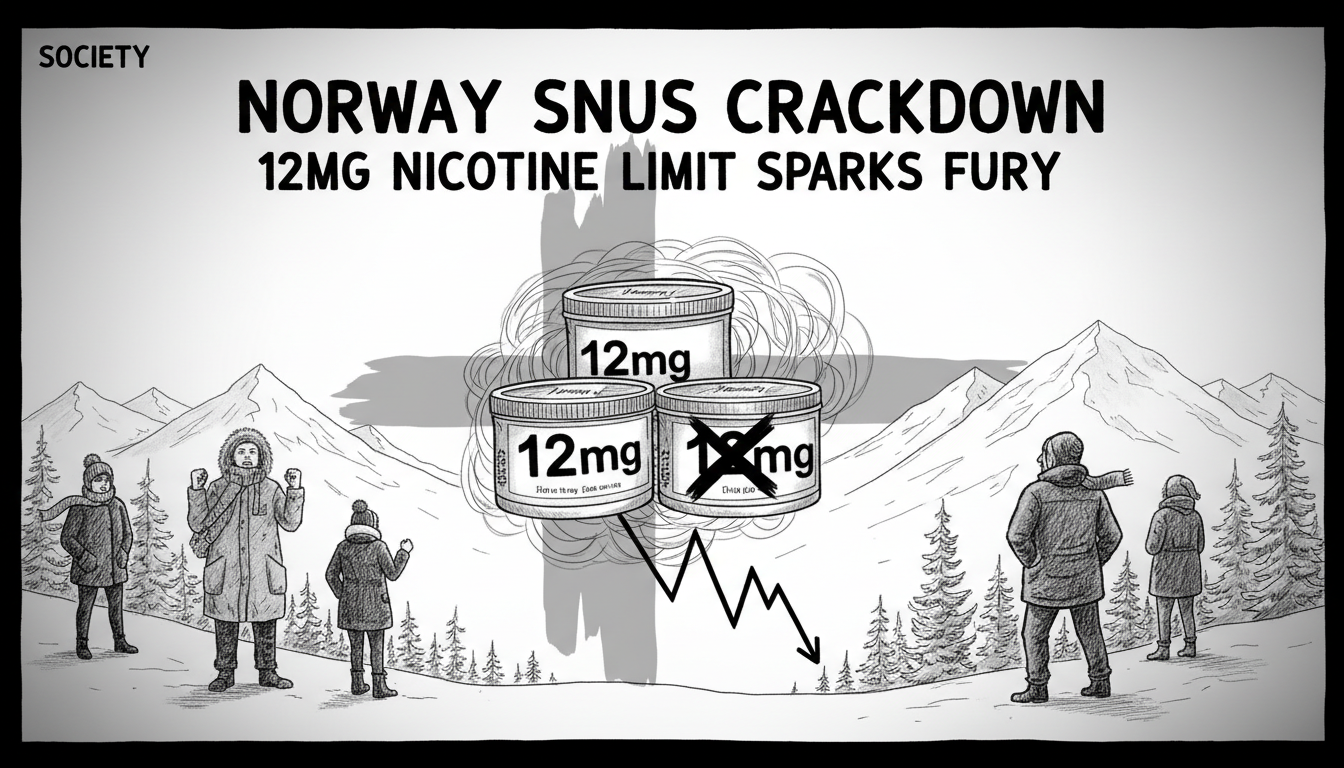
Norway's government faces a political firestorm over its proposal to cap nicotine levels in snus, a move the opposition Center Party warns will criminalize ordinary citizens. The plan, now out for public consultation, aims to set a maximum nicotine content of 12 milligrams per gram of the smokeless tobacco. This directly targets popular products that currently range between 12 and 16 mg/g. Center Party MP Bent-Joacim Bentzen launched a fierce critique, arguing the policy would backfire on public health and erode respect for the law. "This will make ordinary people into lawbreakers," Bentzen said in a statement, capturing the core of a heated debate that pits health objectives against practical enforcement and personal choice.
A Divisive Proposal on a National Habit
The government's consultation document outlines two key restrictions: the 12 mg/g nicotine ceiling and a maximum size for snus pouches. For a nation where 13% of the adult population uses snus daily, according to 2023 data from Statistics Norway, this represents a significant regulatory shift. Usage is heavily skewed, with men being far more likely users than women. Snus, a moist tobacco powder placed under the lip, occupies a unique legal niche. It is banned throughout the European Union, with Sweden securing a permanent exemption due to its cultural tradition. Norway, while not an EU member, follows many EU rules through its EEA agreement but maintains its own legal market for snus, taxing and regulating it domestically. This latest proposal marks the strictest intervention into product composition to date.
The Center Party's Stark Warning
Bent-Joacim Bentzen's criticism goes beyond typical political disagreement. He frames the proposal as a fundamental miscalculation with dangerous unintended consequences. "We risk creating a huge black market," Bentzen argues. His concern is that dedicated users, faced with a legally mandated weaker product, will seek out stronger snus through illicit channels. This, he contends, shifts control from regulated Norwegian producers and retailers to unregulated criminal networks. The health argument is turned on its head: instead of protecting citizens, the state would be pushing them toward products with unknown quality, purity, and strength. Furthermore, Bentzen emphasizes the social cost of turning a common, legal habit into a potential crime. "It undermines the trust between people and the authorities when the law is out of step with daily life," he stated, touching on a deep-seated Norwegian principle of lawful conduct.
The Health Argument: Protection vs. Harm Reduction
The government's rationale is firmly rooted in public health, specifically in preventing nicotine addiction, particularly among youth. Health authorities point to the addictive properties of nicotine and aim to make snus less appealing and less dependency-forming by limiting its potency. This aligns with a broader tobacco control strategy. However, the expert community is not unanimous. A significant school of thought views snus as a substantially less harmful alternative to combustible cigarettes. For them, snus is a critical tool in smoking cessation, offering nicotine without the tar and carcinogens produced by burning tobacco. Stricter regulation, from this perspective, could have the perverse effect of pushing people back to smoking or to the black market, thereby increasing overall health risks. The debate hinges on whether the policy is seen as targeting absolute harm or managing relative risk.
Market Realities and Consumer Choice
A nicotine cap of 12 mg/g is not a marginal adjustment for the industry. It sits at the very bottom of the current standard range. Many bestselling products would require reformulation to comply, potentially altering the taste and experience that users have come to expect. The proposed pouch size limit adds another layer of control, potentially affecting the product's duration and nicotine delivery. Consumers are presented with a constrained choice: accept a milder, legally available product, quit entirely, or seek alternatives. For the government, this constraint is the point. For critics, it represents an overreach that ignores consumer behavior. The experience from other markets with strict prohibitions suggests that demand does not simply vanish; it finds other outlets. The question for Oslo is whether Norway's high levels of trust and rule-following will override the global trend toward illicit trade when a popular product is heavily restricted.
A Look at the Broader Nordic Context
Norway's snus dilemma cannot be separated from its regional context. In Sweden, snus is not only legal but culturally entrenched, credited by many public health researchers as a major factor behind the country's low smoking rates. Sweden is on the verge of achieving "smoke-free" status, defined as less than 5% adult smoking prevalence. Finland, another Nordic neighbor, bans snus as per EU rules but struggles with smuggling from Sweden. Norway's path is its own. It has successfully reduced smoking through high taxes, plain packaging, and public campaigns, while permitting snus as a legal, though taxed, alternative. The new proposal signals a desire to tighten the screws on all nicotine products, not just cigarettes. This puts Norway at a policy crossroads: should it follow Sweden's model of embracing snus as a harm-reduction tool, or pursue a more abstention-focused model that targets nicotine itself?
What Comes Next: Consultation and Political Battle
The proposal is now in a standard public consultation phase, where industry groups, health organizations, and citizens can submit feedback. The feedback will likely be sharply divided. The tobacco industry will argue against the caps, health NGOs will largely support them, and user groups may voice practical concerns. The political battle in the Storting, however, may prove more decisive. The Center Party, despite being in opposition, has a strong voice on issues affecting rural and ordinary Norwegians. Their framing of the debate around lawfulness and practical consequences could resonate with other parties. The government will need to build a convincing case that the health benefits of a weaker snus outweigh the risks of non-compliance and market displacement. It must also detail how it plans to enforce the new limits at the border and within the country, a task that would require new resources for customs and regulatory agencies.
The Core Conflict: State Protection vs. Personal Agency
At its heart, the snus debate is a classic Nordic governance conflict. On one side is the state's role as a protector of citizen health, willing to use regulation to shape behavior for the collective good. On the other is a respect for personal agency and a pragmatic approach to laws that must command public respect to be effective. Bentzen's warning about creating "lawbreakers" strikes at this very tension. Will Norwegians who have legally used a specific-strength snus for years quietly accept a state-mandated weaker version? Or will a segment of them seek to maintain their habit through other means, thus fulfilling the prophecy of increased criminality? The government is betting on compliance; its opponents are betting on human nature. The outcome will set a precedent for how far Norway is willing to go in regulating legal but potentially harmful substances, a question that extends far beyond tobacco. As the consultation proceeds, one thing is clear: the fight over this small pouch of tobacco reflects much larger questions about liberty, health, and the limits of law in Norwegian society.