
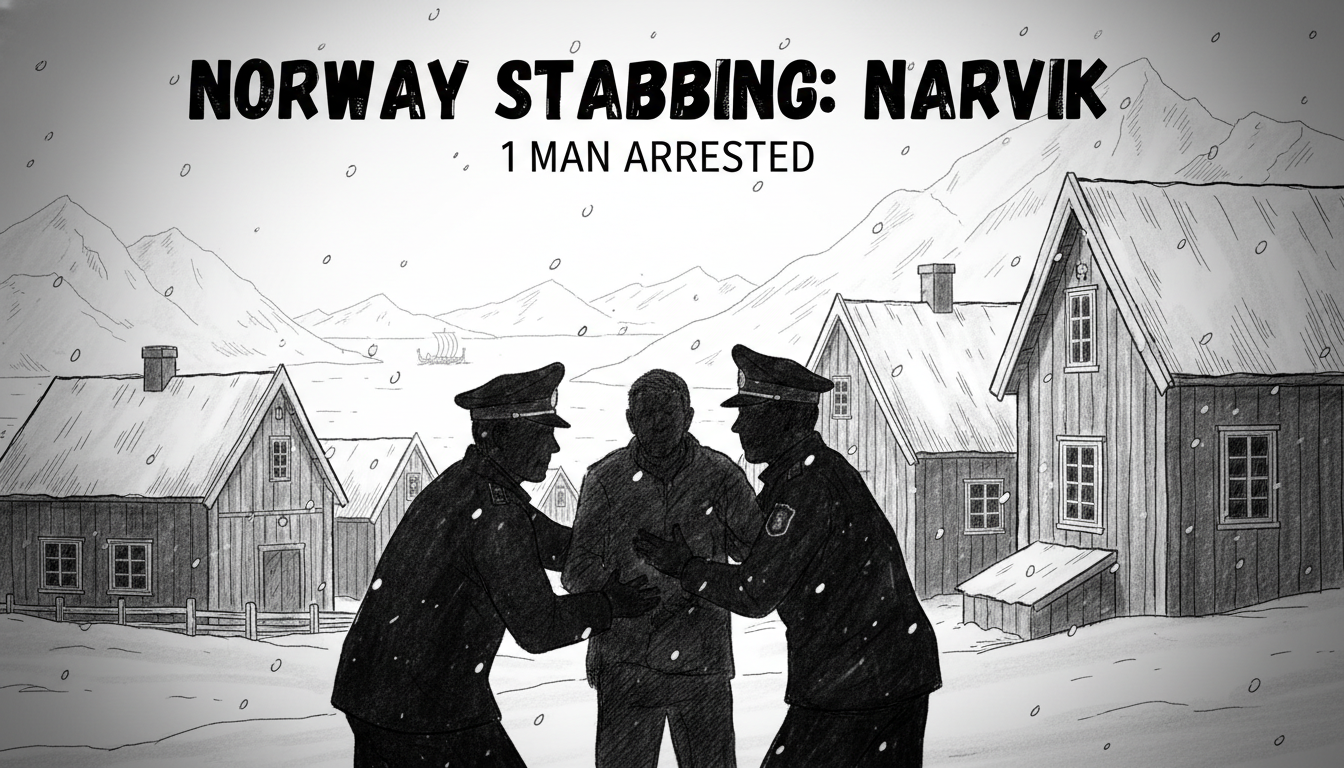
Norway police have arrested one man following a serious stabbing incident in the northern port town of Narvik. The victim was discovered by officers outside a residential address and rushed to hospital, with the severity of their injuries still unknown as authorities work to secure evidence and interview neighbors.
A Quiet Night Shattered by Violence
Police were called to a residential area in Narvik late Tuesday night. Officers found an individual with stab wounds outside a specific address. Emergency services provided immediate aid before transporting the victim to Narvik Hospital. The police operation moved swiftly from securing medical care for the injured person to launching a criminal investigation. A suspect, an adult male, was apprehended at the scene without further incident. The speed of the arrest suggests the alleged perpetrator did not flee the area.
“We are now working on securing evidence in the case,” a police operations leader said in a brief statement. The priority in the immediate aftermath was to preserve the crime scene. Forensic teams would have worked under the long Arctic twilight, a period of extended dusk common in Nordland county during summer, to document the area and collect any physical evidence.
The Investigation Shifts to Motive and Circumstance
With a suspect in custody, the investigation entered a new phase on Wednesday. Police confirmed they would continue their work with interviews of neighbors in the vicinity. This step is standard procedure but critical. Witness accounts can help establish a timeline, the relationship between the victim and suspect, and the events leading up to the violence. The police have not released any information regarding a possible motive, the weapon used, or the condition of the victim, citing the ongoing nature of the inquiry.
Criminologists point to the first 48 hours as vital in cases of serious assault. “The immediate securing of the scene and rapid witness interviews are paramount,” explains Dr. Henrik Lunde, a professor of criminology at the University of Tromsø. “In a stabbing, the forensic evidence can be very specific, but witness testimony often provides the context that explains the ‘why’. The investigators will be piecing together a narrative from physical evidence and human accounts simultaneously.”
The severity of the victim’s injuries will directly influence the potential charges. Norwegian law distinguishes between various degrees of bodily harm, with grievous bodily harm carrying significantly heavier penalties than minor assault. The police’s initial reluctance to detail the victim’s condition is standard, as medical assessments can evolve.
Narvik: A Historic Port Grappling with Modern Realities
The incident casts a shadow over Narvik, a community of roughly 22,000 people known more for its industrial heritage and dramatic scenery than violent crime. Narvik’s ice-free port is a crucial hub for iron ore exports from Sweden, making it an economic linchpin for the region. Its history is dominated by the fierce World War II battles fought for control of that strategic port. Today, it is a gateway for Arctic tourism and maritime industry.
Local crime statistics generally show Narvik as having rates of violent crime comparable to similar-sized Norwegian towns, though any serious incident is deeply felt in a close-knit community. “It is always a shock when something like this happens at home,” says Anna Pedersen, a member of the Narvik municipal council. “We are a town that looks out for one another. Our thoughts are with the victim and their family, and we have full confidence in the police to handle the investigation thoroughly.”
The police presence in the neighborhood where the stabbing occurred remained visible on Wednesday. Officers conducted door-to-door inquiries, seeking anyone who might have seen or heard anything unusual. This methodical, community-focused approach is typical of Norwegian police investigations, which emphasize thoroughness over speed in the follow-up phase.
The Path Forward for the Judicial Process
The suspect will be held in custody while the police complete their initial investigation. Under Norwegian law, he can be held for up to 48 hours before a custody hearing must be held before a judge. At that hearing, the police will argue for continued detention, presenting their initial evidence to show probable cause that a serious crime has been committed and that the suspect is likely responsible.
If the court grants detention, the suspect can be held for up to four weeks at a time while the investigation proceeds. The police will then work with the public prosecutor’s office to build a case. This process involves analyzing forensic reports, compiling witness statements, and potentially conducting further searches. Given the nature of the alleged crime, the case is likely to be handled by the Nordland police district’s serious crimes unit.
Legal experts note that cases with a clear suspect arrested at the scene can proceed more directly than unsolved mysteries. “The focus here shifts from ‘who did it’ to establishing the precise legal qualification of the act and the circumstances that mitigate or aggravate it,” says lawyer Maren Johansen, who practices in Bodø. “The defense will be looking at self-defense claims, provocation, or the suspect’s mental state. The prosecution’s charge will depend almost entirely on the victim’s medical prognosis.”
A Community Awaits Answers
For the residents of Narvik, the coming days will be a waiting game. The lack of detailed information from authorities, while procedurally normal, often fuels community anxiety. Local social media groups were filled with expressions of concern and support, alongside the inevitable spread of unconfirmed rumors, which police typically urge the public to ignore.
The incident serves as a stark reminder that acute violence can occur anywhere, even in Norway’s picturesque and generally peaceful northern communities. It tests the local support systems, from the hospital treating the victim to the social services that may be engaged to support affected families.
The true impact of the event will be measured in the victim’s recovery and the judicial outcome. For now, the historic town of Narvik, surrounded by the steep slopes of the Ofoten mountains and the deep fjords, is left to hope for a full recovery and reflect on the fragile nature of public safety. The question hanging over the community is not just about what happened on one street, but about how a town built on resilience responds when modern violence intrudes upon its quiet Arctic streets.