
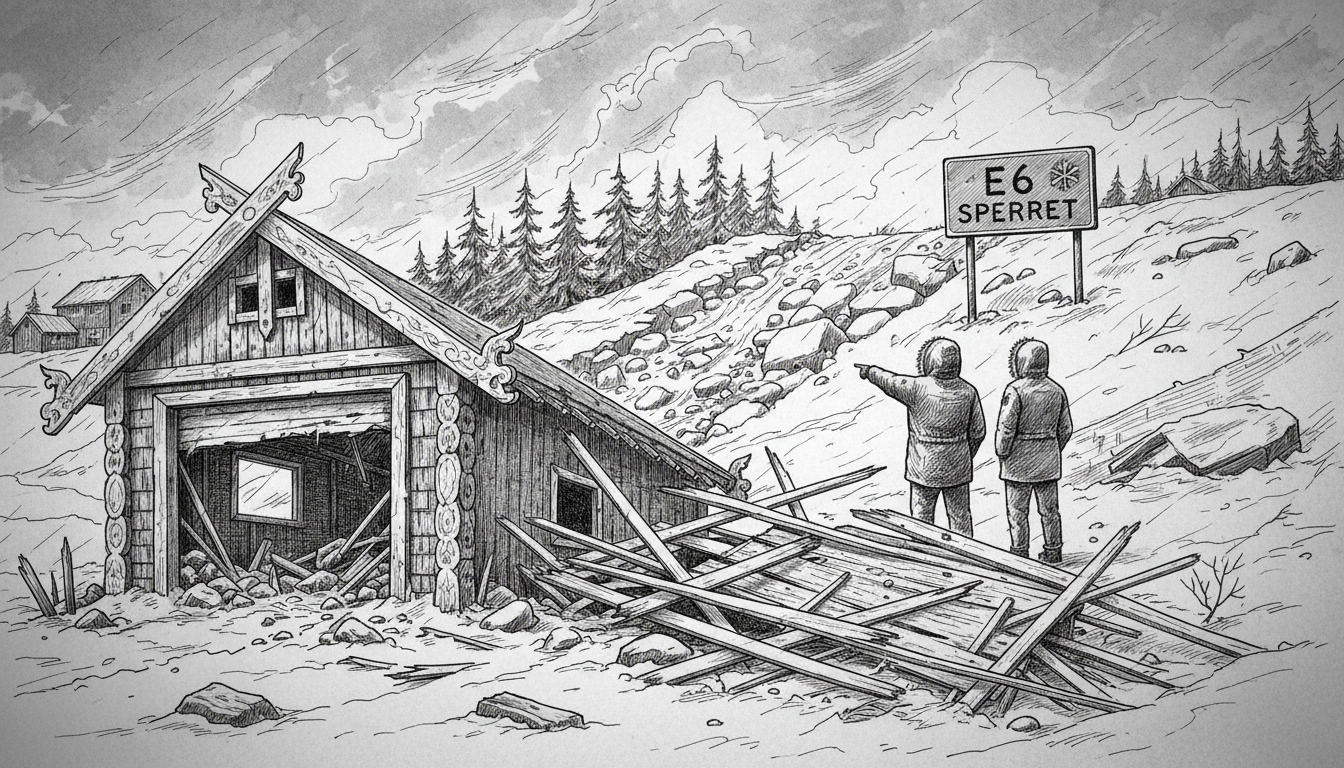
Norway's latest severe Atlantic storm tore a garage from its foundations and hurled it across a road in Finneidfjord early Saturday morning. Police in Nordland reported the incident just before 5 AM, confirming the structure blocked part of Nordmarkveien. No injuries were reported, but the event underscores the raw power of a weather system shutting down major national transport arteries.
A Nation Battered by Wind
The detached garage in Helgeland serves as a dramatic local example of a widespread weather crisis. Meteorological warnings predicted wind gusts reaching 35 to 44 meters per second for Nordland and parts of Southern Troms, equivalent to hurricane-force winds. This led authorities to take drastic preemptive action. The vital E6 highway over the Saltfjellet mountain plateau was closed overnight between the Bolna and Sørelva toll stations. This closure effectively severs the primary road link between southern and northern Norway, forcing long-distance travelers to detour through Sweden.
Transport disruptions extended beyond the north. On the other side of the country, convoy driving, known as 'kolonnkjøring,' was enforced on National Road 7 over the Hardangervidda mountain plateau. This system requires all vehicles, big and small, to follow a guide vehicle between Leiro and Haugastøl due to dangerous, low-visibility conditions. The Norwegian Public Roads Administration continuously updates the status of all mountain passes, urging extreme caution.
The Science Behind the Fury
Such storms are not uncommon in Norway, but their intensity demands respect. The country's location directly in the North Atlantic storm track makes it a frequent target for low-pressure systems, especially from autumn through spring. Norway's complex topography then amplifies the danger. Wind accelerates over mountain ridges and funnels through deep fjords, creating localized extremes that can catch residents and travelers off guard. A seemingly secure object in a sheltered spot can become a lethal projectile when a gust channeled by the landscape hits.
Meteorologists and emergency services consistently repeat the same advice during red-level warnings: secure all loose objects and avoid all non-essential travel. The priority is human safety, which is why roads like the E6 over Saltfjellet are closed proactively. The economic and logistical impact of closing Norway's main highway is significant, but the alternative—risking lives in whiteout conditions or having vehicles blown off the road—is unacceptable. Emergency crews remain on high alert for precisely the type of incident seen in Finneidfjord, responding to structural damage, fallen trees, and stranded motorists.
Infrastructure Under Constant Siege
The recurring nature of these events highlights a persistent challenge for Norwegian infrastructure. Roads like the E6 over Saltfjellet and Route 5 over Filefjell are critical national lifelines that are repeatedly shut down by weather. Each closure triggers a cascade of delays, increased costs for freight transport, and isolation for communities. While detours via Sweden exist for some northern routes, they add hours to journey times and are not feasible for all traffic. The state invests heavily in avalanche protection, wind fences, and improved forecasting, but the battle against Atlantic weather is relentless.
This storm also illustrates the decentralized nature of the threat. While headlines focus on major highway closures, the real frontline is in countless local communities. Homeowners are checking roof tiles, ferry operators are cancelling crossings, and municipal workers are preparing chainsaws to clear roads. The garage in Finneidfjord is a stark reminder that the danger is not abstract; it is literal flying debris in one's neighborhood. The owner of that garage, now tasked with clearing the wreckage from a public road, faces a personal and sudden consequence of the national weather forecast.
Analysis: A Recurring Cost of Arctic Living
For international observers, Norway's storm response can seem both impressively robust and surprisingly routine. The country has developed a sophisticated system for weather warnings and road management, yet these events remain a disruptive fact of life. They test the resilience of supply chains, particularly for fresh goods to northern regions, and complicate everything from hospital travel to tourism. The energy sector, a cornerstone of the Norwegian economy, also monitors such storms closely, as high winds can impact offshore operations in the North Sea and onshore grid stability.
There is an ongoing debate about whether climate change is altering the frequency or intensity of these North Atlantic storms. While scientists note warmer ocean temperatures can fuel more powerful weather systems, attributing any single storm to climate change remains complex. What is certain is that Norway must continue to adapt its infrastructure and preparedness to a climate where extreme weather is a guaranteed annual event. The closed mountain passes and scattered debris are a tangible price paid for living in a landscape of breathtaking beauty that is also fiercely exposed to the elements.
As the wind eventually dies down, the process of assessment and repair will begin. The garage will be cleared, the E6 will reopen under the careful guidance of road crews, and convoys over Hardangervidda will cease. But the next low-pressure system is already forming out in the Atlantic, beginning its track toward the Norwegian coast. The cycle is as predictable as the seasons, and the nation's readiness is perpetually tested. This weekend's storm, with its dramatic opening act in a Helgeland fjord, is merely the latest chapter in Norway's enduring relationship with the power of wind and water.