
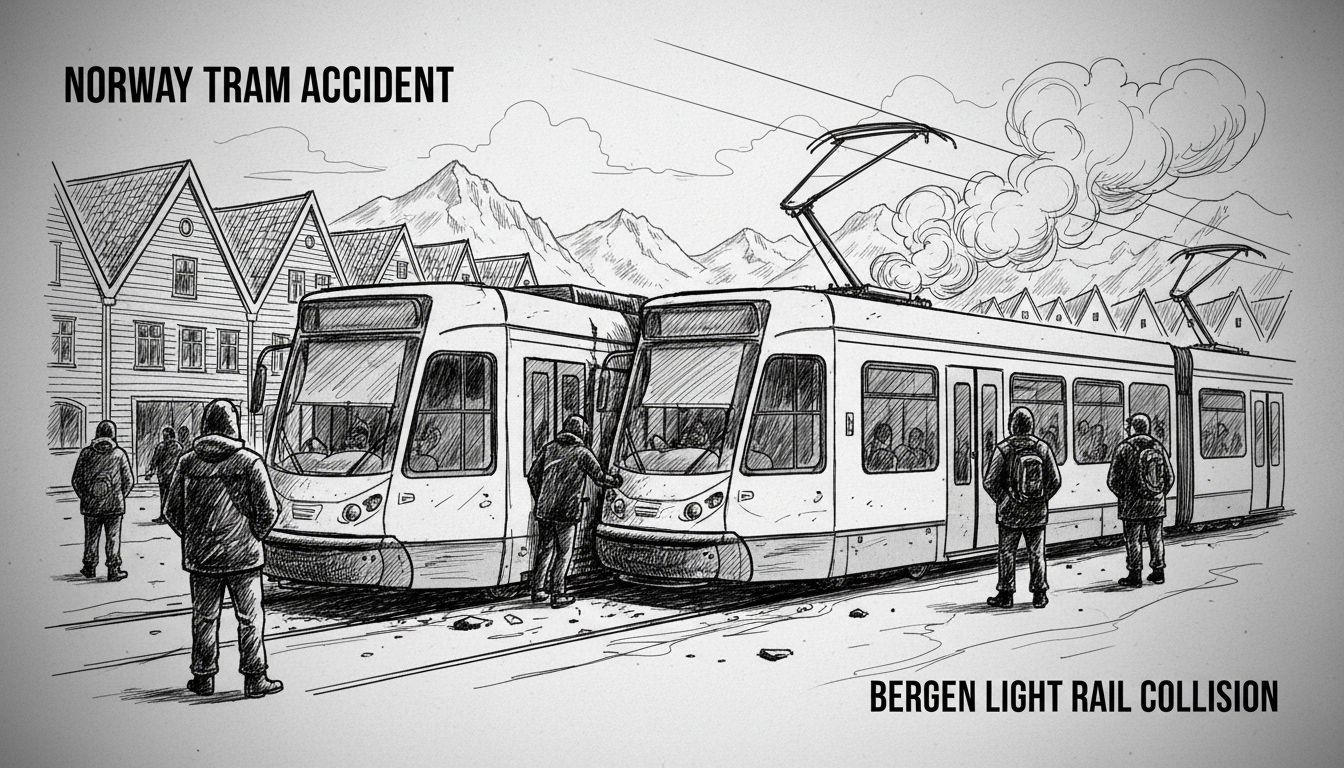
Norway's Bergen Light Rail service was disrupted after a collision between a light rail vehicle and a small van in the Rådal district. The accident occurred on Sætervegen around 7:30 PM, forcing a full stop on Bybanen Line 1. Emergency services confirmed no personal injuries resulted from the incident, which involved only material damage.
"The fire department responded to a report of a traffic accident between a car and the light rail," said duty officer Stian Kvam. He emphasized the initial assessment found no injuries to persons. Police operations leader Tore-André Brakstad later confirmed the van had been removed from the tracks by 7:23 PM, but service restoration depended on damage assessments to the tram itself.
The immediate operational impact was significant. Skyss, the public transport authority, announced Line 1 was suspended between Byparken and Mårdalen, and from Lagunen to Flesland Airport. They quickly implemented contingency plans, directing passengers traveling between Bergen and Flesland to use bus line 600 from Bergen bus station to Lagunen terminal, then transfer to the operational section of Line 1.
A System Under Scrutiny
This incident places Bergen's critical public transport infrastructure under momentary scrutiny. The Bergen Light Rail, known locally as Bybanen, first opened in 2010 and has since become a backbone of the city's transit network. Operated by Keolis Norge under contract with Skyss, the system now comprises four lines spanning 27.4 kilometers. It facilitates over 100,000 daily passenger journeys across the Vestland county capital, connecting the city center with suburbs, the university, and Flesland Airport.
Accidents involving light rail vehicles and road traffic, while uncommon, present complex challenges. The shared urban space where dedicated tracks intersect with roadways creates inherent risk points. "The safety record of modern light rail systems in Europe is generally very high," says transportation analyst Lars Holte, who studies Nordic urban transit. "However, these interfaces with conventional road traffic are where the majority of incidents occur. It underscores the perpetual need for clear signaling, driver awareness, and sometimes, physical separation where traffic volume warrants it."
Emergency Response and Traffic Management
The response from Bergen's emergency services followed established protocols. The fire department's priority was securing the scene and confirming the absence of casualties. Police moved swiftly to clear the obstruction—the small commercial van—from the tracks. This rapid clearance is crucial for restoring service and minimizing city-wide disruption.
Yet, as Operations Leader Brakstad pointed out, removing the vehicle is only the first step. "When the Bybanen can run again, Bybanen must answer for that," he stated, shifting focus to the operator's damage assessment. Light rail vehicles are robust but collisions can damage sensitive components like couplers, doors, or undercarriage equipment. A thorough inspection by technical crews is mandatory before a tram can return to passenger service.
For Skyss, the public transport authority, the incident triggered their disruption management plan. Announcing the suspension and the alternative bus route via line 600 was their immediate public-facing action. This kind of contingency planning is vital for maintaining public trust. When a primary artery like the Bybanen is severed, providing a reliable, communicated alternative is essential to prevent total transport paralysis in the affected corridor.
The Ripple Effect on Bergen Commuters
While the accident resulted in no physical injuries, it caused a logistical headache for countless commuters and travelers. The affected section, Rådal, sits along a key stretch of Line 1. Passengers relying on the connection from the southern suburbs to the city center or the airport faced delays and the inconvenience of a bus transfer.
This disruption highlights the system's importance. On a typical day, the smooth-running Bybanen is a model of efficiency, reducing car traffic into Bergen's congested center. When it stops, the dependency becomes glaringly apparent. The alternative bus service, while helpful, cannot match the light rail's capacity or speed on its dedicated right-of-way. The knock-on effects likely included increased road traffic on parallel routes and longer journey times during the evening rush.
"Efficient incident response isn't just about clearing the tracks," notes Holte, the transport analyst. "It's a multi-agency effort involving police, fire, the transport operator, and the authority. Their communication to the public is a critical component. Telling people what happened, what is being done, and what their alternatives are reduces uncertainty and frustration."
Safety in Shared Urban Spaces
This event invites a broader discussion on urban design and safety. Light rail systems are promoted as safe, sustainable transport solutions. Their integration into existing cityscapes, however, often requires sharing space with road vehicles at level crossings. Norwegian cities like Bergen, Oslo, and Trondheim have extensive experience with this model.
Experts point to several layers of safety. First, there is regulatory oversight and vehicle design standards. Second, there is infrastructure: signaling, crossing gates, and signage. Third, and perhaps most challenging, is human behavior—both tram drivers trained for vigilance and car drivers who must respect rail right-of-way.
"Most such accidents stem from a misjudgment by the road vehicle driver," Holte suggests. "They might try to beat the tram at a crossing, misjudge its speed, or get distracted. The tram, on its fixed track, has very limited ability to evade. This is why ongoing public awareness campaigns about sharing the road with trams are as important as physical infrastructure."
For Bergen, the historical data will be examined. The Bybanen has a strong safety record since its inauguration. Isolated incidents like this one are often statistical anomalies rather than indicators of systemic failure. The investigation will seek to determine the exact cause: was it a technical failure, a traffic signal error, or driver error on the part of the van operator? The answer will inform any potential corrective actions.
Looking Ahead: Resilience and Reliability
As Bergen grows, so does the pressure on its public transport network. The Bybanen is slated for future expansions, extending its reach further into the metropolitan area. Each expansion brings new integration challenges with existing road networks. This incident serves as a real-world test of the system's resilience and the responsiveness of its operators and authorities.
The true measure of a transit system is not that incidents never happen, but how effectively it recovers from them. The reported facts—no injuries, swift vehicle removal, and an immediate alternative transport plan—suggest the response mechanisms functioned as intended. For passengers, the resumption of normal service is the final and most important step.
By the next morning, the tracks on Sætervegen were likely clear, and the trams running their usual schedules. The van driver may face traffic violation charges, depending on the investigation's outcome. The tram involved may have been taken to a depot for checks. For the people of Bergen, the event becomes a brief footnote, a reminder of the complex dance between different transport modes in a modern city. It underscores a simple truth: in the shared space of our cities, attention and respect for all forms of transit are the bedrock of safety and efficiency. The seamless return to normalcy is the ultimate goal, and in this case, it appears the system passed its unexpected test.