
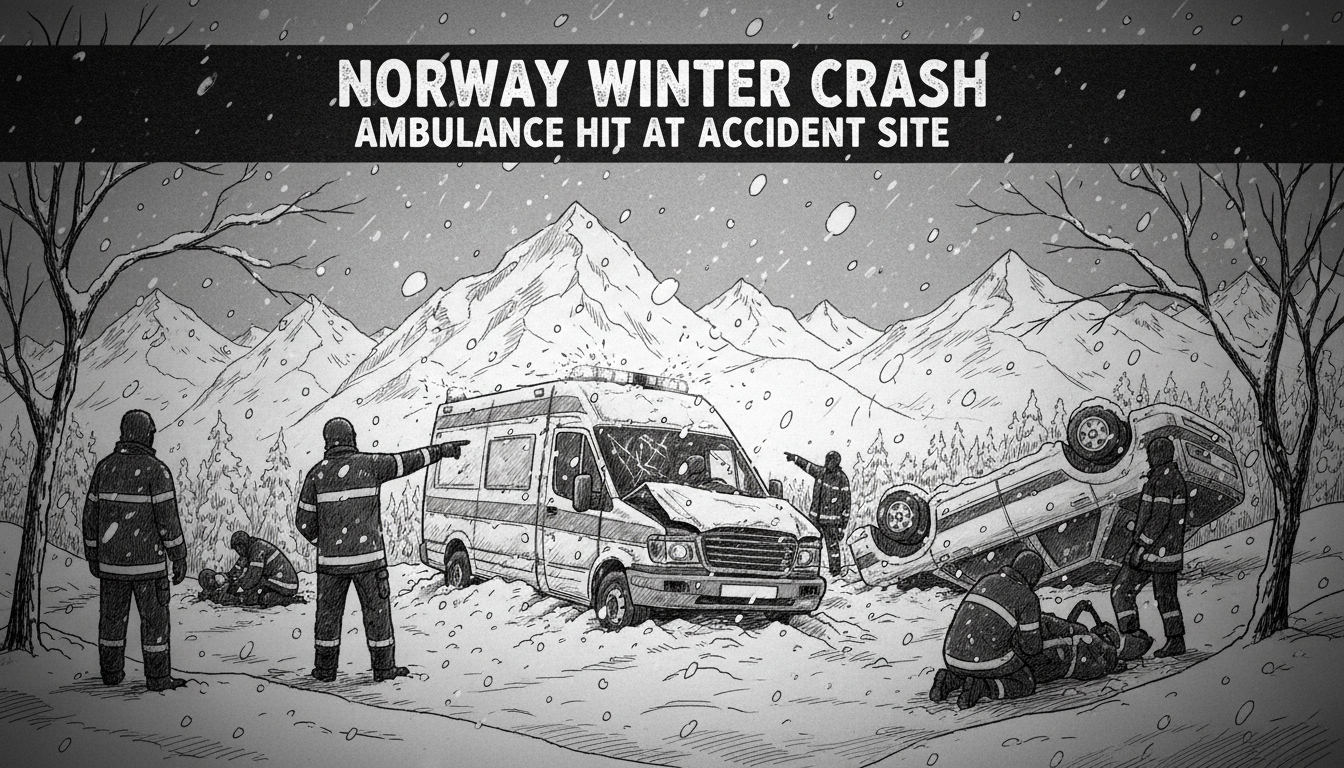
Norway’s emergency responders faced a dangerous chain-reaction collision as an ambulance assisting at a crash site was itself struck by another vehicle. The incident occurred in heavy snowdrift, highlighting the acute risks faced by police and medical personnel during winter operations.
Operational leader Stig Østbø confirmed the sequence of events. While police and ambulance crews were working at the initial accident scene, a separate car collided with the parked emergency vehicle. One person was injured in the secondary collision and required treatment from health personnel at the scene before being transported to hospital. Authorities revoked the driving licenses of two individuals at the site: the driver of the car that originally left the road, and the driver who subsequently hit the ambulance.
Trafikk går forbi skadestedet i ett felt, said Østbø, describing how traffic was being channeled past the damaged vehicles in a single lane. He emphasized the severe conditions: Det er tett snødrev og vanskelige kjøreforhold på stedet.
The Double Danger for First Responders
This collision underscores a persistent occupational hazard for Norway's emergency services. Responders regularly operate on the shoulders of highways and along rural routes, where visibility can plummet in minutes during winter squalls. Their marked vehicles, though equipped with flashing lights, become stationary targets in low-visibility conditions. The incident raises immediate questions about scene safety protocols and driver behavior during winter storms.
Road safety experts consistently stress that Norwegian drivers must dramatically adjust speed and following distance when weather deteriorates. The use of winter tires, mandatory in Norway from November to Easter, is a basic legal requirement. Yet, as this crash demonstrates, compliance with equipment laws does not automatically equate to appropriate driving behavior for the conditions.
A Recurring Seasonal Threat
Statistics from the Norwegian Public Roads Administration (Statens vegvesen) and the Institute of Transport Economics (TØI) provide context. Historical data shows a clear pattern: hazardous driving conditions during the winter months consistently lead to a higher frequency of accidents. While the specific claim of a 30% increase from summer to winter is a common estimate used by safety organizations, current annual reports confirm the significant seasonal spike.
In 2022, the most recent full year with finalized data, 117 people died in road traffic accidents in Norway. Preliminary figures for 2023 suggest a similar toll. A significant portion of these fatalities and serious injuries occur between December and March. Ice, snow, and limited daylight create a perfect storm of risk factors, challenging even experienced drivers.
For emergency services, the math is simple: more accidents mean more call-outs, which in turn increases their exposure to danger on the roadside. Each incident requires personnel to exit their vehicles and work in close proximity to moving traffic, often on roads where drivers are struggling with control.
The Legal and Operational Fallout
The immediate revocation of two driver's licenses at the scene is a standard police procedure in serious incidents. Norwegian law grants officers this authority when they have reasonable grounds to believe a driver poses an immediate danger to traffic safety. The action is typically a prelude to a formal investigation that could lead to prosecution, hefty fines, or a prolonged license suspension.
Operationally, the incident disrupts more than just the traffic flow. An ambulance taken out of service requires redistribution of resources, potentially delaying response times for other emergencies in the region. It also temporarily removes trained personnel from duty, as they must deal with the aftermath of the crash involving their own vehicle.
Police and ambulance unions have long highlighted the risks their members face. They call for stricter enforcement of laws regarding passing emergency vehicles, advocating for rules similar to North American “Move Over” laws, which require drivers to change lanes or slow down significantly when approaching stationary emergency vehicles with activated lights.
Systemic Pressures in a Challenging Climate
Norway’s geography amplifies these challenges. Long, dark winters affect much of the country, while coastal regions like those near Stavanger or Bergen can experience rapid shifts between rain, sleet, and snow. Mountain passes and inland areas face consistently harsh conditions. Road maintenance crews work tirelessly to plough and grit, but they cannot be everywhere at once.
The incident serves as a stark reminder that infrastructure and vehicle preparedness are only part of the safety equation. The human factor remains critical. Drivers must take personal responsibility for adjusting their speed to match not just the legal limit, but the actual conditions before them. This includes accounting for reduced visibility in snowdrift, where a vehicle’s stopping distance can be many times longer than on dry asphalt.
Experts point to the need for continuous public education campaigns, especially as new residents from milder climates join the Norwegian driving population. The concept of ‘vinterdrevne dekk’ (winter-driven tires) is about more than just tread; it’s about adopting a winter driving mindset that prioritizes caution and space.
A Call for Heightened Awareness
As the investigation into this specific collision continues, the broader lesson is clear. The safety of those who respond to our emergencies is dependent on the actions of every driver on the road. When you see flashing blue and yellow lights ahead, the correct response is to slow down early, increase your following distance, and be prepared to stop. If possible, moving over to an adjacent lane provides a crucial buffer for the people working.
This crash in the snowdrift is not an isolated event. It is a symptom of the seasonal danger that returns to Norwegian roads each year. The ultimate question is whether driver education and enforcement can outpace the perennial hazards of ice, snow, and human error. For the paramedics and police officers stepping out into the traffic lane, the answer cannot come soon enough.