
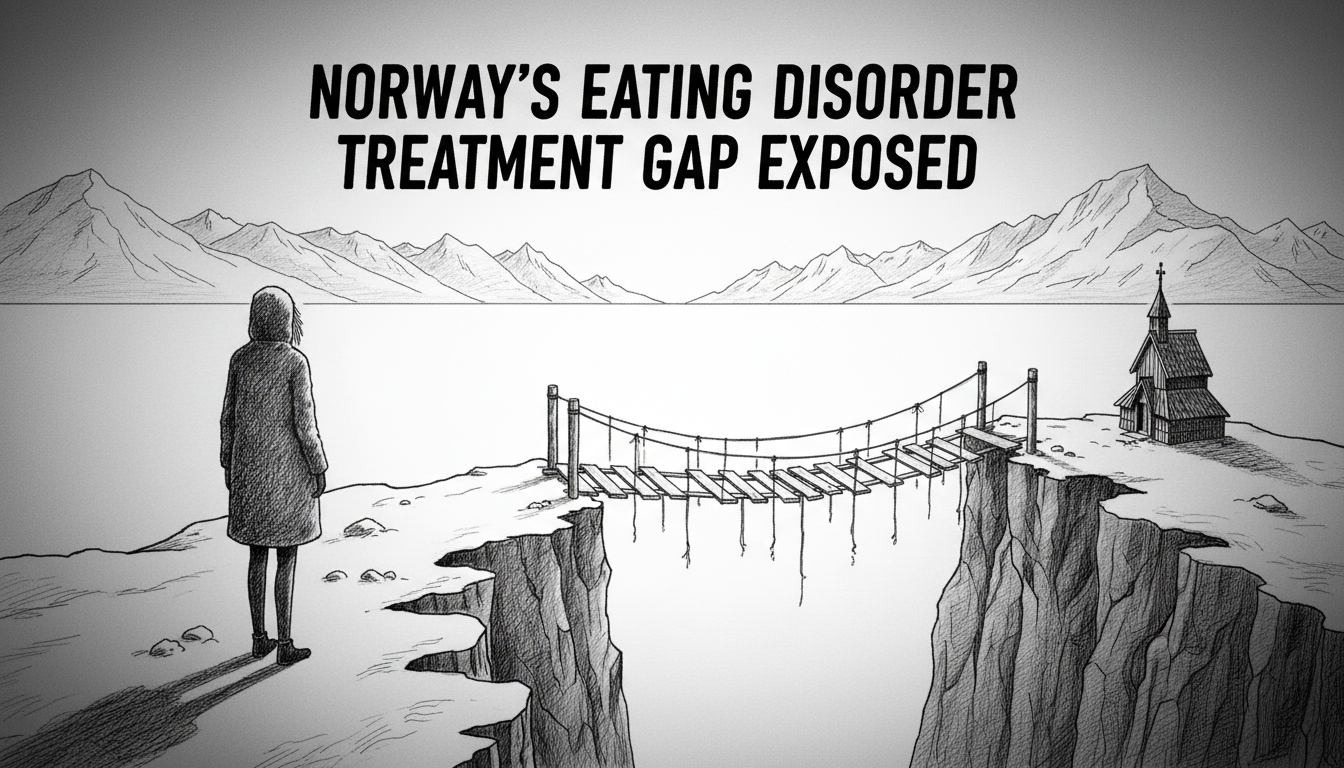
Norway's eating disorder treatment faces a stark evidence gap, with 13.7% of Norwegian women estimated to experience an eating disorder in their lifetime. A new report from the Norwegian Institute of Public Health (FHI) reveals a critical lack of high-quality research to prove which treatments work best, leaving patients and clinicians navigating uncertain terrain.
The FHI's systematic review concludes that a general lack of strong documentation exists due to insufficient large-scale, well-conducted controlled studies. "Our main conclusion is that there is a general lack of good documentation because of a shortage of larger, well-executed controlled studies, preferably randomized ones," the FHI states in its report. This finding comes as demand for eating disorder services, especially among adolescents, has increased across the country.
A System Relying on Incomplete Data
Cognitive Behavioral Therapy (CBT) is identified as the most frequently studied treatment approach in Norway. Yet, even the evidence for CBT, a common therapy for conditions like anorexia nervosa and bulimia, is not as solid as it should be. The FHI's analysis shows that without more randomized controlled trials—considered the gold standard in medical research—the confidence in any treatment's effectiveness remains lower than desired.
This research void has direct consequences for patient care. Clinicians across Norway's regional health trusts must design treatment plans without a clear, nationally consistent evidence base to guide them. A multidisciplinary approach is standard, often involving doctors, psychologists, and nutritionists. However, the specific therapies used and their intensity can vary significantly from one municipality to another, potentially leading to unequal care outcomes.
The Human Cost of Research Gaps
For individuals seeking help, this uncertainty translates to a treatment journey filled with more questions. "When the evidence is fragmented, it becomes harder to give patients clear answers about their prognosis or the best path forward," says Dr. Kari Jansen, a clinical psychologist specializing in eating disorders in Oslo. She emphasizes that patients and their families desperately want confidence in their care plan, which is difficult to build on shaky scientific ground.
The rise in cases, particularly among young people, adds urgency to the problem. The Norwegian Directorate of Health noted increased demand for services in a 2021 report. Schools and primary care doctors are spotting issues earlier, but the specialized treatment system they refer into is operating with an incomplete playbook. This gap affects early intervention strategies and long-term recovery programs alike.
Why High-Quality Studies Are Scarce
Conducting large-scale research on eating disorders presents unique challenges. These are complex mental health conditions with high stakes; randomizing someone to a potentially less effective treatment group raises ethical concerns for researchers. Recruitment for long-term studies is also difficult, and follow-up over many years is needed to understand true recovery rates.
Funding is another persistent issue. Mental health research has historically received less investment than research for physical ailments. "To build the evidence base we need, dedicated and sustained funding streams are essential," argues Professor Lars Mikkelsen, a public health researcher at the University of Bergen. He states that without targeted investment, the cycle of small, inconclusive studies will continue, and Norway's treatment guidelines will remain underdeveloped.
The Path Toward Better Evidence
The FHI report is not just a critique but a call to action. It provides a clear roadmap for strengthening Norway's approach to eating disorders. The primary recommendation is the establishment of coordinated, multi-center randomized controlled trials. These studies would need to follow participants for extended periods to measure sustained recovery, not just short-term symptom reduction.
Standardizing data collection across all health trusts is another crucial step. If every treatment center collected the same core set of anonymized patient outcomes, it would create a powerful national database for analysis. This real-world data could complement clinical trials and help identify what works for different patient subgroups.
Experts also see an opportunity for Norway to lead. "We have a unified health registry system that is the envy of many countries," notes Dr. Ingrid Svensson, a psychiatrist at a major treatment clinic. "We should use this infrastructure to its full potential to answer these critical questions. It's a matter of priority and coordination."
Looking Beyond the Clinical Setting
Effective treatment extends beyond therapy rooms. The FHI's findings indirectly highlight the need for broader societal strategies. Prevention programs in schools, public awareness campaigns to reduce stigma, and better training for general practitioners are all part of a comprehensive response. Strong evidence is needed for these public health interventions, too.
Addressing the evidence gap is also an issue of health equity. Consistent, proven treatment protocols would help ensure that a young person in Finnmark has access to the same quality of care as one in Oslo. Currently, the variation in treatment approaches risks creating a postal code lottery for recovery.
The conversation is shifting from acknowledging the problem to demanding solutions. Patient advocacy groups are increasingly using terms like "evidence-based care" in their dialogues with the health directorate. They argue that their members deserve treatments proven to work, not just those that are conventionally used.
Norway has the resources and the healthcare infrastructure to tackle this challenge. The FHI report has laid bare the problem with unflinching clarity. The question now is whether the health system, research institutions, and funding bodies will mobilize to fill the void. For the thousands of Norwegians affected each year, the answer cannot come soon enough. Their recovery depends on a system built on certainty, not conjecture.