
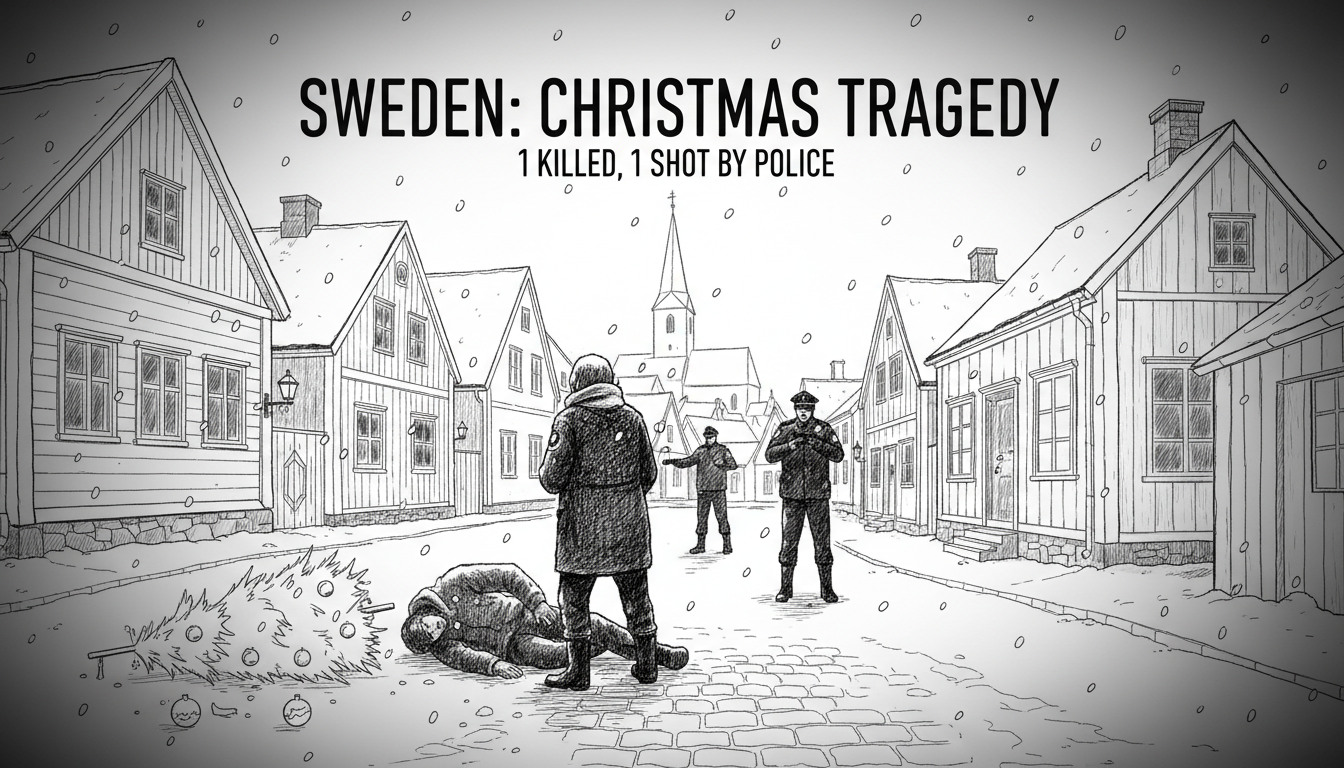
Swedish police shot a man suspected of murdering a woman in her fifties during a major police operation in Boden on Christmas Day. The incident, which also saw two others hospitalized, has sent shockwaves through the quiet northern community, prompting questions about safety and random violence in the Nordic region. As a reporter covering Danish society, I observe these events with a heavy heart, knowing such tragedies ripple across borders and challenge our shared sense of security.
The calm of a Swedish Christmas morning was shattered by screams. A neighbor walking his dog in Boden reported hearing the cries before an unsettling silence fell. "The dog got scared, and then it went quiet," he recalled. This ordinary residential scene became the epicenter of an extraordinary police response. Officers descended on the area, confirming hours later they had shot a man in his twenties, the suspected perpetrator. The victim and the suspected assailant were not known to each other, according to initial police statements, adding a layer of terrifying randomness to the crime.
A Community in Shock
Boden, a municipality of just over 28,000 people known for its historic fortress, is not a place accustomed to headlines of this nature. The community, like many across Scandinavia, prides itself on order and social cohesion. A violent homicide on a major holiday feels like a profound violation of that peace. Local authorities have been measured in their releases, describing only a "serious incident" before confirming the shooting. This caution is typical of Nordic police procedure, which prioritizes investigative integrity over immediate transparency, yet it often leaves a vacuum filled with community anxiety and speculation.
The two other individuals taken to the hospital underscore the incident's chaotic and traumatic scope. Their conditions and relationship to the central event remain unclear, a detail that will be critical for understanding the full narrative. The Swedish police face the dual task of conducting a meticulous investigation while managing public alarm in a town where such violence is statistically rare but deeply impactful.
The Nordic Context of Violent Crime
From my perspective in Copenhagen, this tragedy invites a broader examination of violence in our region. Sweden, like its Nordic neighbors, generally reports lower homicide rates than the European average. For instance, recent data from the European Statistical Office indicates Sweden's homicide rate has fluctuated but remains below many larger EU nations. However, each incident, particularly one as stark as a Christmas Day murder, forces a societal reckoning. It challenges the perception of the Nordics as uniformly safe havens and ignites debates about police resources, mental health support, and social isolation.
Experts on Scandinavian society often note that while overall rates are low, the nature of violent crime can shift. Isolated, acute incidents in smaller communities often carry a heavier psychological weight than statistics suggest. The trauma is amplified by its unexpected setting. The focus in Sweden will now turn to the suspect's motives and background. Understanding what led to this eruption of violence is crucial, not just for justice, but for preventive policy. Could better social intervention systems have identified a person in crisis? This is a question Danish municipalities also continuously grapple with in their own integration and welfare work.
A Personal Reflection on Safety and Society
Reporting on integration and social policy in Denmark, I frequently analyze how communities respond to shock. In Boden, the process of healing will be communal. The local social services, akin to Denmark's municipality-run social centers, will play a vital role in supporting witnesses and affected residents. There is a Nordic model for this: a structured, publicly-funded support system that activates in times of crisis. Yet, no system can immediately erase the fear that follows when violence invades a place associated with family and celebration.
The incident also touches on the sensitive issue of police use of force, which is comparatively rare and heavily scrutinized in Scandinavia. The Swedish police will undergo an internal review, standard protocol when an officer discharges a firearm. This process, though administrative, is a cornerstone of public trust. In Denmark, similar incidents prompt intense media scrutiny and parliamentary questions. We hold our institutions to a high standard of accountability, expecting transparency once the initial investigation allows.
Looking Forward from a Day of Darkness
As the Swedish police continue their investigation, the community of Boden is left to reconcile this violence with its identity. Christmas decorations will come down, but the memory of this day will linger. The story is no longer just a crime report; it becomes a case study in community resilience, the efficacy of social safety nets, and the enduring quest for security.
Does a single violent act redefine a society's sense of safety? Statistically, no. The numbers will still show Sweden and its Nordic neighbors as some of the safest places in the world. Emotionally and psychologically, however, the calculus is different. For the residents of that quiet neighborhood, the world now feels less predictable. The ultimate test for the Nordic model is not in preventing every tragedy—an impossible task—but in how it binds together afterwards, offering support, seeking understanding, and reaffirming a collective commitment to peace. The path forward for Boden is long, and the rest of the region watches with empathy, knowing that societal safety is a fragile construct, constantly being built and rebuilt.