
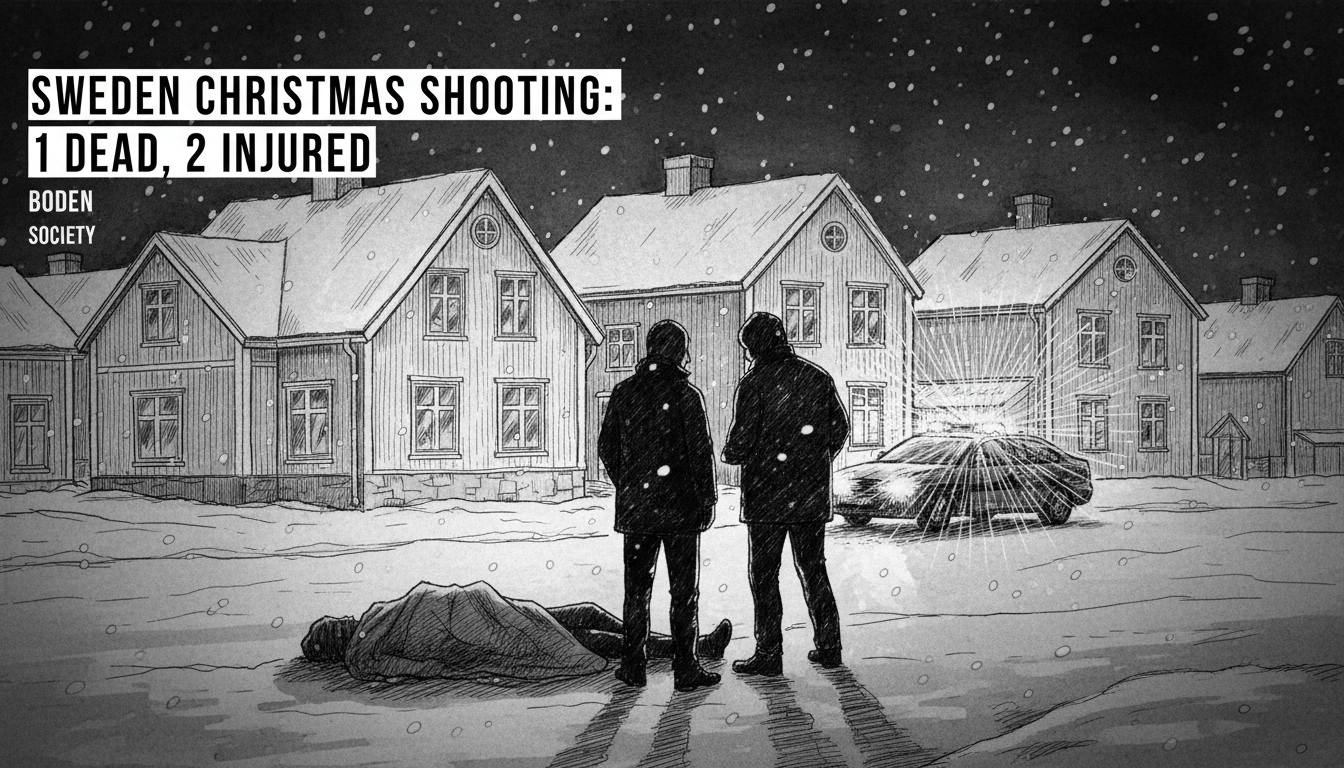
Sweden's quiet Christmas Day was shattered by a deadly shooting in the northern town of Boden. A woman in her 50s was killed, and two others were hospitalized after a violent incident in a residential area. Police shot and killed a man in his 20s at the scene, who is now the sole suspect in the murder and attempted murders. The case has sent shockwaves through a community more accustomed to holiday peace than violent crime.
A Peaceful Town Confronts Sudden Violence
Boden is a town of roughly 28,000 people, known more for its historic military fortress and vast northern forests than for violent crime. The incident occurred in a villaområde, a typical Swedish suburban neighborhood of single-family homes. For residents, the sound of police sirens and gunfire on Christmas Day represented a profound rupture of the normal holiday calm. The traditional Swedish Christmas, or jul, is a time for family, the Donald Duck television special, and a smorgasbord of festive food. This violent act stands in stark contrast to those cultural traditions.
“We cannot say more about what details have emerged in the investigation,” said P-O Andersson of the Luleå police district in a brief statement to press. He confirmed the injured parties are in stable condition at the hospital but offered little else. The police have been notably tight-lipped, a common protocol in the early stages of a major investigation in Sweden. However, Andersson did state that investigators "know quite a lot" about what happened inside the house, suggesting a clearer picture is forming behind the scenes.
The Unanswered Questions Linger
The most puzzling aspect for both police and the public is the apparent lack of connection. Authorities have stated that, so far, they have found no link between the suspected perpetrator and the victims. This absence of a clear motive adds a layer of anxiety and speculation in the close-knit community. Was it a random act? A case of mistaken identity? Or a connection that has yet to be uncovered? These questions hang heavily over Boden.
Crime experts note that such severe, seemingly disconnected violence is statistically rare in smaller Swedish towns. While Sweden has faced challenges with gang-related violence in major cities, incidents of this nature in northern municipalities are uncommon. “When a tragedy like this hits a smaller community, the impact is deeply personal and the shockwaves travel far,” says Lena Korsell, a criminologist specializing in Nordic crime patterns. “Everyone feels closer to the event. The lack of an obvious motive can also amplify the fear and sense of unpredictability.”
A Community in Mourning
The human impact extends far beyond the official casualty count. Neighbors in the villa area are grappling with fear and confusion. The shooting disrupts the fundamental sense of security that defines everyday life in towns like Boden. Local community leaders and church parishes, which play a central role in Swedish society especially during holidays, are now mobilizing to offer support. The psychological toll on first responders, who were forced to act on a day meant for rest, is also a significant concern.
In Sweden, police shootings are rare and subject to intense scrutiny. The independent prosecutor will now investigate the officers' actions to determine if the use of lethal force was justified. This process is standard but adds another layer of official investigation to an already complex case. The protocol for police intervention in such high-risk situations is strict, focused on isolating threats and protecting public safety above all.
Looking Beyond the Headlines
This tragedy in Boden inevitably fuels broader discussions about Sweden crime rates and safety. It is crucial to analyze such events within their specific context. This appears to be an isolated, horrific incident rather than indicative of a trend in northern Sweden. The Nordic model, with its strong social safety net, is often contrasted with higher violence rates elsewhere, but no society is immune to random acts of violence.
For international observers following Nordic crime news, this story is a reminder that Sweden is a complex, modern nation facing the same human challenges as others. The image of a perfectly peaceful utopia is a simplification. Communities here experience grief and trauma just as deeply. The Swedish response will likely be characterized by a methodical investigation, strong community support systems, and a collective search for understanding.
The Path Forward for Boden
In the coming days, the focus in Boden will slowly shift from the initial shock to the process of healing. The police investigation will continue its meticulous work, piecing together the final hours and moments that led to the tragedy. The victims' families will begin the unimaginable task of coping with their loss. The town itself must find a way to reconcile this violent memory with its own identity.
Will this event change the character of this northern town? Swedes have a cultural concept called "lagom," meaning not too much, not too little—just the right amount. It signifies balance and moderation. The violence of Christmas Day was the extreme opposite of lagom. The community's task now is to restore that balance, to mourn appropriately, and to support one another without letting fear take root. The quiet, snowy streets of Boden will never look quite the same to those who live there, but the strength of community often shines brightest in the darkest times. As the long winter night continues, the people of Boden are left with a simple, painful question: why? And for now, there is no answer.