
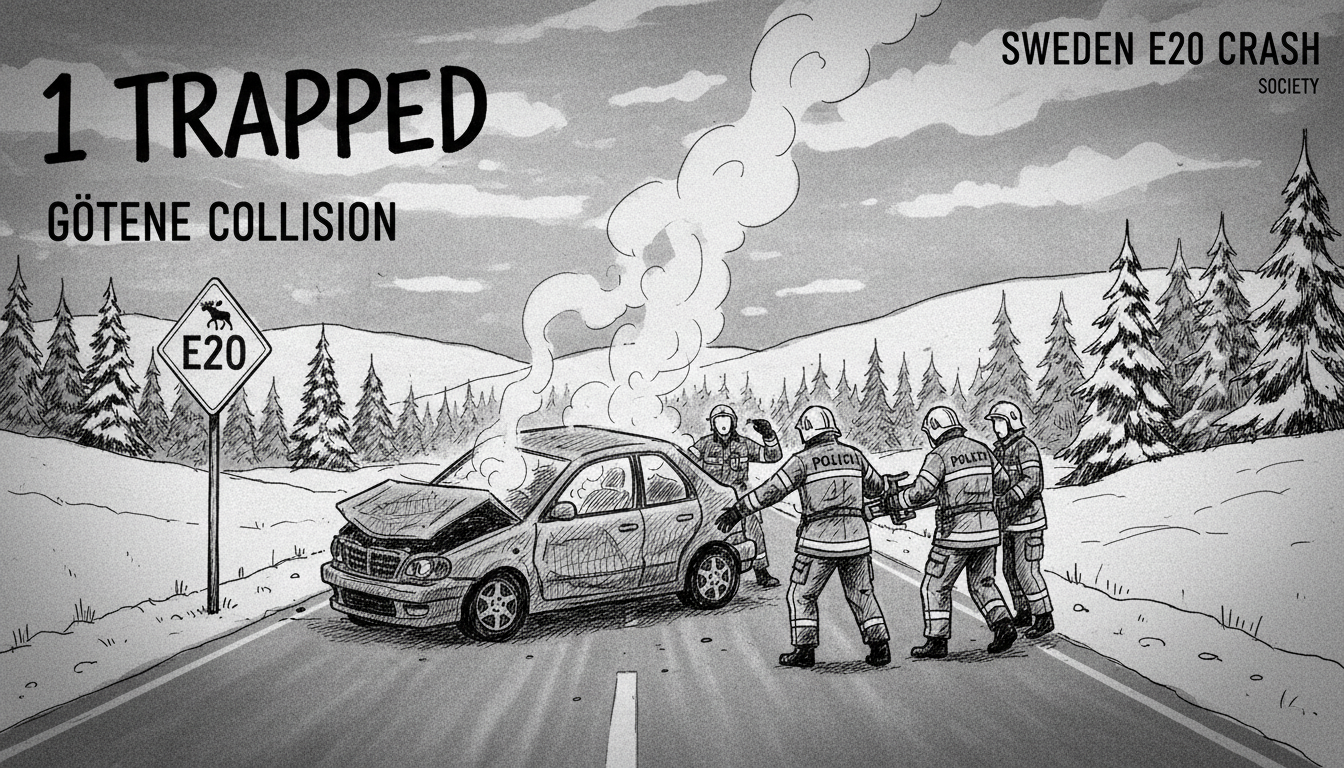
Sweden's critical E20 highway was the scene of a major emergency response Friday afternoon after a severe frontal collision left one person trapped and seriously injured. The crash between a truck and a passenger car occurred near Brännebrona, north of Götene in Västergötland, leading to a complete traffic standstill and a large-scale rescue operation.
Emergency services were alerted at 14:52. Police, ambulance, and rescue crews rushed to the scene. “We have a major rescue operation at the site,” said police press spokesperson Johan Håkansson. The individual trapped in the smaller vehicle was described as seriously injured. Traffic was completely stopped in both directions on the stretch between Holmestad and Myggeberg, with vehicles being diverted around the area.
A Highway at a Standstill
The E20 is not just any road. It is a vital artery in Sweden’s transport network, part of a European route stretching from Ireland to Russia. When it stops, the ripple effects are significant. For hours on Friday, this key corridor was silent, a line of halted vehicles testament to the sudden violence that can interrupt the flow of daily life. The Swedish Transport Administration (Trafikverket) confirmed the total closure, disrupting both personal travel and commercial logistics in southern Sweden.
Götene, a municipality nestled by Lake Vänern, is more accustomed to tourism and industry headlines than major traffic incidents. This accident brought a starkly different kind of attention. Local residents familiar with the hum of highway traffic instead saw the flashing blue lights of a concentrated rescue mission, a desperate race against time to free the trapped victim.
The Grim Reality of Frontal Collisions
Road safety experts describe frontal collisions as among the most dangerous on high-speed routes. The physics are brutal. “When two vehicles collide head-on at speed, the forces involved are extreme,” explains a traffic safety analyst who preferred not to be named. “The risk of severe or fatal injury is very high, which is why preventing these types of accidents is a top priority in infrastructure planning.”
In Sweden, a nation proud of its Vision Zero road safety policy which aims to eliminate all traffic fatalities and serious injuries, every such crash is a sobering event. Official statistics show that 240 people died in road traffic accidents in Sweden in 2022. While heavy goods vehicles are involved in a significant portion of fatal accidents, precise, verified current data on the exact percentage is continually updated by transport authorities. Each number represents a profound personal tragedy, a story that began with an ordinary journey.
The Human Story Behind the Headlines
While the facts of the crash are clinical—time, location, vehicle types—the human reality is visceral. For the person trapped in the wreckage, those minutes waiting for rescue crews are an eternity. For the first responders, it’s a complex technical challenge requiring hydraulic cutting tools and stabilising equipment, all performed under immense pressure. For families waiting for news, it’s a nightmare.
“Our focus is always on saving lives and minimising injury,” a rescue service spokesperson typically states in such situations. The coordination between police, who manage the scene and traffic; ambulance crews, who provide emergency medical care; and rescue services, who perform the delicate extraction, is a well-rehearsed but emotionally heavy ballet.
The aftermath of such an accident extends beyond the roadside. The investigation into the cause will begin immediately. Was it a moment of distraction? A failed overtaking attempt? A technical fault? The answers are crucial not only for potential legal proceedings but for understanding how to prevent a similar tragedy. Sweden’s traffic safety work heavily relies on analysing accident data to improve road design, signage, and vehicle safety standards.
Infrastructure and the Safety Balance
This crash on the E20 near Götene will inevitably renew discussions about road safety infrastructure. The E20, like many older European highways, has sections without continuous median barriers—physical separations between lanes of opposing traffic. These barriers are highly effective at preventing cross-over head-on collisions.
“Median barriers are a critical investment,” says Lars Bergström, a retired traffic engineer familiar with the region's roads. “They are expensive to install along hundreds of kilometres, but the cost is measured against the lives they save. Every serious frontal collision puts this calculation back on the table.” The Swedish Transport Administration constantly evaluates such safety upgrades, balancing cost with the potential to save lives on some of the country’s busiest routes.
The conversation also turns to driver behavior. Sweden has strict laws on distracted driving and fatigue. Yet, on long, straight stretches of highway like parts of the E20, complacency can set in. Maintaining safe distance, avoiding distractions like mobile phones, and taking breaks on long journeys are simple messages that remain life-saving.
A Community and a Corridor Await Answers
As Friday turned to evening, the damaged vehicles were likely removed, and traffic slowly began to flow again on the E20. The physical scars on the asphalt would be patched. But for the injured individual, their family, and the responders who helped them, the event marks a before and an after.
Accidents like this one outside Götene are a stark reminder of the fragility of our daily routines. They highlight the incredible skill and bravery of emergency services, who face these crises head-on. They also force a moment of collective reflection on a society deeply dependent on road transport. How safe are our most important roads? Are we doing enough to protect people from the worst-case scenario? The pursuit of Vision Zero continues, but on days like this, the destination feels painfully distant. The hope now rests with the recovery of the injured, and the lessons that might make Sweden's roads safer for everyone.