
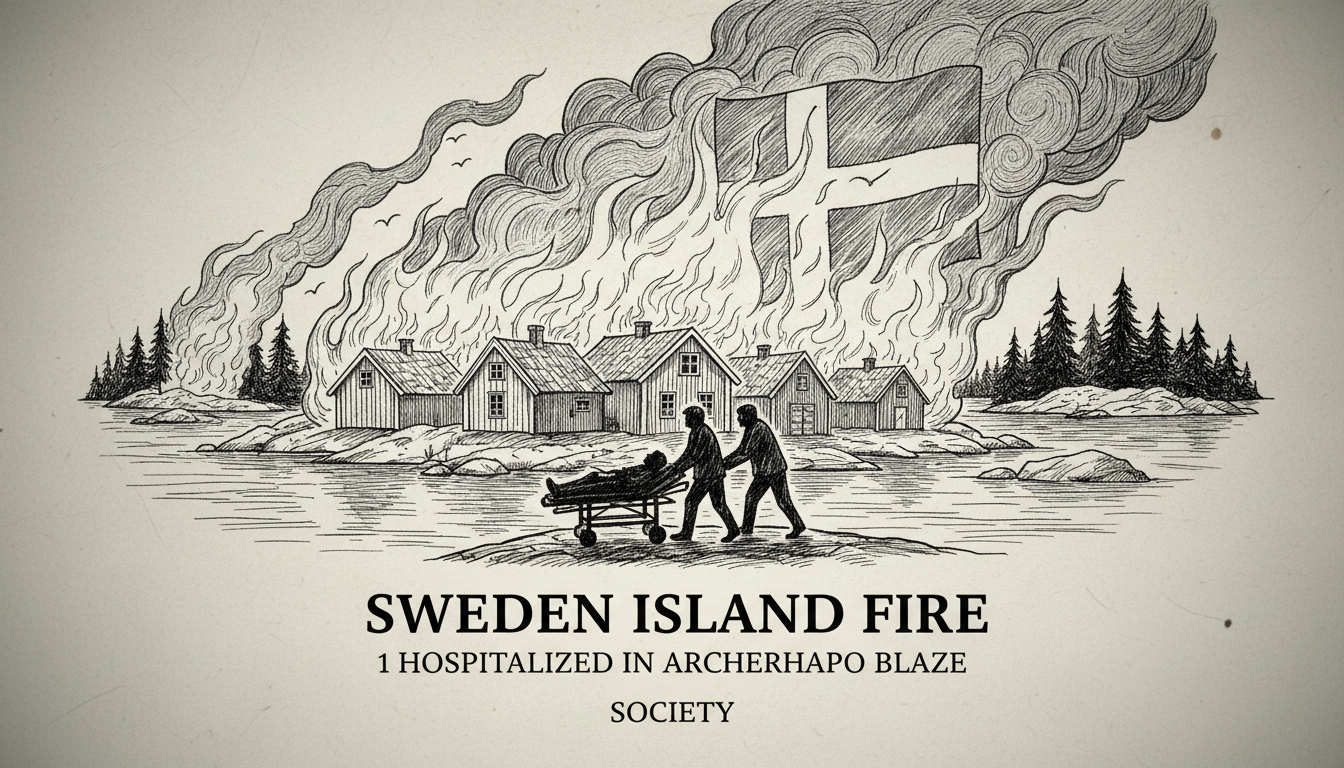
Sweden's Stockholm archipelago faced a dramatic emergency Monday as a villa fire on Blidö island sent one person to the hospital. Firefighters, alerted shortly before 5 PM, arrived to find the wooden house completely engulfed in flames. In a dramatic rescue, smoke divers entered the burning structure to pull one individual to safety. The person was rushed to the hospital for treatment. By 6:30 PM, crews could begin external firefighting operations, with expectations they would remain on scene for many hours. This incident highlights the unique dangers and challenges of life in Sweden's vast and remote island landscape.
A Remote Island Engulfed
The fire broke out on Blidö, a island in the outer reaches of the Norrtälje archipelago. This area is part of the sprawling Stockholm archipelago, a collection of roughly 30,000 islands, islets, and rocky outcrops stretching into the Baltic Sea. For many Swedes, these islands represent a cherished summer paradise. They are dotted with red wooden cottages and villas, places for relaxation and connection with nature. But this idyllic setting can quickly turn perilous. "When the alarm comes from an outer island, our entire operational calculus changes," a veteran fire officer, who asked not to be named, explained. "Access is everything. We're not just fighting a fire; we're fighting geography and time."
The challenges are manifold. Narrow, winding roads designed for summer traffic can hinder heavy fire trucks. Some properties are accessible only by private roads or footpaths. Water supply is a constant concern, as hydrants are rare. Fire crews often rely on tanker trucks or must pump water directly from the sea. The response to Blidö involved multiple units, coordinating both land-based and potentially marine resources. The use of smoke divers indicates the intensity and danger of the initial situation, with crews prioritizing life-saving above all else.
The Human Story Behind the Headlines
While details about the rescued individual are scarce to protect privacy, the event sends a ripple through the tight-knit archipelago community. These islands have small permanent populations that swell in the summer. Neighbors often look out for one another, especially during the quieter off-season months. A fire like this is not just a property loss; it's a personal tragedy for the owners and a shock to the community. Many island homes are family treasures, passed down through generations, filled with memories of summers past. Losing such a home is like losing a part of one's history.
"You hear the sirens on the ferry, and you know something serious has happened," says Erik Lundström, a Stockholm resident with a summer house on a neighboring island. "Out here, everyone knows everyone in a way. You worry immediately if it's someone you know. There's a feeling of vulnerability, because we all live in these wooden houses, surrounded by forest. We choose this for the peace and beauty, but an event like this reminds us of the risks." This sense of communal vulnerability is a defining feature of archipelago life, where self-reliance and mutual aid are essential.
Fire Safety in a Wooden Wonderland
The prevalence of wooden buildings is a key factor in Swedish archipelago fire safety. Wood is the traditional and beloved building material, prized for its aesthetic and connection to nature. However, it is also highly combustible. Fire safety experts consistently stress prevention as the first and most critical line of defense in these areas. "In a remote location, a small spark can become a catastrophic loss before the first engine even boards the ferry," says Karin Ahlström, a fire prevention specialist with the Swedish Civil Contingencies Agency (MSB).
She emphasizes several non-negotiable measures for island homeowners. These include installing modern, regularly tested smoke alarms in every bedroom and hallway. Many older summer houses lack these basic devices. Fire extinguishers should be placed in key locations like the kitchen and near fireplaces. Chimneys must be swept annually. With the increase of electrical usage in older homes not designed for modern loads, having an electrician inspect the wiring is crucial. "Prevention is about respect," Ahlström notes. "Respect for the power of fire, for the isolation of your home, and for the firefighters who will risk their lives to reach you."
The Race Against Time and Distance
The operational response to an island fire is a complex ballet of logistics. The initial alarm triggers a assessment of location. Can standard pumpers reach it? Is a special off-road vehicle needed? Will a fire boat be required? The response to Blidö likely involved units from Norrtälje's main station, but could also have drawn from volunteer brigades in smaller archipelago communities. These volunteer brigades are the backbone of rural and archipelago fire protection in Sweden. They are often first on the scene, performing vital initial attacks and rescue efforts.
Once on the island, crews face the tactical challenge. A fully involved structure fire, as reported on Blidö, often dictates a defensive strategy. The priority shifts from saving the building to preventing the fire from spreading to nearby forests or other homes. This involves massive water application from the outside—precisely the "external firefighting" mentioned. The work is physically grueling and can last for many hours, even after the main flames are knocked down, to extinguish hot spots in the smoldering wood. The prognosis of a multi-hour operation, as stated by officials, is standard for a fire of this magnitude.
A Community Reflects on Risk and Reward
This fire on Blidö will inevitably lead to conversations in community associations and around dinner tables across the archipelago. It's a sobering reminder of the fragility of the island dream. For permanent residents, especially the elderly, the fear of fire is a real concern during the long, dark winters when response times may be longer. For summer residents, it's a call to action to prepare their properties before locking them up for the season.
The Stockholm archipelago is a national treasure, a place of stunning natural beauty and cultural significance. The classic red and yellow wooden houses are iconic. Protecting this heritage requires a shared responsibility. It requires homeowners investing in prevention, communities supporting their local volunteer brigades, and authorities ensuring resources and training for these specialized responses. The successful rescue on Blidö is a testament to the skill and bravery of the firefighters involved. But the sight of a villa lost to flames asks a difficult question: in our pursuit of pastoral peace, are we doing enough to manage the inherent dangers? As the smoke clears over Blidö, that question will linger longer than the smell of ash.