
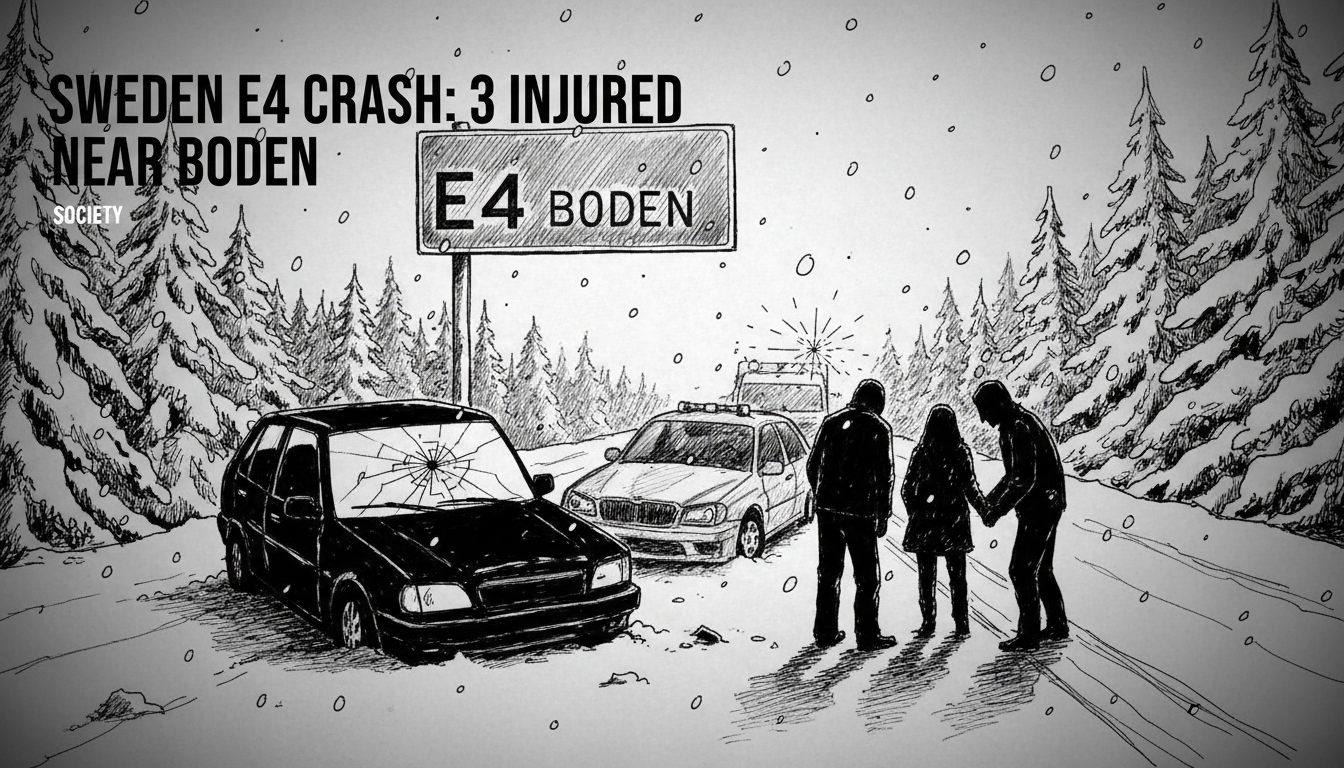
Sweden road accident investigators are working to determine the cause of a serious head-on collision on the E4 highway outside Boden. The crash involved two cars and three people, with two requiring hospital transport. Rescue services worked for hours to cut one driver free from the wreckage. The incident caused significant traffic disruption in northern Sweden, with diversions in place until late evening.
A Long Night on the Northern E4
The call came in during the day on the E4, Europe's vital north-south artery that threads through Sweden's vast northern forests. Near Boden, a municipality of about 28,000 people in Norrbotten County, two vehicles collided head-on. Police, ambulance, and rescue services rushed to the scene. The initial report was stark: three people involved, two needing urgent hospital care. The extent of their injuries remains unclear, according to authorities. 'The damage situation is uncertain,' a police spokesperson said, noting the investigation is ongoing and no official classification for the incident has been set.
For the rescue teams, the priority was extraction. One of the cars was so badly damaged that firefighters had to use hydraulic cutting equipment to free the occupant. The process, known as 'vägfordonsbefrielse' or vehicle extrication, is a standard but critical procedure in Swedish emergency response. Both vehicles were later towed from the crash site. Meanwhile, the Swedish Transport Administration, Trafikverket, set up detours. They initially estimated the road would reopen by 10:30 PM, a forecast that underscored the accident's severity and the cleanup required.
The Grim Statistics Behind the Headlines
This crash near Boden is a single entry in Sweden's annual road safety ledger. The country is often hailed as a global leader in traffic safety, thanks to decades of policy focusing on safer cars, infrastructure, and strict enforcement. Yet, the goal of 'Vision Zero'—eliminating road deaths and serious injuries—remains a work in progress. In 2022, there were 270 fatal road accidents in Sweden, resulting in 287 deaths. Approximately 1,500 people were seriously injured. Each number represents a story like the one on the E4: a sudden, violent event that changes lives forever.
Frontal collisions are particularly devastating. The combined force of two vehicles traveling toward each other creates enormous energy on impact. Even with modern safety features like crumple zones and airbags, the risk of severe trauma is high. 'Speed, distraction, fatigue, or a moment of misjudgment on a long, straight road—these are often the factors,' says a road safety analyst familiar with northern routes. 'On highways like the E4, especially in remote areas, driver monotony can be a silent risk.'
Life on Sweden's Arctic Highway
The E4 is more than just a road in northern Sweden; it's a lifeline. It connects the cities and towns of Norrbotten County—like Luleå, Boden, and Haparanda—with the rest of the country. For locals, it's the route to work, school, and the grocery store. For the region's crucial industries, including mining and forestry, it's an essential corridor for transporting goods. An accident that closes a lane or the entire highway causes immediate logistical headaches. Alternative routes are few, often smaller secondary roads not designed for heavy traffic or long-distance travel.
This dependency makes the work of Trafikverket critical during an incident. Their quick establishment of detours and public communication via platforms like Trafikverkets.se is a routine part of the emergency response ecosystem. For travelers, a closure means long delays. For emergency services, it underscores the challenge of covering vast geographical areas. The response to the Boden crash involved coordinated efforts from multiple agencies, a testament to the region's preparedness despite its sparse population.
The Human Cost Beyond the Crash Barrier
Behind the police bulletins and traffic reports are three people whose day turned catastrophic. While their identities and conditions are private, the aftermath of such an accident follows a familiar, painful pattern. It begins with the scream of metal and the shatter of glass. Then comes the blur of flashing blue lights, the focused voices of first responders, and the clinical rush of the ambulance. For those hospitalized, the journey is just beginning. It continues in the emergency room, through surgeries, and into a long period of physical and psychological recovery.
Families are notified, their lives also abruptly altered. In close-knit northern communities, news travels fast. It's likely that neighbors and friends in Boden were soon aware an accident had happened, perhaps worrying until they knew their loved ones were safe. This social fabric, strong in Sweden's smaller towns, provides support but also means the ripple effects of a local tragedy are widely felt.
What Happens Next?
The police investigation will now work methodically to piece together the moments before the impact. Officers will examine skid marks, vehicle positions, and damage. They will interview witnesses and the involved parties, if possible. Technical inspections of the vehicles will check for mechanical failures. The goal is not just to assign blame, but to understand causation. Every investigation feeds into Sweden's data-driven approach to road safety, informing where to build a new roundabout, add a median barrier, or launch a speed enforcement campaign.
For the E4 north of Boden, this crash is a grim reminder. The highway, while modern, stretches through challenging terrain and extreme weather. Winter brings darkness, ice, and snow for many months, testing drivers and road maintenance crews alike. Summer brings midnight sun and the potential for driver fatigue. The very landscape that makes northern Sweden breathtaking—its endless forests and expansive skies—can also contribute to the monotony that precedes a lapse in concentration.
The road has now reopened. Traffic flows again, past the scarred asphalt and the removed debris. But for the injured, their recovery continues. For the investigators, the work of understanding why continues. And for every other driver on the E4, the message is reinforced: on the long road north, vigilance is the most important passenger you can carry. How many more times must rescue services cut through steel before the journey becomes safe for all?