
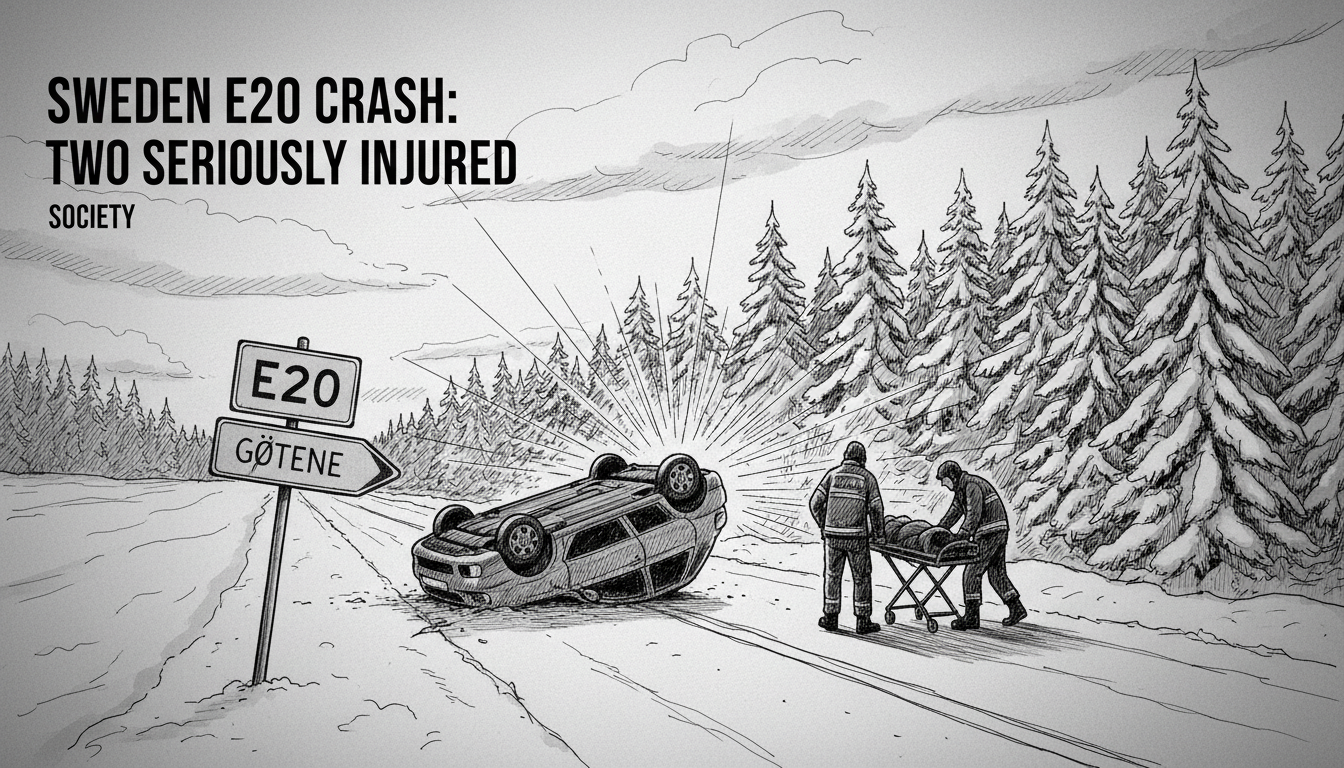
Sweden's E20 highway was the scene of a major rescue operation Thursday afternoon after a head-on collision between a truck and a passenger car. The crash, which occurred near Brännebrona north of Götene, left two people trapped and seriously injured in the smaller vehicle, leading to a complete traffic shutdown on one of the country's most vital transport arteries.
Emergency services were alerted at 14:52. Police, ambulance, and rescue services rushed to the scene. A large-scale operation unfolded to free the two individuals pinned in the wreckage. "We have a major rescue effort at the site," said police press spokesperson Johan Håkansson. Traffic was at a total standstill in the area, with vehicles being rerouted. The Swedish Transport Administration reported the stoppage affected the stretch from Holmestad to Myggeberg in both directions.
A Major Artery Severed
The E20 is not just any road. It is a critical lifeline connecting Sweden's west coast to its capital. Running from Gothenburg to Stockholm, it carries a constant flow of commuters, tourists, and freight. An accident here doesn't just affect local traffic; it sends ripples across the regional transport network. For hours, the highway was silent where it should have been humming. This disruption highlights the fragility of our interconnected systems. A single moment on a stretch of asphalt near Götene can delay deliveries, strand travelers, and demand immense resources from emergency responders.
The scene described by officials—a head-on collision resulting in people being trapped—is among the most severe scenarios traffic safety experts warn about. The sheer force involved when two vehicles traveling at high speed meet head-on is devastating. Modern vehicle safety features, like crumple zones and airbags, are designed to mitigate this, but the physics are brutal. The fact that a rescue operation was required to extract the victims indicates the severity of the impact and the deformation of the passenger car.
The Human Cost Behind the Headlines
While the traffic reports focus on delays and detours, the core of this story is human. Two people, whose identities have not been released, began their day normally. They were traveling on the E20, a routine act for thousands of Swedes daily. By mid-afternoon, their lives were altered dramatically. They were seriously injured and trapped, relying on the skill and speed of strangers in uniforms to free them. Their families received calls nobody wants to get. This sudden violence on a Thursday afternoon is a stark reminder of the stakes every time we get behind the wheel.
In communities like Götene, a town of around 5,000 in Västra Götaland County, news of such an accident travels fast. It’s a tight-knit place where people know each other. The sound of sirens piercing the afternoon air would have drawn attention and concern. Was it someone they knew? The uncertainty in the immediate aftermath is its own kind of torment. Local Facebook groups and community chats likely lit up with questions and fragmentary information as people sought answers.
The Science of Survival on High-Speed Roads
Traffic safety research consistently shows that head-on collisions are disproportionately deadly. On high-speed, divided highways like the E20, they often occur due to a loss of control, a dangerous overtaking maneuver, or driver impairment. The margin for error is slim. Experts emphasize the non-negotiable rules for such roads: maintain a safe distance, never drive fatigued, and eliminate distractions. In Sweden, with its long, dark winters, conditions add another layer of risk, though this accident occurred on a spring afternoon.
The design of the road itself is also a factor. While the E20 is a modern highway, any roadway has points where risk can concentrate. The involvement of a heavy truck also changes the dynamics. The mass disparity in a collision between a truck and a passenger car is severe, often to the detriment of the smaller vehicle's occupants. This reality fuels ongoing discussions in transportation policy about vehicle safety standards, truck design, and road infrastructure improvements aimed at preventing crossover accidents.
After the Sirens Fade
The immediate crisis of the crash near Götene has passed. The injured have been transported to hospital, likely to Sahlgrenska University Hospital in Gothenburg, a major trauma center for the region. Their road to recovery begins. The wrecked vehicles will be cleared. Traffic will slowly resume, the backlog of trucks and cars dissipating. The police will begin their technical investigation, piecing together the moments before impact. They will look at skid marks, vehicle data recorders, and witness statements to understand the why behind the what.
For the rescue personnel who responded—the firefighters who cut through metal, the paramedics who stabilized the injured, the police officers who secured the scene—this is part of their job. But it’s a part that leaves a mark. They see the human cost firsthand, a perspective most of us are shielded from. Their efficient, professional response is a testament to Sweden's emergency preparedness, but it’s a service we hope is never needed.
This accident on the E20 is a single data point in Sweden's traffic safety statistics. The country has long been a world leader in road safety, with Vision Zero—the goal that no one should be killed or seriously injured in traffic—as a central policy. Each serious accident is analyzed not as an inevitable "accident," but as a system failure. What in the system—the road, the vehicle, the driver—broke down? The answers from Götene will feed into that ongoing work.
Yet, for all the statistics and policy, Thursday's crash remains a profoundly human event. It’s a story of a disrupted journey, of pain and fear, of skill and compassion. It’s a reminder that the smooth ribbon of the E20, so familiar to so many, can in an instant become a place of tragedy. As the highway reopens and life moves on, two people and their families face a different journey, one of healing, hoping the serious injuries they sustained will not define their futures. The rest of us are left with a simple, urgent reminder: on the road, nothing is routine. Every trip demands our full attention, our greatest care, because the consequences of a moment's lapse are measured in more than traffic delays.