
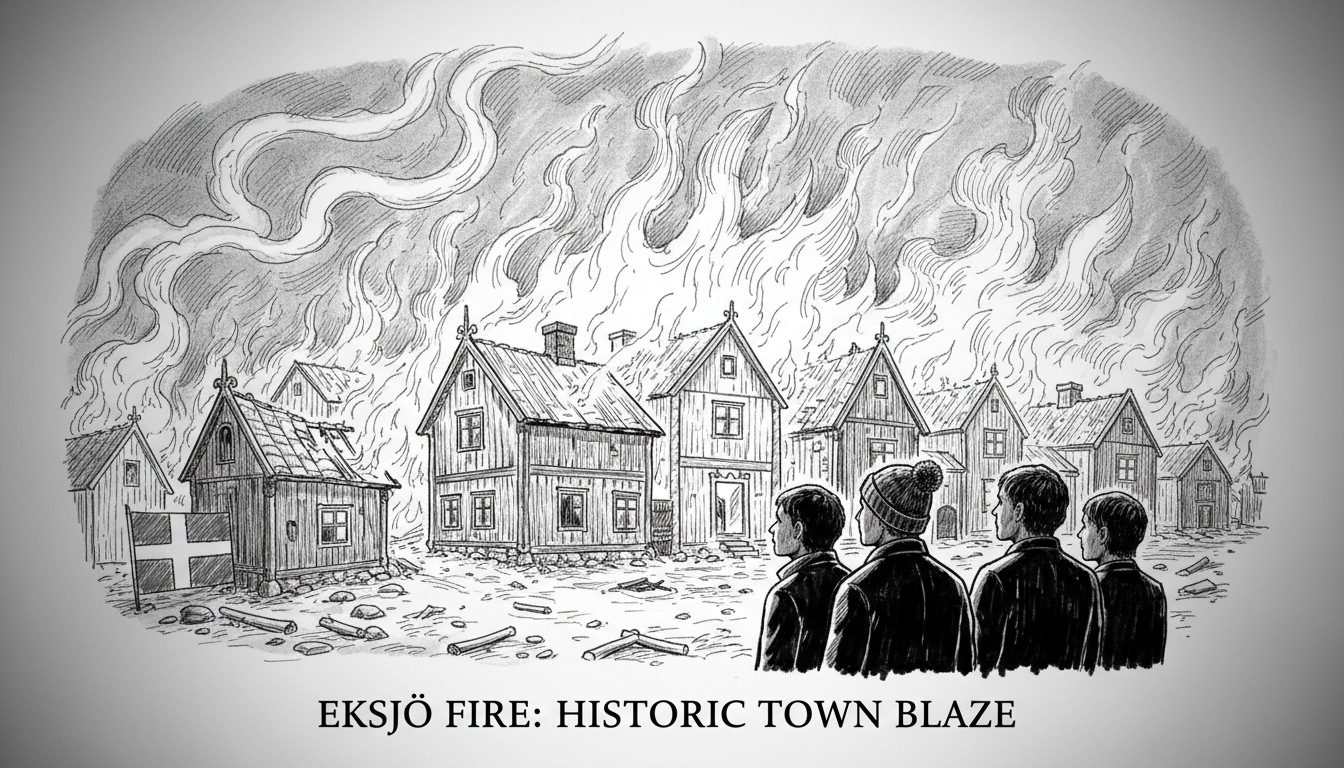
Sweden's historic town of Eksjö faced a major emergency as a fire erupted in an apartment building in its protected old town, Gamla Stan. The alarm reached emergency services at 8:14 PM, prompting a large-scale response from fire, police, and ambulance crews. The fire, described as fully developed, sent significant smoke pouring from the building, though no open flames were visible from the outside. Residents were swiftly evacuated to the local Stadshotellet as firefighters worked to contain the blaze.
Alexander Kristensen, the neighbor who first raised the alarm, described the tense moments. "I saw how it looked strange in the window and that there was soot on the panes," he said. "I called the emergency number and together with a neighbor, we got everyone out of the house." His quick actions, alongside another resident, ensured the immediate evacuation of the apartments. He added that he was not aware of anyone being injured in the incident. The rescue service's lead operator confirmed teams were working at full capacity with more resources en route. No information was available about potential injuries or a prognosis for when the fire might be extinguished.
A Night of Fear in a National Treasure
The location of the fire adds a profound layer of concern for the local community and cultural heritage advocates. Eksjö's Gamla Stan is not just any old town. It is one of Sweden's best-preserved wooden towns, a living museum of 18th and 19th-century architecture where history is not just displayed but lived in. The streets are lined with brightly painted wooden houses, a hallmark of Swedish provincial charm and a major tourist attraction. A fire in this district strikes at the heart of the town's identity. For residents, it's not just a building on fire; it's a piece of their shared history and daily life under threat. The use of the Stadshotellet as an evacuation center is a poignant detail—it is itself a historic building, now providing sanctuary in a crisis.
Local reactions on social media and community forums reflected this deep-seated worry. "This is our worst nightmare," one long-time resident posted online. "These houses are our heritage, but they are also our homes." The incident immediately raises questions about the unique vulnerabilities of living in such historically significant, yet inherently more flammable, structures. The rapid response from neighbors like Kristensen highlights the tight-knit nature of communities in these smaller Swedish towns, where people know each other and act quickly in a crisis.
The Inherent Risk of Wooden Heritage
Fire safety experts point to the particular challenges presented by historic wooden buildings. "Wooden constructions, especially older ones, can act like a tinderbox if a fire takes hold," explains Lars Pettersson, a fire safety engineer with experience in heritage properties. "The materials are dry, and there can be hidden voids in walls and between floors that allow fire to spread rapidly and unseen. Modern building codes have fire-stops and compartmentalization that simply didn't exist centuries ago." This means that even a small electrical fault or kitchen accident in one apartment can escalate into a major threat to an entire building block with alarming speed.
The preservation of towns like Eksjö's Gamla Stan is a point of national pride in Sweden, balancing the need to maintain historical authenticity with the imperative of modern safety. Many such buildings are retrofitted with discreet smoke alarms and, in some cases, sprinkler systems, though the installation in historical interiors is complex and costly. The primary defense often remains early detection and immediate evacuation, exactly the sequence that played out successfully in the initial moments of this fire. The effectiveness of this first response is now the key factor in limiting the damage, both human and cultural.
Community Response and Looking Ahead
In the immediate aftermath, the focus is on the well-being of displaced residents and containing the fire. The Stadshotellet will provide a temporary base, but the coming days will involve assessments by insurance companies, building inspectors, and cultural heritage authorities. For the residents, the uncertainty is profound. They wait to learn if their homes and belongings are salvageable. For the town, the question is whether a piece of its irreplaceable architectural fabric can be saved or must be painstakingly reconstructed.
Such events often trigger broader conversations in Sweden about investing in the protection of its wooden towns. Cities like Stockholm, Uppsala, and Lund also have historic wooden districts, though perhaps not as extensive as Eksjö's. This fire may serve as a stark reminder of the ongoing responsibility that comes with preserving living history. It also showcases the Swedish model of crisis response: a coordinated effort between professional emergency services and an engaged citizenry. The actions of Alexander Kristensen and his unnamed neighbor are a testament to the 'grannsamverkan' or neighborly cooperation that is deeply valued in Swedish society.
A Town Built on Resilience
Eksjö is a town familiar with rebuilding. Its history is marked by a devastating fire in 1856, after which it was reconstructed in the precise, orderly wooden style that defines it today. That historical resilience is part of its story. While the scale of this current fire is not comparable, the community's instinct to protect and support one another echoes through the centuries. As the smoke clears over the picturesque rooftops, the process of recovery will begin. It will involve not just builders and architects, but also the collective spirit of a community that sees its past, present, and future intertwined in the timber and paint of its beloved Gamla Stan. The final assessment of the damage will take time. The emotional and cultural impact will last much longer, a sobering chapter in the story of one of Sweden's most charming towns.