
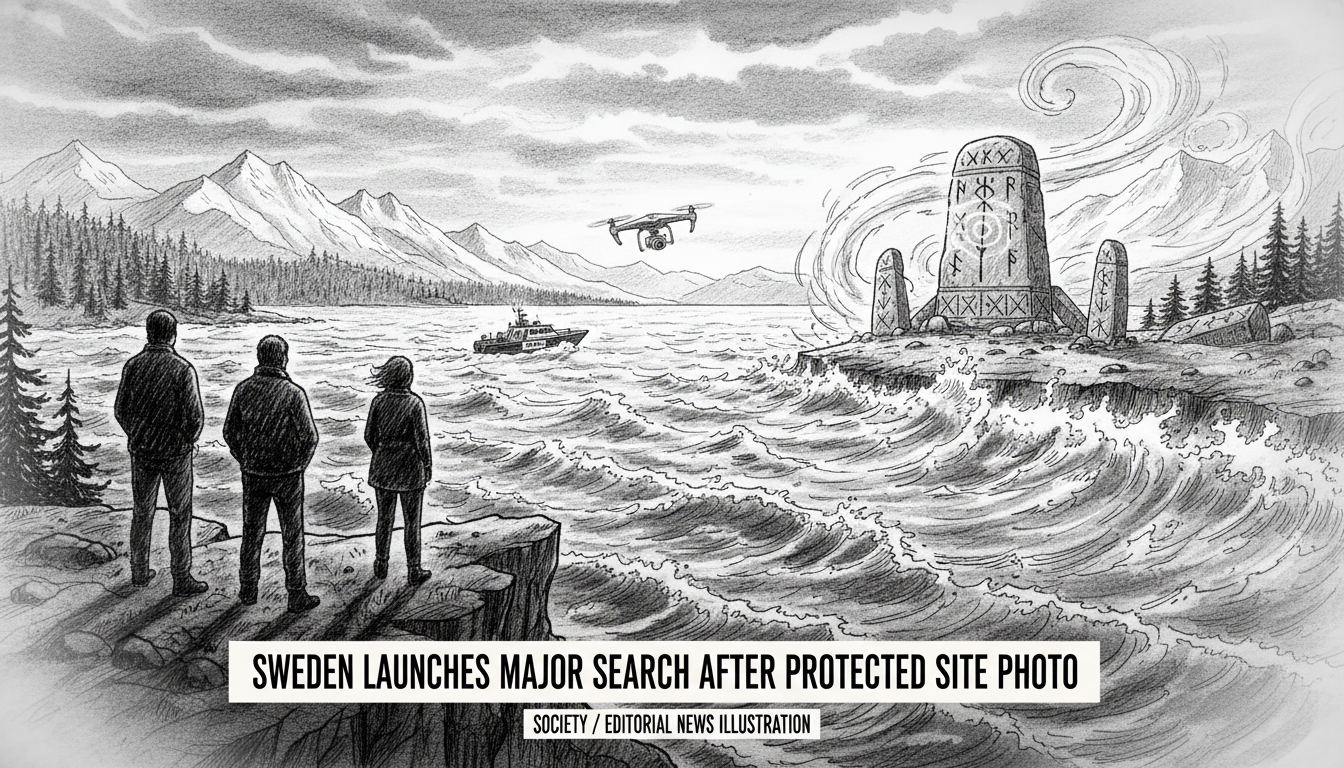
Swedish police deployed helicopters and dog patrols across the popular Delsjön nature reserve near Gothenburg on Thursday afternoon. Their target: a man reportedly photographed a protected object, a crime under Sweden's stringent Protection Act. The skies over the tranquil lakeside recreation area buzzed with uncommon urgency as officers moved through the woods.
"It might seem excessive, but it is a crime with imprisonment in the penalty scale, so our response is proportionate," said police press spokesperson Jens Andersson in a statement from Region West. The incident was logged as "unauthorized depiction of a protected object." Authorities have not identified the specific site or object in question. "I don't want to go into that," Andersson said. "We are proceeding on the basis that it was an intentional crime. It concerns a socially vital operation."
Helicopters Over a Leisure Lake
For residents of Gothenburg, Delsjön is synonymous with weekend hikes, swimming, and family barbecues. The sudden appearance of a police helicopter hovering over the dense pine forests and quiet trails around 2 p.m. created a stark contrast. It transformed a space of relaxation into a scene of a security operation. Dog handlers joined the search, combing areas typically filled with joggers and families. The response highlights how Sweden's national security infrastructure can become visible in the most unexpected of public spaces. The operation centered on locating the individual to inform him that his actions constituted a crime, police stated.
The Protection Act Explained
The swift and substantial police action is mandated by Sweden's Protection Act (Skyddslagen 2010:305). This law designates certain locations, objects, and activities as critical to national security. Its purpose is to prevent espionage, sabotage, terrorist acts, and other serious threats. Unauthorized photographing, filming, or surveying of such a protected site is a criminal offense. Penalties can range from fines to up to one year in prison. In gross violations, the sentence can extend to four years imprisonment. The law creates an invisible map of sensitive sites across the country, often in plain sight but legally off-limits for documentation.
"The public often doesn't know what is protected and what isn't," said Lars Pettersson, a retired security policy analyst I spoke with in Stockholm. "It could be a power substation, a communications tower, part of a water treatment plant, or research facility. The ambiguity is intentional from a security perspective, but it creates situations where a tourist or hobby photographer accidentally crosses a legal line." Pettersson emphasized that enforcement actions like the one at Delsjön serve a dual purpose: apprehending potential suspects and acting as a public deterrent.
When Nature Meets National Security
The Delsjön area presents a unique challenge. It is a vast, publicly accessible nature reserve bordering the city. Identifying what, among its forests and lakesides, qualifies as a "socially vital operation" requires local knowledge. This incident raises immediate questions about the balance between the public's right to enjoy nature and the state's duty to protect critical infrastructure. Sweden's tradition of allemansrätten, or the right of public access, allows people to roam freely in nature. However, that right is not absolute and collides directly with the restrictions of the Protection Act.
Local reactions in Gothenburg were mixed. "I was out for a run and saw the helicopter circling low. It felt surreal, like a scene from a film," said Malin Berg, a resident of the nearby Kallebäck neighborhood. "It makes you wonder what's hidden in the woods you walk through every day." Others expressed understanding for the security concerns. "If it's important to protect, then the police have to do their job," noted Erik Lundström, visiting the area with his children. "But I hope they inform the public better about where not to point a camera."
Security Experts Weigh In: A Necessary Deterrent?
The police's large-scale response, while seemingly disproportionate to a single photograph, is analyzed by experts as a standard and necessary protocol. "The act of photographing a protected object is itself the crime they are responding to," explained Karin Söderlund, a professor of national security law at Lund University. "The scale of the search is not about the immediate danger of the photo itself, but about locating the individual to investigate intent. Was it a curious hiker, or part of something more systematic? The law does not distinguish based on the photographer's assumed innocence. The violation triggers the response."
Söderlund points out that in an era of digital espionage and open-source intelligence gathering, a single image posted online can provide valuable information to hostile actors. "What seems like an innocent picture of a building or a piece of equipment can be cross-referenced with other data. The Protection Act is a blunt but essential tool. The enforcement must be consistent to maintain its deterrent effect."
However, this approach has critics. Civil liberties advocates argue that such operations can feel intimidating and erode trust in public spaces. "There is a real lack of public education about the Protection Act," said Anna Forsberg of the Swedish Civil Rights Association. "People need clear, unambiguous signage if an area is protected. Relying on a secret map and then launching major police operations creates confusion and fear. The principle of legality requires that people can know what is forbidden."
The Gothenburg police concluded their active search of the Delsjön area by evening without reporting an arrest. The investigation into the incident remains open. The man they sought, whose description has not been released, is still to be identified and questioned. For now, the tranquil atmosphere has returned to Delsjön's trails. But the event serves as a public reminder. In Sweden's open landscape, the lines between public space and protected secret are sometimes invisible—until the helicopter arrives.
As Sweden continues to navigate its security posture in a changing world, the tension at Delsjön is a microcosm of a larger national question: How does a society built on transparency and public access effectively guard its secrets without closing itself off? The search for one man with a camera may be over, but the search for that balance continues.