
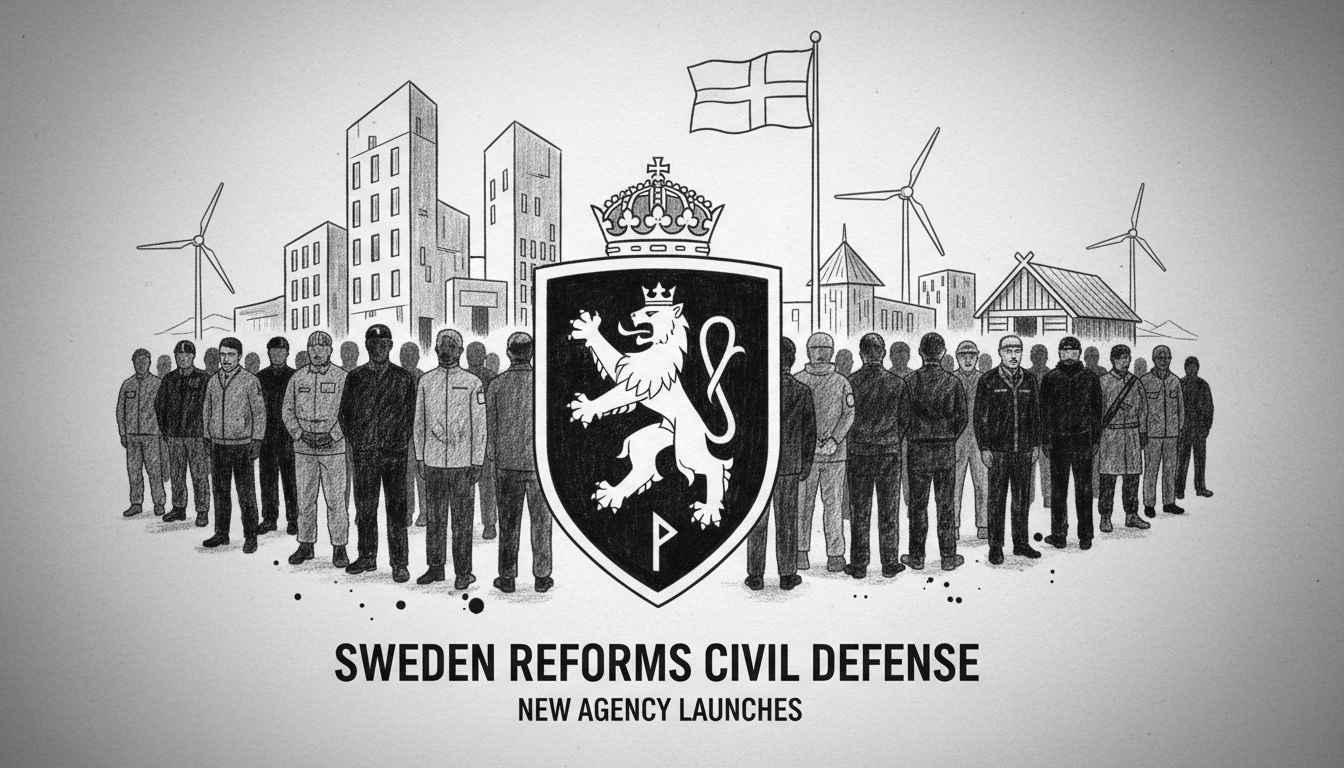
Sweden's national security architecture has undergone a significant structural change with the dissolution of its main preparedness agency. The Swedish Civil Contingencies Agency (MSB) ceased to exist on January 1st, replaced by the new Agency for Civil Defense. This move signals a major shift in Stockholm's security policy from broad emergency management to targeted defense against severe threats.
General Director Mikael Frisell leads the newly formed agency, headquartered in the government district near Rosenbad. He stated the organization now possesses a sharpened mandate directly from the government. "We will focus more on 'worst case scenario' planning," Frisell said. "That is the signal the government wants to send." The change reflects the Riksdag's evolving stance on national security in a destabilized geopolitical climate.
From All-Hazards to Defense Focus
The previous MSB was established in 2009, consolidating agencies like the Swedish Emergency Management Agency. Its mission covered a wide spectrum of societal risks, from floods and fires to pandemics. The new Agency for Civil Defense narrows that scope intentionally. Its central task is strengthening Sweden's capacity to withstand and manage severe crises, particularly those related to armed conflict or hybrid threats.
Analysts see this as a logical progression. Sweden's 2022 NATO application and the subsequent security policy review compelled a reassessment of all state functions. "This isn't just a rebranding," said a senior fellow at the Swedish Defence University. "It is an institutional recalibration. The government is streamlining bureaucracy to meet defined high-end threats, a necessity given current European tensions." The decision follows years of increased defense spending and the reintroduction of conscription.
A Government-Directed Strategic Pivot
The reform stems from a directive issued by the Swedish Government, specifically from the Ministry of Defence. It represents a clear policy choice to prioritize civil defense within the broader national security framework. The agency's revised ordinance details its responsibility for planning, coordinating, and supporting civil society's role in total defense.
This includes securing vital supply lines, protecting critical infrastructure, and ensuring population protection measures. Resources are being reallocated within the agency's substantial budget to fulfill these duties. The shift has required internal reorganization and new recruitment strategies to attract expertise in areas like logistics under duress and infrastructure resilience.
Operational Implications and Civil-Military Link
The name change carries practical weight. Clarity of mission is critical for inter-agency cooperation. The Agency for Civil Defense will now work in closer operational lockstep with the Armed Forces (Försvarsmakten) and the National Defence Radio Centre (FRA). Its role in coordinating civilian resources for defense support is now its primary purpose, rather than one of many competing priorities.
This creates a more defined civil-military link, a component NATO emphasizes for member states. "In a crisis leading to or during conflict, the lines between civilian and military support blur," explained a security policy researcher. "Having a lead civilian agency with an explicit defense mandate eliminates ambiguity. It answers the question of who is in charge of civilian preparedness for war."
Public Communication and Preparedness Messaging
A key challenge for the new agency will be public communication. The MSB was a recognizable brand associated with general safety advice. The Agency for Civil Defense must now engage the public on more sobering scenarios without causing unnecessary alarm. Its website and public campaigns are expected to evolve, providing practical guidance for households on preparedness for prolonged crises.
This includes advice on stocking essential supplies, creating home preparedness plans, and understanding official alert systems. The tone of this messaging is a delicate balance. It must be serious enough to motivate action but measured enough to maintain public trust. The government has indicated that public information campaigns will intensify throughout 2024.
International Context and Nordic Alignment
Sweden's move aligns with a broader trend across Northern Europe. Neighbors like Finland have maintained strong civil defense structures for decades. Norway and Denmark have also recently reviewed and strengthened their total defense concepts. The change brings Sweden's model closer to the Finnish one, where civil defense is an integral, well-funded pillar of national security.
This regional alignment is beneficial for cross-border cooperation on resilience. It facilitates joint planning for shared challenges like securing Baltic Sea infrastructure or managing refugee flows in a crisis. The agency will continue to work with counterparts like Norway's DSB and Finland's Ministry of the Interior, but now with a more harmonized strategic outlook.
A Lasting Institutional Shift
The creation of the Agency for Civil Defense is unlikely to be a temporary measure. It institutionalizes a security policy consensus that has formed across the Swedish political spectrum. While the former MSB's all-hazards approach was suited to the post-Cold War era, the current assessment in Stockholm demands specialization.
The true test will come in the implementation. Budget allocations in the coming years will show the government's commitment. The agency's ability to coordinate complex preparations across county administrative boards and municipalities will be scrutinized. For now, the message from Rosenbad is clear: Sweden is preparing for a different, more demanding set of risks. The new sign on the door of the headquarters is the most visible symbol of that calculation.