
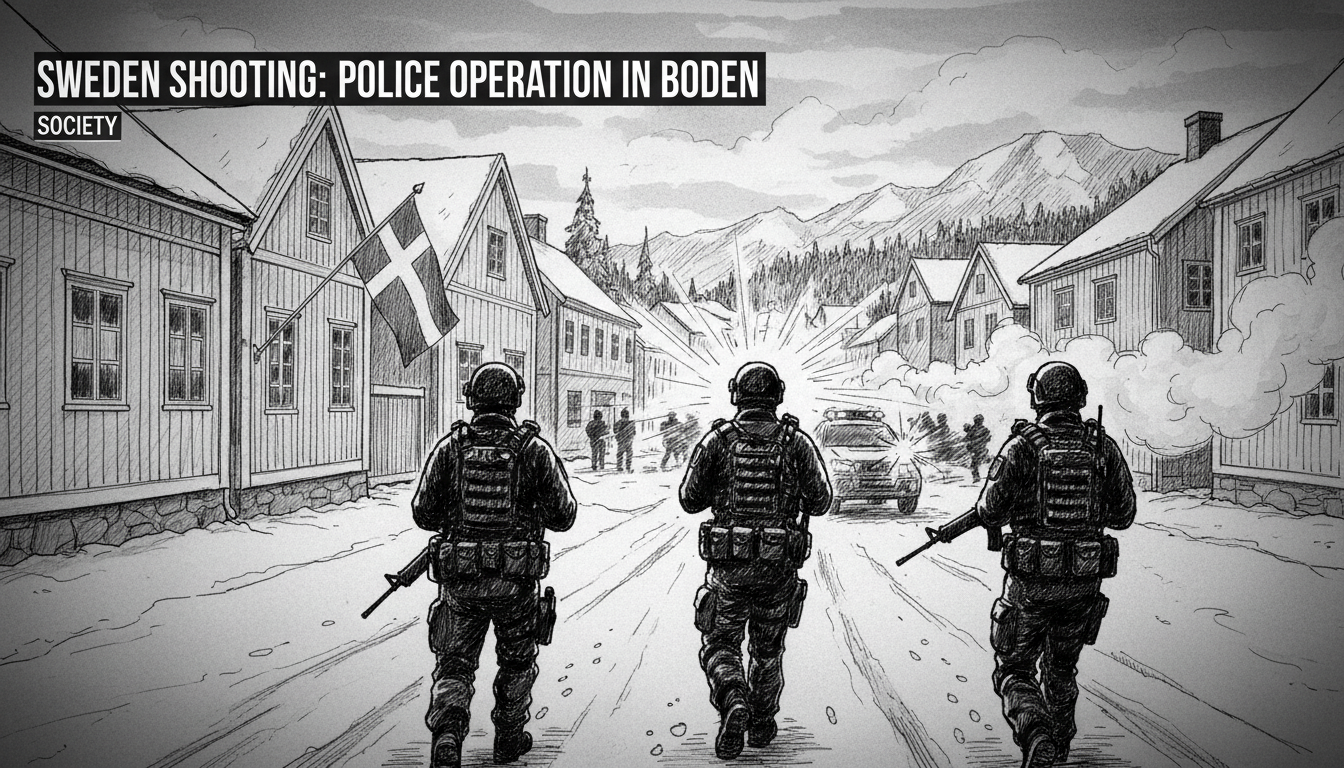
Sweden police are responding to a major incident in the northern town of Boden. A violent crime reported around lunchtime has left multiple people injured. According to initial reports, officers shot a suspected perpetrator. The situation remains active and unclear.
Police spokesperson Åsa Mjörndal confirmed the seriousness of the event in a brief statement. "We have an ongoing matter concerning a serious incident," Mjörndal said. "More than that, I cannot say about this right now." Her words, measured and cautious, reflect standard protocol during unfolding crises. Yet they do little to calm the growing unease in a community unaccustomed to such violence.
Boden, a municipality of about 28,000 people in Norrbotten County, is known for its vast military base. The town's identity is intertwined with national defense, a legacy from the Cold War. Violent crime here is statistically rare, especially compared to Sweden's larger southern cities. An incident of this scale, involving police gunfire and multiple casualties, shatters the ordinary quiet of northern life. It sends shockwaves far beyond the immediate crime scene.
A Community in Shock
The news spread quickly through Boden's tight-knit neighborhoods. Social media filled with concern and fragmented information. Residents described hearing police sirens converging from different directions. The normal midday rhythm of a small Swedish town—people on lunch breaks, children in schoolyards—was abruptly replaced by a tense lockdown atmosphere. Local shops near the operation area reportedly closed their doors as a precaution.
"It's a terrible feeling, not knowing," said Erik Lundström, a lifelong Boden resident reached by phone. He lives several blocks from where the police cordon was established. "We hear the helicopters, see the armed police. This is something you see on the news from Stockholm or Malmö, not here. Boden is a safe place. Or it was." His sentiment echoes a common narrative in smaller Swedish towns. They often view themselves as insulated from the gang-related violence that plagues some urban areas. Today, that sense of insulation is gone.
Understanding Boden's Context
To grasp the impact of this event, one must understand Boden's place in Sweden. It is a garrison town, home to the Norrbotten Regiment and a key part of the nation's northern defense strategy. The population includes many military personnel and their families. The social fabric is traditionally stable, with a strong sense of collective responsibility. Crime rates in Norrbotten County are consistently among the lowest in Sweden for serious violent offenses.
This context makes the police operation not just a local crime story, but a national anomaly. Analysts note that when severe violence erupts in such communities, the psychological and social effects are often magnified. "In a major city, a shooting might be one tragic event among many," explains Karin Söderberg, a sociologist who studies community resilience in northern Sweden. "In a place like Boden, it becomes a defining moment for the entire town. It challenges their fundamental perception of safety and community. The recovery process is as much about rebuilding that trust as it is about solving the crime."
The Police Response and Public Information
The police strategy appears focused on securing the area and assessing the threat. The deployment of significant resources to a northern town indicates the perceived severity of the situation. The confirmation that officers used their firearms is a critical detail. In Sweden, police shootings are rare and subject to intense scrutiny. The independent prosecutor's office will automatically investigate any incident where an officer discharges a weapon, a process that adds another layer of official inquiry to the tragedy.
Mjörndal's limited statement follows a common playbook for Swedish authorities during active incidents. The priority is operational security and accuracy, not real-time updates. This often creates a vacuum filled by speculation and unconfirmed reports from other sources. For residents glued to their phones and local news, the wait for verified facts is agonizing. They are left piecing together fragments from witnesses, social media posts, and the distant sound of sirens.
A Broader Look at Swedish Society
While this event is exceptional for Boden, it touches on ongoing national conversations about violence, policing, and community safety in Sweden. Recent years have seen a heightened focus on gun violence and organized crime, though these issues are predominantly concentrated in specific urban neighborhoods. This incident in the far north is a stark reminder that no community is entirely immune. It may prompt difficult questions about resource allocation for police and social services across Sweden's vast geographic expanse, from the bustling south to the quieter northern regions.
The coming days will be crucial. Police will shift from crisis response to investigation. They will need to communicate findings transparently to a worried public. The community will begin the process of making sense of the senseless. Local schools and community centers may organize discussions or offer support services. The familiar Swedish concept of "trygghet"—a deep sense of security and predictability—has been violated here. Restoring it will take time.
The Path Forward for Boden
For now, the people of Boden are left in a painful limbo. They know a serious violent crime has occurred in their midst. They know people are hurt. They know the police were forced into a lethal confrontation. The specific motives, relationships between those involved, and the precise sequence of events remain hidden behind the yellow police tape.
The true story of this day will eventually emerge through police reports, court documents, and the quiet stories of those affected. The narrative will move from breaking news to a painful chapter in the town's history. How Boden manages that transition—with openness, support, and a commitment to its communal values—will define it far more than the violence itself. In a country that prizes stability and consensus, a single afternoon in a northern town has shown how fragile that peace can be. The search for answers, and for healing, has just begun.