
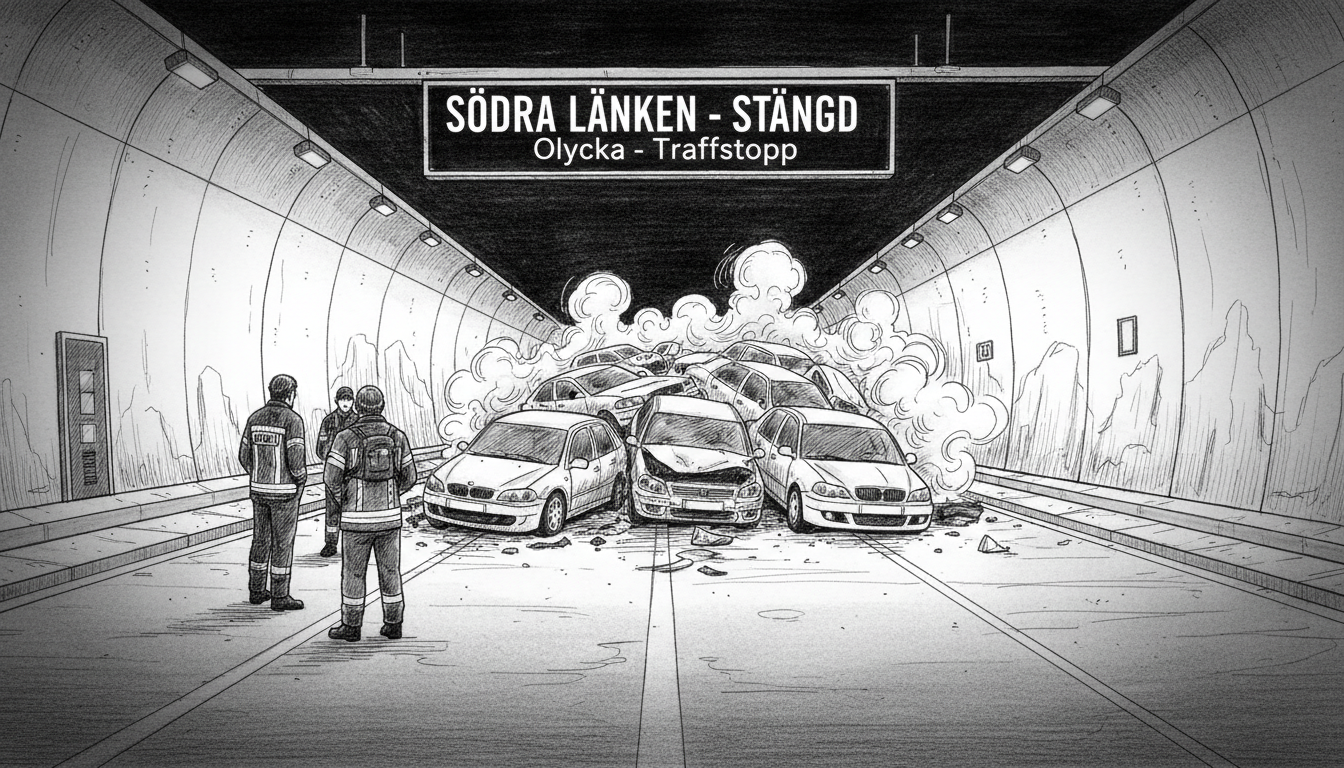
Sweden traffic accident news centers on Stockholm's Södra Länken tunnel, where a serious collision has caused major disruption. The incident occurred around 2 PM on Thursday, blocking the left lane heading towards the E4/E20 and Södertälje. Entrances from the critical hubs of Sickla and Gullmarsplan were immediately closed, triggering long queues that stretched back for kilometers during the afternoon rush.
For the thousands of commuters caught in the gridlock, the afternoon turned into a test of patience. "I've been sitting here for over an hour, barely moving," said Erik Lundström, a graphic designer trying to get home to Hägersten. "You just have to accept it. There's no alternative route that isn't also packed." His sentiment was echoed by drivers across southern Stockholm, as the city's arterial route seized up.
A Critical Artery Grinds to a Halt
The Södra Länken is not just any road. This 6-kilometer motorway tunnel is a vital piece of Swedish infrastructure, forming part of the European E4 and E20 routes. It acts as the primary connector between Stockholm's western and eastern sectors, funneling a significant portion of the capital's daily traffic. Estimates suggest hundreds of thousands of vehicles rely on it each day. When it blocks, the entire region feels the strain.
"An incident in the Södra Länken is like a heart attack for Stockholm's traffic system," explains traffic analyst Mats Berggren. "The tunnel is a bottleneck by design. There are very few alternative routes with similar capacity, so congestion spreads rapidly to surface streets in areas like Årsta, Hammarby Sjöstad, and Liljeholmen." This cascading effect is precisely what unfolded on Thursday afternoon, with secondary roads becoming parking lots.
The Human Cost of Congestion
Beyond the inconvenience, these disruptions have a tangible economic and personal impact. Studies have repeatedly shown that traffic delays in the Stockholm region cost the economy millions of Swedish kronor annually in lost productivity. But the cost is also deeply personal. Parents miss daycare pick-up windows, workers arrive home exhausted hours late, and appointments are missed.
At Gullmarsplan, a major public transit hub adjacent to the closed tunnel entrance, the scene shifted from road to rail. Commuters spilled out of backed-up cars and onto already busy buses and the metro. "The tunnel closure means everyone has the same idea—take the train," said Lena Forsberg, waiting for a Tvärbanan tram. "It's more crowded than usual, but at least it's moving." This shift highlights the interdependence of Stockholm's transport network and how a failure in one node stresses all others.
Stockholm's Eternal Traffic Dilemma
This incident throws a harsh light on Stockholm's perennial struggle with traffic congestion. The city, built across islands, has inherent geographical challenges. Tunnels like Södra Länken are engineering solutions that become critical single points of failure. While the congestion tax and investment in public transport have eased some pressure, the system remains vulnerable.
"We've built a city where car dependency for certain journeys is still high, especially for cross-city travel that doesn't go through the center," Berggren notes. "The Södra Länken serves that specific need. When it's out, the alternatives are simply not good enough." This reality fuels ongoing debates about further public transit expansion, the feasibility of additional road crossings, and the city's sustainable mobility goals.
Response and Recovery
Emergency services, including police and tow trucks, responded quickly to the accident scene. Their primary goals were to attend to those involved and clear the blockage as safely and swiftly as possible. The efficiency of this response is crucial to limiting the total disruption. Every minute the lane is closed compounds the traffic backlog, which can take hours to dissipate even after the road reopens.
Information flow is another key factor. In Sweden, real-time traffic updates are widely available via apps and radio reports, like those from P4 Stockholm that first alerted drivers. This allows some motorists to adjust their routes before becoming trapped. However, as Thursday showed, the sheer volume of traffic means even with warning, widespread delays are often inevitable when such a key route fails.
Looking Beyond the Incident
As the cleanup proceeded and traffic began its slow return to normal in the evening, the event served as a stark reminder. It highlighted the fragility of urban mobility systems and the profound impact a single accident can have on a modern city. For Stockholm, a city proud of its efficiency and innovation, these episodes are frustrating punctuations in daily life.
They also prompt reflection on resilience. How does a city build a transport network that can withstand shocks? Is it through more infrastructure, better digital tools for remote work, or a more radical shift away from private car use? The red brake lights snaking through Södermalm on Thursday evening were a visual manifestation of this complex question. The tunnel will reopen, the traffic reports will clear, but the underlying challenge of keeping a growing city moving remains, waiting for the next inevitable incident to bring it back into sharp, frustrating focus.